Tag: Mark Twain

  • The Philadelphia Orchestra and Mark Twain’s Daughter:  One Degree of Separation

    The Philadelphia Orchestra and Mark Twain’s Daughter: One Degree of Separation

    Happy birthday, The Philadelphia Orchestra! Looking pretty good for 125.

    The Fabulous Philadelphians gave their first public concert under Fritz Scheel on this date in 1900. The event took place at the orchestra’s former home of the Academy of Music, located on the southwest corner of Broad and Locust Streets. On the program were works by Carl Goldmark (“In Spring” Overture), Beethoven (Symphony No. 5), Tchaikovsky (Piano Concerto No. 1), Weber-Berlioz (“Invitation to the Dance”), and Wagner (“Entry of the Gods into Valhalla”).

    The soloist on that occasion was Ossip Gabrilowitsch. Gabrilowitsch’s teachers at the Saint Petersburg Conservatory included Anton Rubinstein and Nikolai Medtner. He then studied for two years in Vienna under the legendary pedagogue Theodor Leschitizky. Not only was Gabrilowitsch a prominent pianist, he was also offered the music directorship of the Boston Symphony Orchestra, which he politely declined. Later, he became founding director of the Detroit Symphony in 1918. He was also Mark Twain’s son-in-law. In my possession is a biography I picked up for $3 at a public library sale, “My Husband, Gabrilowitsch,” that I noticed had been inscribed by Twain’s daughter, Clara Clemens!

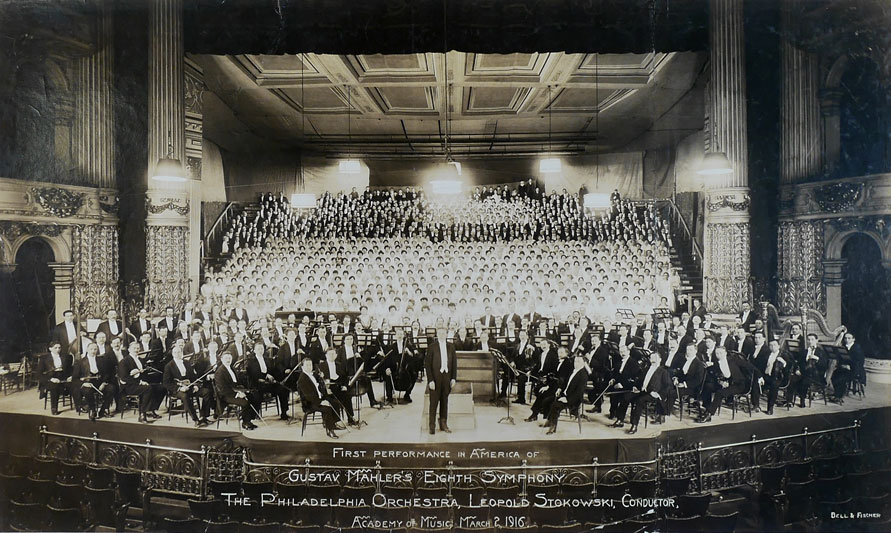
    Fritz Scheel was succeeded as music director of the Philadelphia Orchestra by Carl Pohlig in 1908. Leopold Stokowski (pictured) followed in 1912; Stoky would lead the group for the next 24 years. Then came Eugene Ormandy, who held the podium until 1980 – 44 years. Ormandy passed the baton to Riccardo Muti, who directed from 1980 to 1992. Muti was followed Wolfgang Sawallisch, who remained with the orchestra for the next decade. Sawallisch was succeeded by Christoph Eschenbach in 2003. Eschenbach was followed by Charles Dutoit, appointed “Chief Conductor” in 2008. And, bringing us up to the present, Yannick Nézet-Séguin arrived, with vitality to burn, in 2012. What a history!

    Since I lived in Philadelphia for over three decades, this was my resident orchestra. I saw many of the greats there, with some particularly unforgettable nights at the Academy of Music, especially when I was in my 20s. Also in the summers, at the Mann Center in Fairmount Park, when the orchestra played three or four different programs a week. A lot of those artists aren’t around anymore. I have some cherished memories of the orchestra at its current home at the Kimmel Center for the Performing Arts, too, but perhaps inevitably I view those earlier concerts through rose-tinted glasses, halcyon experiences preserved in the amber of my youth. It’s astonishing to realize that I have been attending concerts with this ensemble over a span of 41 years! It’s been an indispensable part of my life.

    Thank you, and a happy 125th, Philadelphia Orchestra!

    —————

    A great read about Clara Clemens and Ossip Gabrilowitsch in the Star-Gazette of Elmira, NY

    https://www.stargazette.com/story/news/local/2024/03/08/mark-twain-daughter-clara-clemens-studied-music-performed-in-elmira/72775353007/

    The Twain plaque was stolen from a joint monument dedicated to the author and Gabrilowitsch at Elmira’s Woodlawn Cemetery, but returned, in 2015

    https://www.syracuse.com/state/2015/09/mark_twain_stolen_plaque_returned_to_tomb.html

    An account of Gabrilowitsch, guest conducting the Philadelphia Orchestra, addressing the audience on the subject of applause. (He was in favor of it; apparently Stokowski was not.)

    https://www.nytimes.com/1930/02/01/archives/gabrilowitsch-urges-audience-to-applaud-takes-issue-with-stokowskis.html

    —————

    PHOTO: Stokowski and the Philadelphia Orchestra at the Academy of Music in 1916, ready to go for the American premiere of Gustav Mahler’s “Symphony of a Thousand”

  • CD’s 40th Anniversary Still Spinning Strong

    On the 40th anniversary of the compact disc, here is an interesting discussion – to which, naturally, I’ve contributed. To paraphrase Mark Twain, reports of the format’s death, so far, have been greatly exaggerated.

  • Twain’s Take on Music & Opera

    Twain’s Take on Music & Opera

    When I was in my late teens and early 20s, no writer enthralled me more than Mark Twain. His observations could be so contemporary, so scathing, and so hilarious.

    As with much else, Twain had a lot to say about music. He was not a big fan of classical music, least of all opera. Or so he maintained. Everyone loves a good bon mot, so we all remember the withering zingers.

    But taken collectively, Twain’s reactions are more of a mixed bag. He likes the stuff he knows and enjoys Wagner in moderation. At the very least, he concedes that he wants to like “the higher music,” but would like to do so without expending the time, the effort, and the attention it would take to make it more rewarding, or at the very least comprehensible. Somehow, he just never caught the spark that for me flared into a wildfire. Perhaps if at the time the ability to hear the music had been more accessible.

    I gather, more than anything, it’s the phonies that he found repellent, and justifiably so. He singles out those who make a big display of themselves, humming along to ensure everyone around them recognizes their authority and absorption. It’s worth noting that this was at a time when going to the opera was more of a rarified experience, for many financially prohibitive, and perceived as a social gathering of the upper classes.

    Twain’s experiences with music were in the days before records, before classical radio, even before supertitles at the opera. He refers to melodies he knows from having encountered them on a hand-organ or a music box as the extent of his music education. These, he confesses, he finds delightful when heard in the opera house. So it seems the potential was there. What he lacked was regular exposure, without the annoyance and affectations of other people – a few more positive experiences. What he might have thought in this more democratic age of cell phone disruptions is anyone’s guess.

    Twain on opera:
    http://www.twainquotes.com/Opera.html

    Of course, he could be just as irreverent about the banjo:

    Mark Twain on the ‘glory-beaming banjo’

    It’s okay, Sam. You may hate classical music, but we still love you. Happy birthday.

  • Gilded Age Novels: Soundtracks & Stories

    Gilded Age Novels: Soundtracks & Stories

    “The Gilded Age” was a term coined by none other than Mark Twain to describe the era spanning, roughly, from the end of Reconstruction (after the Civil War) to the turn of the 20th century. He didn’t mean it as a compliment. A gilded age is one that conceals serious social problems beneath a veneer of gold. This week on “Picture Perfect,” we look past the dazzle to focus on music from films inspired by novels from, or about, the period.

    “The Heiress” (1949) was adapted from a play by Ruth and Augustus Goetz, which in turn was based on the book “Washington Square,” by Henry James. Olivia De Havilland plays the “plain Jane” heiress of the title, Ralph Richardson her overbearing father, and Montgomery Clift, the adventurer who may or may not be out for her fortune. De Havilland won an Oscar for her portrayal, as did the music, by Aaron Copland.

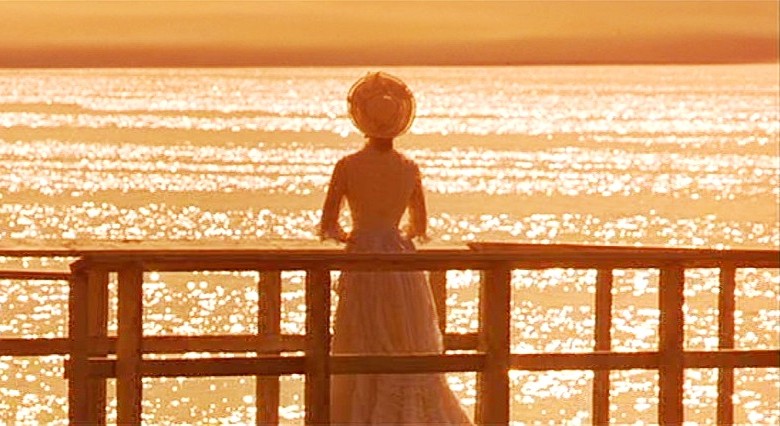
    “The Age of Innocence” (1993) was written by one-time James correspondent, his close friend, Edith Wharton. The book was published in 1920, but looks back to the 1870s, its story dealing with the impending marriage of an upper class couple and the appearance of a disreputable interloper who threatens their happiness. The title is an ironic play on the contrast between the outward manners of New York society and its inward machinations. The novel earned Wharton a Pulitzer Prize, the first ever to be awarded to a woman. The film was something of a curve ball from director Martin Scorsese, who made his reputation on arguably meaner streets. Veteran composer Elmer Bernstein provided the lovely, Brahmsian score.

    “The Magnificent Ambersons” (1942) is based on another Pulitzer Prize winner, this time by Booth Tarkington, from 1918. The novel is part of trilogy that traces the declining fortunes of three generations of an aristocratic Midwestern family. With industrialism on the rise, the Ambersons’ “old money” wealth and prestige wane.

    “Ambersons” was only the second film directed by Orson Welles. Sadly, the financial failure of “Citizen Kane” and Welles’ uncompromising artistic vision caused the project to be removed from his control and re-cut by the studio, shaving a full hour off the original running time. It says something about the strength of Welles’ material that what survives yet remains a magnificent achievement.

    The score was by Bernard Herrmann, CBS staff composer from Welles’ radio days. Herrmann had followed Welles to Hollywood to supply the music for “Kane.” With the trimming of “Ambersons,” his score was drastically edited and half the music removed. The famously irascible Herrmann, who had just written his Academy Award winning music for “The Devil and Daniel Webster,” was so angry that he threatened legal action if his name was not removed from the credits. (The studio complied.)

    The action of “Mr. Skeffington” (1944), based on a 1940 novel by Elizabeth von Arnim, begins at a point some consider to be the twilight of the Gilded Age, the eve of World War I. Bette Davis stars as a woman so enamored with her own beauty, and the suitors it attracts, that she fails to value the affections of the man who eventually becomes her husband. Mr. Skeffington, played by Claude Rains, is a Jewish financier, riding high in the ‘teens, but his fortunes change when he’s caught in Europe during the rise of the Nazis.

    Davis and Rains both earned Academy Award nominations for their work. The vivid score is by Franz Waxman. Davis was going through a period of emotional turmoil during the filming, so that she was allegedly insufferable to be around throughout the entire shoot. Someone finally poisoned her eyewash. When the police questioned the director, Vincent Sherman, he wished them good luck with their investigation. “If you asked everyone on the set who would have committed such a thing, everyone would raise their hand!”

    Certainly all that glitters is not gold. We peel back the veneer of prosperity, this week, with “Novels of the Gilded Age,” on “Picture Perfect,” this Friday evening at 6:00 EDT on WWFM – The Classical Network and wwfm.org.


    PHOTOS: The late Olivia de Havilland (left), as Catherine Sloper (upper right), and posing with her Oscar for “The Heiress”

  • Fredric March A Cinematic Mark Twain

    Fredric March A Cinematic Mark Twain

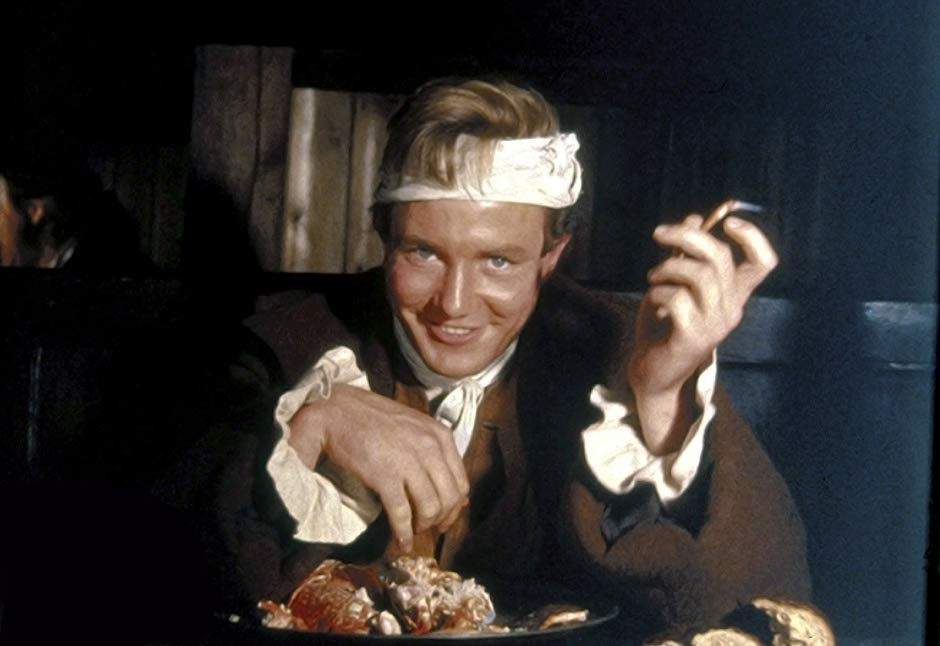
    Fredric March as Mark Twain? Well, it ain’t Hal Holbrook.

    This week on “Picture Perfect,” the focus is on real-life writers as characters in the movies.

    Good writers captivate so completely with their words, it’s easy to imagine that they must lead very colorful lives – all the more so when they are given the big screen treatment.

    Music lends an extra dimension to the fictionalized Brontë sisters, in “Devotion” (Erich Wolfgang Korngold); Iris Murdoch, in “Iris” (James Horner); the Bard of Avon, in “Shakespeare in Love” (Stephen Warbeck); and Samuel Clemens, in “The Adventures of Mark Twain” (Max Steiner).

    Writers are such characters, aren’t they? Join me for an hour of cinematic scribes. Everything’s writ large, this Friday evening at 6:00 EST, on WWFM – The Classical Network and wwfm.org.

Tag Cloud

Aaron Copland (92) Beethoven (95) Composer (114) Film Music (123) Film Score (143) Film Scores (255) Halloween (94) John Williams (187) KWAX (229) Leonard Bernstein (101) Marlboro Music Festival (125) Movie Music (138) Opera (202) Philadelphia Orchestra (89) Picture Perfect (174) Princeton Symphony Orchestra (106) Radio (87) Ralph Vaughan Williams (85) Ross Amico (244) Roy's Tie-Dye Sci-Fi Corner (290) The Classical Network (101) The Lost Chord (268) Vaughan Williams (103) WPRB (396) WWFM (881)

DON’T MISS A BEAT

Receive a weekly digest every Sunday at noon by signing up here


RECENT POSTS