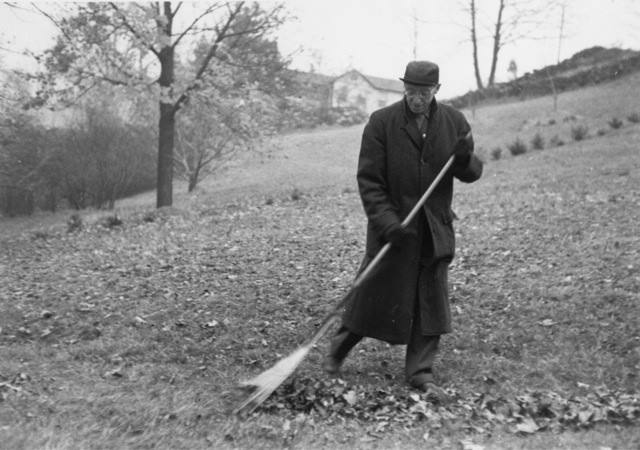
One might say it’s a little cool for spring. But when Aaron Copland came to write his magnum opus, he wasn’t thinking of spring or even the Appalachia, for that matter. What he had to work with were a series of impressions from Martha Graham. In fact, while composing the music, he thought of the project simply as “Ballet for Martha.”
This week on “Music from Marlboro,” we’ll celebrate Copland’s birthday with a suite from this most durable of American ballets, since recognized as “Appalachian Spring.”
It was Graham who came up with the title, well after Copland had finished. A phrase in a poem by Hart Crane had caught her fancy. When Copland asked her if the ballet had anything to do with the poem, Graham said, “No, I just liked the title and I took it.” Yet, as Copland loved to relate, people were always coming up to him and saying, “Mr. Copland… when I hear your music I can just see the Appalachians and I can just feel spring.” (FUN FACT: In Crane’s poem, “spring” isn’t even seasonal; it refers to a source of water.)
Graham, every bit as concerned as Copland with forging a uniquely American art, had envisioned a ballet set during the Civil War. In her correspondence with the composer, she was quite specific in the moods she wished to evoke.
By the time she came to choreograph the piece, Graham decided on a scenario built around the courtship and wedding of a young couple in a western Pennsylvania community in the early 19th century. One of the original dancers, Pearl Lange, remembered, “The first day we heard the music, it was like the sun spread over the floor.”
All the themes are Copland’s own, except of course for “Simple Gifts,” the Shaker hymn that forms the basis for a series of variations at the work’s climax.
“Appalachian Spring” was given its first performance at the Library of Congress on October 30, 1944. On V-E Day, 1945, the work was awarded the Pulitzer Prize for Music. We’ll hear it performed this evening in its original guise, for a chamber ensemble of thirteen instruments, from the 2006 Marlboro Music Festival.
We’ll preface that with music by Heitor Villa-Lobos. In parallel with Copland’s experiments to the north, Villa-Lobos made a conscious effort in the late ‘30s to embrace a more populist style. The sixth of his seventeen string quartets was composed in Rio de Janeiro in 1938. The work received its first performance there on November 30, 1943. The quartet incorporates elements of Brazilian folk and popular music. At the same time, the composer is not at all bashful about his debt to the works of Franz Joseph Haydn.
We’ll hear a performance of Villa-Lobos’ String Quartet No. 6, from the 2007 Marlboro Music Festival, featuring violinists Celeste Golden and Lucy Chapman, violist Kyle Armbrust, and cellist Wendy Law.
It’s music from the Americas on this week’s “Music from Marlboro,” Wednesday evening at 6:00 EST, on WWFM – The Classical Network and wwfm.org.
Marlboro School of Music and Festival: Official Page
PHOTO: Copland, feeling a little nostalgic for that Appalachian spring