So, was I the last guy to discover there was a time change this weekend? Surely there was someone who figured it out later than 12:30 p.m. on Sunday?
I’m usually on top of that sort of thing, and even program radio shows around it, or at least pull together a “timely” post. But it’s a good indicator of how busy I was last week, or least where my head was at. I even had a Monday wedding to attend yesterday – nearly a seven-hour round-trip!
Now it’s Election Day, but once I get out there and do my civic duty, which I intend to fulfill as soon as I’m done with breakfast, and then make my belated “Monday” fruit and vegetable deliveries to the wildlife center, and then hit the grocery store, which I haven’t done in some time (and I realize I’m out of everything), I hope to claw my way back to normalcy.
One of the reasons this page exists is so that I can share important news about musical figures who have made a difference in many of our lives, or at least my life, and naturally those who made an indelible imprint on the field. I especially try to mark the deaths of major figures, and sadly there are times when this place seems to read more like an obituaries page.
Three notable artists to have passed in recent weeks include sopranos Martina Arroyo and Judith Blegen and pianist Stephen Kovacevich. Any one of these would have received the full Classic Ross Amico treatment. However, by this point, you will have perhaps read extensive appreciations of all three, and I don’t really have any personal anecdotes that might make anything I have to say stand out from the crowd. For the most part, I am just catching up.
So I thought I would write something brief about each one of the them. It was only when I began cresting a third screen in Word that I realized I should probably hold off on sharing the material on Blegen and Kovacevich for another day, and just give you what I’ve pulled together for Arroyo, about whom I wrote the most.
As you may already know, Martina Arroyo, who died on October 13 at the age of 90, was of the first generation of Black opera singers to achieve prominence in the United States. She was one of the leading sopranos at New York’s Metropolitan Opera from 1965 to 1968. Further, she sang in many of the great opera houses of Europe and at the Teatro Colon in Buenos Aires.
It is interesting to note that she also received a touch of notoriety internationally, not through one of her performances of Verdi or Puccini (she was a Black Madama Butterfly more than 60 years before Christopher Nolan’s casting of Lupito Nyong’o as Helen of Troy was like the world was going to end on social media), but rather Karlheinz Stockhausen, when she sang the world premiere of “Momente” and made a recording that was issued in the U.S. on Nonesuch Records.
Arroyo was born in Harlem in 1937. Her father, who emigrated from Puerto Rico, worked as a mechanical engineer in the Brooklyn Navy Yard. Her mother, who hailed from Charleston, South Carolina, was an amateur pianist, who gave her early lessons. Arroyo’s first experiences as a singer came through her participation in church choirs and her school glee club.
Her parents understood the importance of the arts and made sure she was exposed to a wide array of offerings in New York’s cultural scene. It was Broadway that really sparked her interest in becoming a performer, and her mother enrolled her in ballet classes.
At Hunter College, she studied Romance languages to aid her in the mastery of Italian arias. Earlier, while still in high school, she was accepted into an opera workshop, a graduate level course at Hunter, where she began her formal training. At first, she regarded it as something of a lark, in light of the fact that, at the time, there were really no Black singers performing with any of the major opera companies. (Marian Anderson didn’t make her Met debut, as Verdi’s Ulrica, until 1955.) It was only after her voice teacher threatened to drop her that Arroyo really buckled down and applied herself.
She supported herself as a social worker for two years before making her Carnegie Hall debut as a recitalist in 1957. She then auditioned for the Met, but was not accepted. However, she won a singing competition there the next year. She was cast as the Celestial Voice, a small, off-stage role in Verdi’s “Don Carlo,” in 1959. She continued to sing comprimario roles at the Old Met into the early ‘60s.
It was the Met’s director, Rudolf Bing, who, in light of the dearth of opportunities for Black performers in the United States, suggested she build her reputation in Europe, which is exactly what she did. Arroyo received her first major international contract at the Zurich Opera, where she sang as a principal soprano from 1963 to 1965. But she wasn’t exactly under the radar here.
While gradually gaining notice elsewhere, she sang the world premiere of Samuel Barber’s “Andromache’s Farewell” with the New York Philharmonic conducted by Thomas Schippers, as part of the Philharmonic’s opening season at Lincoln Center in 1963. (The Met would transplant itself to Lincoln Center in 1966 with Barber’s “Antony and Cleopatra.”) Later in the season, Arroyo joined the orchestra for Paul Hindemith’s “When Lilacs Last in the Dooryard Bloom’d,” under the direction of the composer (interesting, because I believe the part is usually sung by a mezzo), and Beethoven’s Symphony No. 9, conducted by Leonard Bernstein (she appears on Bernstein’s 1964 recording).
She returned in the Met in 1965, after she receiving a call from Bing, who asked her to step in as Aida to replace an ailing Birgit Nilsson. Arroyo thought it was a prank. The audience groaned when the substitution was first announced in the house, but by the end of the performance, they were in her lap. Arroyo’s future at the Met was secure.
Later, she observed that she had never really experienced, or at least was not aware of, discrimination ever actually being an impediment to her career. As a person, she was widely perceived as down-to-earth and unpretentious. She dismissed an alleged rivalry with fellow African American singer Leontyne Price (Barber’s Cleopatra) as an invention of the press. Once, when a Met doorman mistakenly greeted her as “Miss Price,” she deadpanned, “No, honey. I’m the other one.”
In 2013, Martina Arroyo received a Kennedy Center Honor. On Election Day, I’ll allow that detail to speak for itself.
R.I.P.
———-
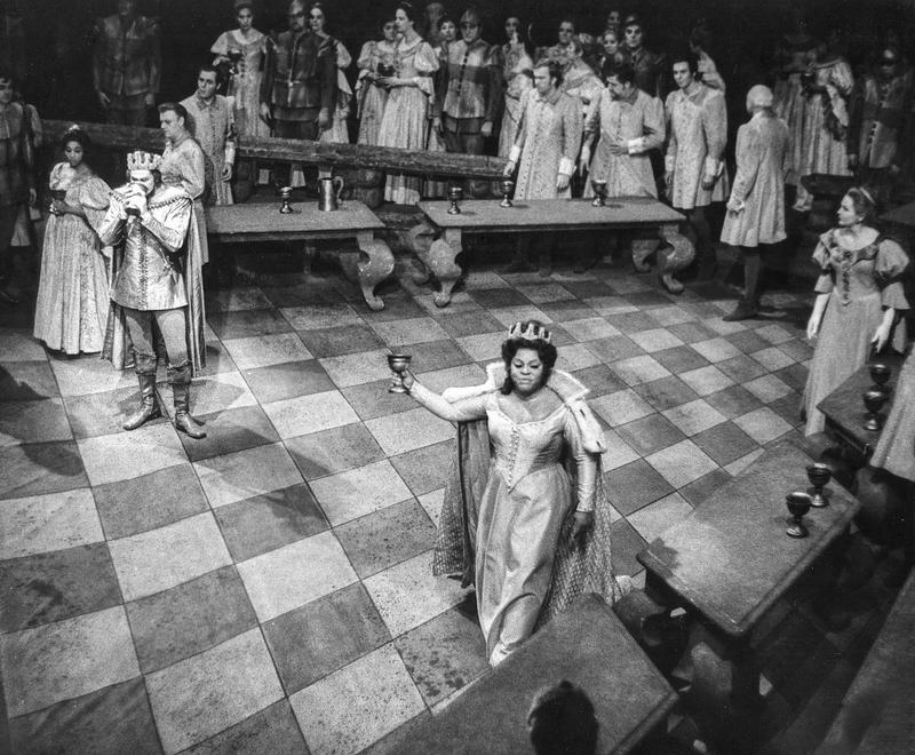
PHOTO: Arroyo as Lady Macbeth at the Met
Tag: Martina Arroyo
-
The Internet’s Last Obituary for Martina Arroyo
Tag Cloud
Aaron Copland (94) Beethoven (95) Composer (114) Film Music (152) Film Score (143) Film Scores (255) Halloween (107) John Williams (198) KWAX (233) Leonard Bernstein (105) Marlboro Music Festival (125) Movie Music (167) Mozart (91) Opera (222) Philadelphia Orchestra (91) Picture Perfect (174) Princeton Symphony Orchestra (110) Radio (90) Ross Amico (244) Roy's Tie-Dye Sci-Fi Corner (290) The Classical Network (101) The Lost Chord (269) Vaughan Williams (107) WPRB (397) WWFM (881)