A couple of years ago, I was generating Classic Ross Amico crosswords to post on Sundays. This one celebrates film composers Max Steiner and Dimitri Tiomkin, both of whom happened to be born on this date (Steiner in 1888 and Tiomkin in 1894).
The clues not only allude to specifics of their respective lives and careers, but they should also be of ample interest, I hope, to classic movie buffs. So even if you’re convinced you don’t know a lot about music, do check it out if, like me, you happen to watch a lot of movies from the ‘30s, ‘40s, and ‘50s.
To fill out the puzzle, follow the link and select “solve online” at the bottom of the page. You’ll then be able to type directly into the squares. Once you feel you’ve exhausted the puzzle, you’ll find the solutions by clicking on “Answer Key PDF.”
There’s enough distance now that even I was able to fill it out and enjoy the challenge. I probably should have indicated in the clues that some of the answers require full names or, in the case of titles, multiple words.
Open up a box of Sno-Caps, and try not to get buttered popcorn all over your keyboard. Happy birthday, Max Steiner and Dimitri Tiomkin!
While Ernest Gold embarked on his career as a composer of symphonies, his heart was always in the world of Max Steiner. Gold was born Ernst Sigmund Goldner, in Vienna, 100 years ago today.
If you missed my tribute to Gold Sunday night on “The Lost Chord,” on WWFM – The Classical Network, the show is now posted as a webcast. On the program is his String Quartet No. 1, his song cycle “Songs of Love and Parting,” and two of his most famous film themes – those for “Exodus” and “It’s a Mad, Mad, Mad, Mad World.” The songs are performed by Gold’s wife of 19 years, Marni Nixon, the soprano who “ghost voiced” for a number of the musicals’ leading ladies, in films like “The King and I,” “My Fair Lady,” and “West Side Story.”
As an addendum, it’s only within the last year or so that I discovered Gold’s Piano Concerto, written when he was 17 years-old. The recording appeared on a CD with George Antheil’s music for the film “Dementia.” Gold worked as an orchestrator on a number of Antheil’s films. When Antheil fell ill and was unable to follow through on a commitment to score “On the Beach,” Gold stepped up. The music earned Gold an Academy Award nomination and a Golden Globe.
In all, Gold would be nominated by the Academy four times. He was recognized with an Oscar for his powerful contribution to “Exodus” in 1960. Here’s another nice Gold tribute:
Eddie Harris riffs on “Exodus”:
Not really my cup of tea, but “Fight for Survival” from “Exodus” was sampled (a string passage, reversed) by Moby, great-great-great nephew of Herman Melville (!), for his song “Porcelain.”
All that glitters is Gold. Happy birthday, Ernest Gold!
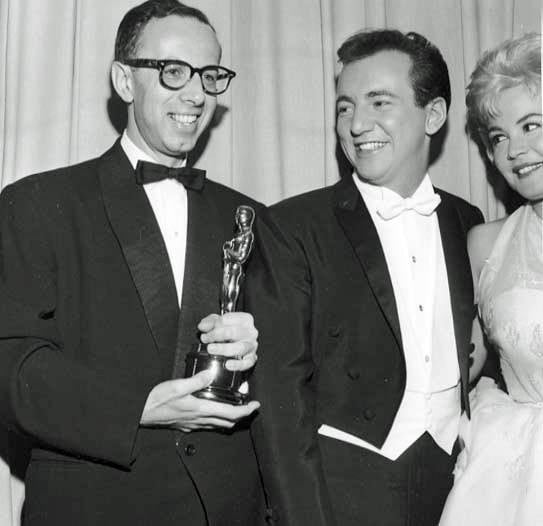
PHOTO: With Bobby Darin, Sandra Dee, and his “Exodus” Oscar
On Friday, May 7, the classical music world celebrated the dual birthdays of Johannes Brahms and Peter Ilych Tchaikovsky. But for those who care about film music, there’s May 10 – the anniversary of the births of Max Steiner and Dimitri Tiomkin.
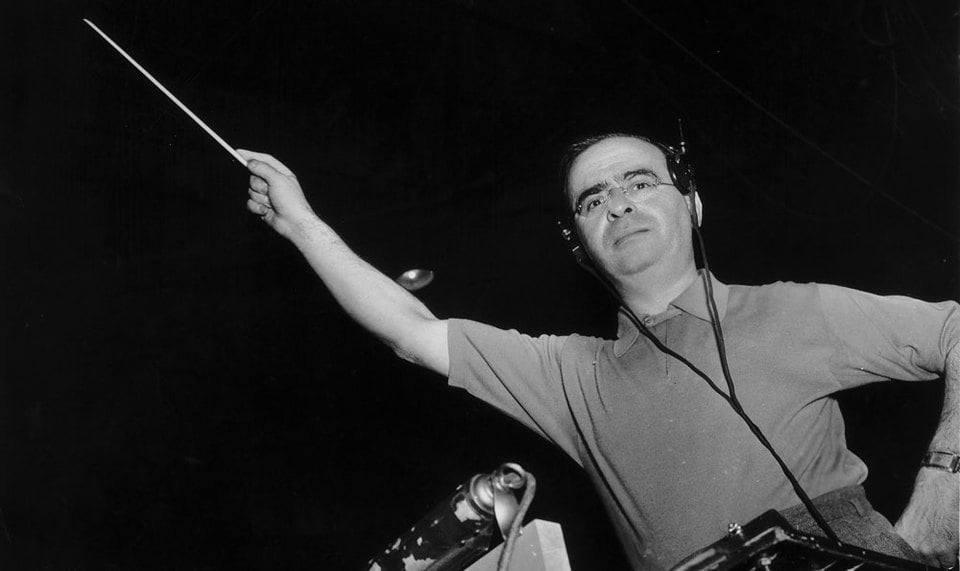
Steiner (1888-1971), the literal godson of Richard Strauss, was instrumental in transplanting the sound of fin de siècle Vienna to the realm of cinematic dreams. He composed over 300 film scores for RKO and Warner Brothers, earning 24 Academy Award nominations and winning three – for “The Informer,” “Now, Voyager” and “Since You Went Away” – though he is unquestionably better remembered today for his work on “King Kong,” “Gone with the Wind” and “Casablanca.”
Tiomkin (1894-1979), a pupil of Alexander Glazunov, was born in Ukraine. He settled in the United States, where he composed music for films in all genres, though in the 1950s he enjoyed particular success writing for Westerns, including the Academy Award-winning “High Noon.” When asked why this would be the case, that a composer born halfway around the world would have such a command of this distinctly American idiom, Tiomkin replied, “A steppe is a steppe is a steppe.”
Tiomkin was honored with four Academy Awards – three for Best Original Score (for “High Noon,” “The High and the Mighty” and “The Old Man and the Sea”) and one for Best Original Song (“The Ballad of High Noon”).
Here’s a transcript of his acceptance speech, delivered after being handed the Oscar for “The High and the Mighty” in 1955:
“Lady and gentlemen, because I working in this town for twenty-five years, I like to make some kind of appreciation to very important factor what make me successful to lots of my colleagues in this town. I’d like to thank Johannes Brahms, Johann Strauss, Richard Strauss, Beethoven, Mozart, George Gershwin, Jerome Kern, Wagner, Tchaikovsky, Rimsky-Korsakov. Thank you.”
You can watch it here:
Though Steiner and Tiomkin were both very well-connected in the wider musical world, comparatively speaking, neither left very much in the way of classical concert music. In 2019, Intrada Records put out a diverting 2-CD set of Tiomkin’s brightly-scored ballet music, dances composed in Paris for his wife, Albertina Rasch, in 1927-1932, prior to his work in film. It’s good mid-morning music, but would also be wonderful for afternoon drive-time – if only I had a live air shift! You can sample some of it by following the link. Already detectable is Tiomkin’s trademark snarling brass, in a number titled “Mars” (the second track in this YouTube playlist):
In 2020, Oxford University Press published a book by Steven C. Smith, “Music by Max Steiner: The Epic Life of Hollywood’s Most Influential Composer.” Read my impressions of this authoritative biography, unbelievably the first full-length treatment of Steiner’s life and achievements, here. Then get yourself a copy!
Also last year, while I was twiddling my thumbs, waiting to get back to work, I put together a Steiner-Tiomkin crossword puzzle. The clues not only allude to specifics of their respective lives and careers, but they should also be of ample interest, I hope, to classic movie buffs. So even if you’re convinced you don’t know a lot about music, do check it out if, like me, you happen to watch a lot of movies from the ‘30s, ‘40s, and ‘50s.
To fill out the puzzle, follow the link and select “solve online” at the bottom of the page. You’ll then be able to type directly into the squares. Once you feel you’ve exhausted the puzzle, you’ll find the solutions by clicking on “Answer Key PDF.”
This week on “Picture Perfect,” Peter Lorre gets more than his share of left-hand piano repertoire, in “The Beast with Five Fingers” (1946). Max Steiner’s score, built on Brahms’ transcription of the Bach Chaconne, is one of the highlights of an hour of music from movies about madness and the piano.
The program will also include a macabre concerto by Bernard Herrmann, written for the Laird Cregar thriller “Hangover Square” (1945), about a deranged concert pianist in fog-shrouded London. Alan Alda seeks fame at all costs – even Satanism – in “The Mephisto Waltz” (1971), with music by Jerry Goldsmith, and just a touch of Franz Liszt. And power-mad pedagogue Hans Conried lords it over a legion of his long-suffering pupils, in the Dr. Seuss fantasy “The 5,000 Fingers of Dr. T” (1953), with music and songs by Frederick Hollander.
We’re mad about the piano this week, on “Picture Perfect,” music for the movies, this Saturday evening at 6:00 EDT, on WWFM – The Classical Network and wwfm.org.
If the definition of insanity is doing the same thing over and over and expecting a different result, then surely Hanon etudes are a ticket to the madhouse.
This week on “Picture Perfect,” get keyed-up with music from movies about madness and the piano.
Whenever he hears a loud, discordant sound, unhinged pianist-composer Laird Cregar is compelled to commit murder, in the 1945 film “Hangover Square.” Bernard Herrmann wrote the moody, romantic score, which includes a piano concerto, played by Cregar’s character during the film’s conflagration finale.
Peter Lorre is an unstable musicologist who is haunted by the disembodied hand of a murdered pianist with a penchant for Brahms’ arrangement of Bach’s Chaconne, in “The Beast with Five Fingers,” from 1946. Max Steiner was the composer. The piano is played on the film’s soundtrack by Victor Aller, the brother-in-law of Felix Slatkin – also Leonard Slatkin’s uncle.
Alan Alda plays a frustrated pianist who falls in with a ring of Satanists, in “The Mephisto Waltz” from 1971. This time, Jerry Goldsmith blends Franz Liszt with amplified instruments and electronics to memorably eerie effect. Five years later, Goldsmith would win his only Academy Award for his music to “The Omen.”
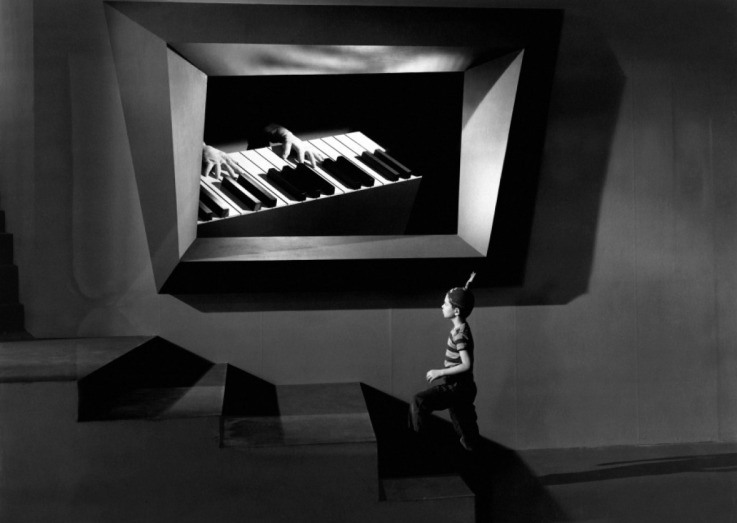
Finally, Hans Conried plays a dictatorial pedagogue in “The 5000 Fingers of Dr. T,” released in 1953. “5000 Fingers” holds the distinction of being the only feature ever written by Dr. Seuss. The film sports an outrageous production design (including a gargantuan keyboard for 500 enslaved boys) and whimsical songs.
The composer was Frederick Hollander. Born in London, Hollander attained fame in Germany as Friedrich Hollander. His best-known international success was “The Blue Angel,” starring Marlene Dietrich, who introduced his song, “Falling in Love Again.” With the rise of the Nazis, Hollander fled to the United States, where he worked on over 100 films.
That’s music from movies about madness and the piano this week, on “Picture Perfect.” Practice makes psychotic, THIS SATURDAY EVENING AT 6:00 EDT, on WWFM – The Classical Network and wwfm.org.