Tag: Max Steiner

  • Fantasy Film Music From Lost Worlds on KWAX

    Fantasy Film Music From Lost Worlds on KWAX

    Summer arrives today at 10:42 p.m. EDT. But who’s keeping track? This week on “Picture Perfect,” time means nothing, as we’re bound for an hour of music from fantasy films set in lost worlds.

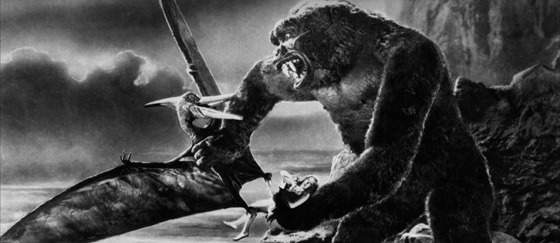
    In “King Kong” (1933), filmmaker and entrepreneur Carl Denham hires a ship to an uncharted island, known only from a secret map in his possession. There the crew discovers the titular gorilla and other outsized, should-be-extinct creatures. Kong is abducted from his natural habitat – and you know the rest. The composer, Max Steiner, pulls out all the stops. “Kong” was one of the first films to demonstrate how truly powerful an orchestral soundtrack could be.

    Then we travel to the earth’s core, courtesy of Jules Verne and “Journey to the Center of the Earth” (1959). James Mason plays the professor who leads the expedition. The film sports one of Bernard Herrmann’s most outlandish soundscapes, the orchestra consisting of winds, brass and percussion, but also cathedral organ, four electric organs, and an obsolete Renaissance instrument called the serpent. Watch out for that giant chameleon!

    “One Million Years B.C.” (1966) is a guilty pleasure if ever there was one. Produced by Hammer, the studio that gave us all those repugnant yet somehow delicious Peter Cushing-Christopher Lee horror team-ups, the film features special effects by the legendary Ray Harryhausen and an equally legendary fur bikini, sported by Raquel Welch. The music is by Mario Nascimbene, who wrote one of my favorite scores for Kirk Douglas, for “The Vikings.” We’ll be listening to the film’s climactic volcano sequence.

    As he did with the Indiana Jones films, director Steven Spielberg turned to B-movie source material as his visual inspiration for “Jurassic Park” (1993), based on the novel by Michael Crichton. The herky-jerky dinosaur effects of yore are replaced by state-of-the-art computer-generated imagery, in this story of a remote island safari park gone wrong.
    Sure, we’ve come a long way from Raquel Welch being carried off by a Pteranodon, but admit it, we all still want to see people fight dinosaurs. Instead of fudging history, now we can feel superior by fudging science. “Jurassic Park” plays on modern scientific thinking, with DNA extracted from mosquitoes trapped in amber, cloning, and the theory that dinosaurs were not lizards, after all, but rather birds. The music is by long-time Spielberg collaborator, John Williams.

    If you happen to forget a compass, or a watch, don’t panic! In the words of Ian Malcolm, life finds a way. Join me for “Lands That Time Forgot,” on “Picture Perfect,” music for the movies, now in syndication on KWAX, the radio station of the University of Oregon!


    Clip and save the start times for all three of my recorded shows:

    PICTURE PERFECT, the movie music show – Friday at 8:00 PM EDT/5:00 PM PDT

    SWEETNESS AND LIGHT, the light music program – Saturday at 11:00 AM EDT/8:00 AM PDT

    THE LOST CHORD, unusual and neglected rep – Saturday at 7:00 PM EDT/4:00 PM PDT

    Stream them, wherever you are, at the link!

    https://kwax.uoregon.edu/
  • Old World Composers Score the Wild West

    Old World Composers Score the Wild West

    Before American composers like Jerome Moross and Elmer Bernstein made the western distinctly their own, the task of scoring the genre fell largely to European émigrés. This week on “Picture Perfect,” we’ll take a look at some outside perspectives on how the West was won.

    Literally the godson of Richard Strauss, Max Steiner (born on this date in 1888) came from Vienna, where he studied with Johannes Brahms and Robert Fuchs. In Hollywood, he wound up scoring such classics as “King Kong,” “Gone with the Wind” and “Casablanca.”

    Among his over 300 film projects were a number of westerns. One of these was “They Died with Their Boots On” (1941), which starred Errol Flynn as George Armstrong Custer and Olivia de Havilland as Libby, the woman who becomes his wife. Steiner’s score features familiar folk material, some old-fashioned faux “Indian” music, and one of his characteristically lush love themes.

    Dimitri Tiomkin (born in Ukraine on this date in 1894) was a pupil of Alexander Glazunov. He came to revolutionize the sound of the American West, when he wrote the music for “High Noon,” the first of his “ballad” scores. Advance word, based on an early screening for the press, was that the picture would be a failure. However, Tiomkin had such faith in the theme song, sung in the film by Tex Ritter, that he hired Frankie Laine to record it, and the record became a world-wide hit. In fact, his score is largely credited with having saved the film.

    Tiomkin was recognized with two Academy Awards: one for Best Original Song, and one for the score itself. It was the first time a composer won two Oscars for his work on the same movie. It also changed the way western scores were done. In the 1950s, Tiomkin became THE western composer of choice. He produced a number of subsequent ballad scores, including that for “Gunfight at the O.K. Corral” (1957). Asked how it was that a composer from Ukraine could write so convincingly for the American West, Tiomkin quipped, “A steppe is a steppe is a steppe.”

    Another unexpected source of classic western music, Franz Waxman was born in Upper Silesia. He arrived in the U.S. by way of Germany. Nonetheless, as part of the composer’s varied and prolific output, he did indeed score a number of films in the genre, including “The Furies” (1950), a peculiar noir-western hybrid. Walter Huston, in his final film, plays a cattle baron who remarries and throws his empire into jeopardy. Barbara Stanwyck is his strong-willed daughter.

    Hungarian-born composer Miklós Rózsa scored many films with historical settings – “Quo Vadis,” “Ben-Hur,” and “King of Kings,” among them. However, to my knowledge, his only western was “Tribute to a Bad Man” (1956). James Cagney stars as a rancher who doles out some frontier justice.

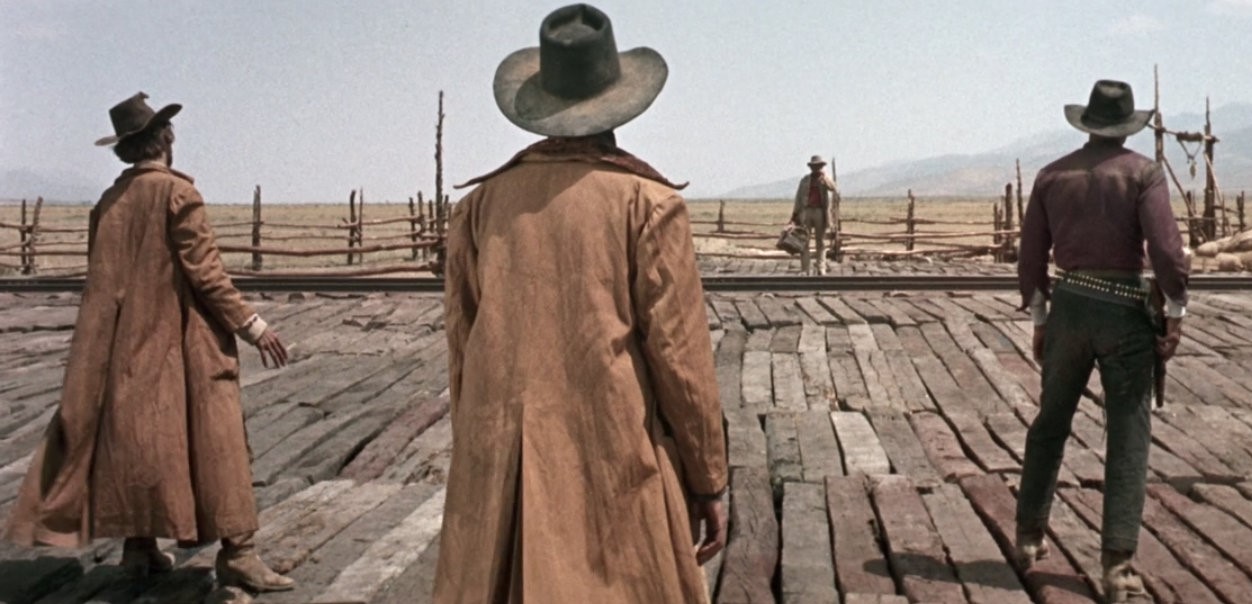
    Finally, we’ll hear music by Ennio Morricone, from arguably the most operatic of all spaghetti westerns, “Once Upon a Time in the West” (1968). As a reaction to Tiomkin’s ballad scores and the neo-Coplandisms of Elmer Bernstein and the rest, Morricone brings his own quirky sensibility to bear on the classic western iconography. Get ready for indelible motifs for harmonica and banjo, but also an unexpectedly moving elegiac arioso, underscoring the close of the American West with the arrival of the railroad.

    Doublecheck your train tables and wind your pocket watches. Old World composers go west this week on “Picture Perfect,” music for the movies, now in syndication on KWAX, the radio station of the University of Oregon!


    Remember, KWAX is on the West Coast, so there’s a three-hour difference for those of you listening in the East. Here are the respective air-times for all three of my recorded shows (with East Coast conversions in parentheses):

    PICTURE PERFECT, the movie music show – Friday on KWAX at 5:00 PM PACIFIC TIME (8:00 PM EASTERN)

    SWEETNESS AND LIGHT, the light music program – ALL NEW! – Saturday on KWAX at 8:00 AM PACIFIC TIME (11:00 AM EASTERN)

    THE LOST CHORD, unusual and neglected rep – Saturday on KWAX at 4:00 PM PACIFIC TIME (7:00 PM EASTERN)

    Stream all three, at the times indicated, by following the link!

    https://kwax.uoregon.edu/
  • Max Steiner & Dimitri Tiomkin Birthday Film Scores

    Max Steiner & Dimitri Tiomkin Birthday Film Scores

    May 10th is bursting with birthday energy! Turn down the lights for a celebration of those two silverbacks of the silver screen, Max Steiner and Dimitri Tiomkin.

    Steiner (1888-1971), the literal godson of Richard Strauss, was instrumental in transplanting the sound of fin de siècle Vienna to the realm of cinematic dreams. He composed over 300 film scores for RKO and Warner Brothers, earning 24 Academy Award nominations and winning three – for “The Informer,” “Now, Voyager” and “Since You Went Away” – though he is unquestionably better remembered today for his work on “King Kong,” “Gone with the Wind” and “Casablanca.”

    Tiomkin (1894-1979), a pupil of Alexander Glazunov, was born in Ukraine. He settled in the United States, where he composed music for films in all genres, though in the 1950s he enjoyed particular success writing for Westerns, including the Academy Award-winning “High Noon.” When asked why this would be the case, that a composer born halfway around the world would have such a command of this distinctly American idiom, Tiomkin replied, “A steppe is a steppe is a steppe.”

    Tiomkin was honored with four Academy Awards – three for Best Original Score (for “High Noon,” “The High and the Mighty” and “The Old Man and the Sea”) and one for Best Original Song (“The Ballad of High Noon”).

    Here’s a transcript of his acceptance speech, delivered after being handed the Oscar for “The High and the Mighty” in 1955:

    “Lady and gentlemen, because I working in this town for twenty-five years, I like to make some kind of appreciation to very important factor what make me successful to lots of my colleagues in this town. I’d like to thank Johannes Brahms, Johann Strauss, Richard Strauss, Beethoven, Mozart, George Gershwin, Jerome Kern, Wagner, Tchaikovsky, Rimsky-Korsakov. Thank you.”

    You can watch it here:

    Though Steiner and Tiomkin were both very well-connected in the wider musical world, comparatively speaking, neither left very much in the way of classical concert music. In 2019, Intrada Records put out a diverting 2-CD set of Tiomkin’s brightly-scored ballet music, dances composed in Paris for his wife, Albertina Rasch, in 1927-1932, prior to his work in film. It would be wonderful for afternoon drive-time – if only I had a live air shift! You can sample some of it by following the link. Already detectable is Tiomkin’s trademark snarling brass, in a number titled “Mars” (the second track in this YouTube playlist):

    In 2020, Oxford University Press published a book by Steven C. Smith, “Music by Max Steiner: The Epic Life of Hollywood’s Most Influential Composer.” Read my impressions of this authoritative biography, unbelievably the first full-length treatment of Steiner’s life and achievements, here. Then get yourself a copy!

    Also in 2020, while I was twiddling my thumbs, waiting to get back to work, I put together a Steiner-Tiomkin crossword puzzle. The clues not only allude to specifics of their respective lives and careers, but they should also be of ample interest, I hope, to classic movie buffs. So even if you’re convinced you don’t know a lot about music, do check it out if, like me, you happen to watch a lot of movies from the ‘30s, ‘40s, and ‘50s.

    To fill out the puzzle, follow the link and select “solve online” at the bottom of the page. You’ll then be able to type directly into the squares. Once you feel you’ve exhausted the puzzle, you’ll find the solutions by clicking on “Answer Key PDF.”

    https://www.armoredpenguin.com/crossword/Data/2020.05/1007/10071219.977.html?fbclid=IwAR1pIAkaVZccK4LXQ5yTMtwJ7kzNlQeOPjgyn3Fkx4X4NcAvd1Cxp52iahw

    Happy birthday to Max Steiner and Dimitri Tiomkin, two composers who enriched generations of movie lovers by keeping it “reel!”

    Steiner’s “Now, Voyager”

    Tiomkin’s “Land of the Pharaohs”

    A great, two-part interview with Steiner:

    Part 1 https://www.youtube.com/watch?v=eQuNnzH6_g8
    Part 2 https://www.youtube.com/watch?v=jmJLTn_6UOY

    The official Dimitri Tiomkin website:

    Welcome to DimitriTiomkin.com


    PHOTOS (counter-clockwise from top): Screen credits for their work on “Lost Horizon” (1937); Steiner conducting; Frank Capra (in coat) with Steiner and Tiomkin on the podium; Tiomkin composing

  • Nyiregyházi: Lost Genius of the Silver Screen

    In “The Beast with Five Fingers” (1946), Peter Lorre plays an unstable musicologist, haunted by the disembodied hand of a murdered pianist, which exhibits a marked predilection for Brahms’ arrangement of Bach’s “Chaconne.”

    Max Steiner, who is said to have studied piano with Brahms as a child, makes the “Chaconne” the basis of his score, to the extent of orchestrating it for several key sequences. I fail to mention, Brahms wrote the piece for left hand alone. Get it?

    It’s possible the piano is played on the film’s soundtrack by Victor Aller, the brother-in-law of Felix Slatkin (that is, Leonard Slatkin’s uncle). But many sources also credit Ervin Nyiregyházi.

    I venture to guess, you are probably unfamiliar with Nyiregyházi, and perhaps even more so at a loss as to how to pronounce his name. (It’s said kind of like “Nyeer-edge-ha-zee.”)

    Nyiregyházi was a child prodigy, born in Budapest in 1903. He studied with Ernő Dohnanyi and Frederic Lamond, a pupil of Franz Liszt. At 15, he played Liszt’s Piano Concerto No. 2 with the Berlin Philharmonic, conducted by Arthur Nikisch. His Carnegie Hall debut two years later drew mixed reviews, with critics lauding his “brilliant technical equipment,” “originality” and “white heat of sincerity, conviction of faith,” but notably less enthusiastic about his “erratic” conceptions and “arbitrary disregard of the obvious intentions of the great composers.”

    Oh, please. Nyiregyházi was obviously a pianist in the great Romantic tradition. Parallels have been drawn between his technique and that of the great Liszt himself.

    No less than Arnold Schoenberg, high priest of dodecaphonic music, who philosophically disagreed with many of the pianist’s interpretive choices, fairly gushed about him in a letter to Otto Klemperer: “What he plays is expression in the older sense of the word…. The sound he brings out of the piano is unheard of… although he appears to be a man of intelligence and not just some flaccid dreamer…. Such fullness of tone I have never encountered before…. One never senses that it is difficult, that it is technique – no, it is simply a power of the will, capable of soaring over all imaginable difficulties in the realization of an idea.”

    Unfortunately, Nyiregyházi was hobbled by a traumatic childhood. That he hated his mother is no understatement. (As a result of her coddling, he literally did not know how to tie his own shoes.) Whether or not she was the underlying cause of his lack of confidence, I leave it for others to divine, but by his early 20s, he started to self-combust.

    First, he sued his concert manager, alleging that he was being treated as an inferior artist. Nyiregyházi lost the suit, which led to his being blackballed in the industry. On some level, his lashing out was likely a reflection of his own insecurity. He avoided playing the standard repertoire out of fear of being compared to other pianists. By the time Schoenberg heard him, he was nearing a dead end.

    Nyiregyházi would marry ten times. One of his wives attacked him with a knife; he divorced another because she yawned during one of his concerts. He lived most of his life in poverty, and was reduced to sleeping in subway stations and on park benches.

    In 1928, at the age of 25, with six dollars in his pocket, he moved to Los Angeles. There he found work playing piano reductions of film scores. Eventually, he worked as a hand double in movies like “A Song to Remember” (the Chopin biopic starring Cornel Wilde), “Song of Love” (about the Schumanns and Johannes Brahms, with Katharine Hepburn, Paul Henreid, and Robert Walker – and Henry Daniell as Liszt), and possibly “The Beast with Five Fingers.”

    But Nyiregyházi was bad with finances, had taken to drink, and had little clue how to manage his own career. In 1946, he appeared in concert wearing a black hood and billed himself as “Mr. X – Masked Pianist.” It’s said that he didn’t own a piano for 40 years.

    Late in life he reemerged, both in concerts and on studio recordings. By that point, he was in his 70s, and critics were still divided, praising him on the one hand as “Franz Liszt reincarnated,” and on the other deriding him as “slipshod” and “amateurish.”

    He declined a lucrative offer to return to Carnegie Hall. Instead, his last concerts were given in Japan. He died of cancer in L.A. in 1987 at the age of 84.

    Among his own original compositions (he composed over a thousand) were works with titles like “Goetz Versus the Punks,” “It’s Nice to be Soused,” “Shotgun Wedding,” and “Vanishing Hope.”

    Tormented and self-destructive, Nyiregyházi nevertheless earned many notable fans, including Bela Lugosi, Gloria Swanson, Jack Dempsey, Theodore Dreiser, Rudolf Valentino, and Harry Houdini.

    He made some Ampico piano rolls in the 1920s, and as mentioned, some studio recordings 50 years later. But the latter were made at the far end of a rough life. Beyond anything he may have done for the movies, there were no recordings made when Nyiregyházi would have been in his prime. Written accounts of his concerts and critical discernment of his technique, filtering out the imperfections of those late records, offer frustrating glimpses of what might have been.

    If you’re interested to learn more about this most eccentric pianist, there was a book written about him in 2007, “Lost Genius: The Curious and Tragic Story of a Musical Prodigy,” by Kevin Bazzana.

    In the meantime, you’ll find more – much more, and sufficiently lurid – here:

    THE FALL AND RISE OF ERVIN NYIREGYHAZI, L.A.’s SKID ROW PIANIST

    1924 piano roll of Franz Liszt’s Transcendental Etude No. 4 in D minor, “Mazeppa”

    “Nyiregyházi Plays Liszt,” from 1974

    1978 Canadian Television documentary

    “The Beast with Five Fingers” trailer

  • Westerns from the Old World

    Westerns from the Old World

    Before American composers like Jerome Moross and Elmer Bernstein made the western distinctly their own, the task of scoring the genre fell largely to European émigrés. This week on “Picture Perfect,” we’ll take a look at some outside perspectives on how the West was won.

    Literally the godson of Richard Strauss, Max Steiner came from Vienna, where he studied with Johannes Brahms and Robert Fuchs. In Hollywood, he wound up scoring such classics as “King Kong,” “Gone with the Wind” and “Casablanca.”

    Among his over 300 film projects were a number of westerns. One of these was “They Died with Their Boots On” (1941), which starred Errol Flynn as George Armstrong Custer and Olivia de Havilland as Libby, the woman who becomes his wife. Steiner’s score features familiar folk material, some old-fashioned faux “Indian” music, and one of his characteristically lush love themes.

    Born in Ukraine in 1894, Dimitri Tiomkin was a pupil of Alexander Glazunov. He came to revolutionize the sound of the American West, when he wrote the music for “High Noon,” the first of his “ballad” scores. Advanced word, based on an early screening for the press, was that the picture would be a failure. However, Tiomkin had such faith in the theme song, sung in the film by Tex Ritter, that he hired Frankie Laine to record it, and the record became a world-wide hit. In fact, his score is largely credited with having saved the film.

    Tiomkin was recognized with two Academy Awards: one for Best Original Song, and one for the score itself. It was the first time a composer won two Oscars for his work on the same movie. It also changed the way western scores were done. In the 1950s, Tiomkin became THE western composer of choice. He produced a number of subsequent ballad scores, including that for “Gunfight at the O.K. Corral” (1957). Asked how it was that a composer from Ukraine could write so convincingly for the American West, Tiomkin quipped, “A steppe is a steppe is a steppe.”

    Another unexpected source of classic western music, Franz Waxman was born in Upper Silesia. He arrived in the U.S. by way of Germany. Nonetheless, as part of the composer’s varied and prolific output, he did indeed score a number of films in the genre, including “The Furies” (1950), a peculiar noir-western hybrid. Walter Huston, in his final film, plays a cattle baron who remarries and throws his empire into jeopardy. Barbara Stanwyck is his strong-willed daughter.

    Hungarian-born composer Miklós Rózsa scored many films with historical settings – “Quo Vadis,” “Ben-Hur,” and “King of Kings,” among them. However, to my knowledge, his only western was “Tribute to a Bad Man” (1956). James Cagney stars as a rancher who doles out some frontier justice.

    Finally, we’ll hear music by Ennio Morricone, from arguably the most operatic of all spaghetti westerns, “Once Upon a Time in the West” (1968). As a reaction to Tiomkin’s ballad scores and the neo-Coplandisms of Elmer Bernstein and the rest, Morricone brings his own quirky sensibility to bear on the classic western iconography. Get ready for indelible motifs for harmonica and banjo, but also an unexpectedly moving elegiac arioso, underscoring the close of the American West with the arrival of the railroad.

    Better wind your pocket watches. Old World composers go west this week on “Picture Perfect,” music for the movies. The train arrives this Saturday evening at 6:00 EDT, on WWFM – The Classical Network and wwfm.org.

Tag Cloud

Aaron Copland (92) Beethoven (95) Composer (114) Film Music (119) Film Score (143) Film Scores (255) Halloween (94) John Williams (185) KWAX (229) Leonard Bernstein (99) Marlboro Music Festival (125) Movie Music (134) Opera (198) Philadelphia Orchestra (86) Picture Perfect (174) Princeton Symphony Orchestra (106) Radio (87) Ralph Vaughan Williams (85) Ross Amico (244) Roy's Tie-Dye Sci-Fi Corner (290) The Classical Network (101) The Lost Chord (268) Vaughan Williams (102) WPRB (396) WWFM (881)

DON’T MISS A BEAT

Receive a weekly digest every Sunday at noon by signing up here


RECENT POSTS