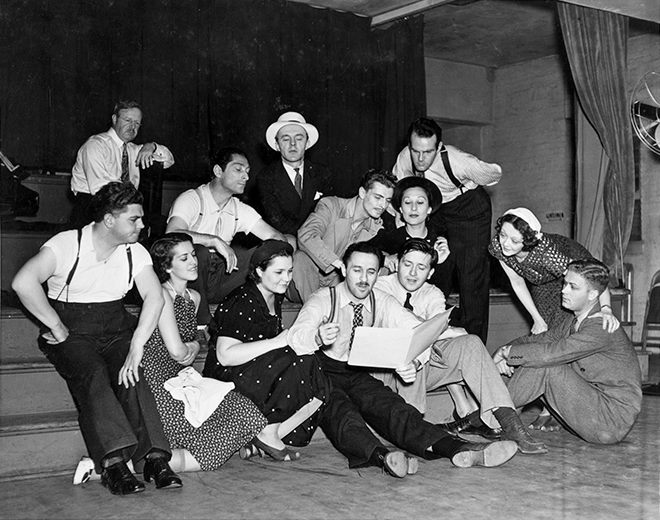
For Labor Day, Marc Blitzstein and Orson Welles stick it to the Man – or Mr. Mister, as the case may be – with “The Cradle Will Rock.”
The Philadelphia-born Blitzstein is probably best remembered for two things: for supplying the fine English translation/adaptation of Kurt Weill and Bertolt Brecht’s “The Threepenny Opera;” and for being the composer of this incendiary entertainment.
Not long before “Cradle”s scheduled premiere, on June 16, 1937, the Brechtian, pro-labor musical was shut down by the Works Progress Administration, allegedly due to budget cuts. However, the padlocks on the theatre, the security guards, and the unwillingness to release props or costumes seemed to bolster assertions that the play was censored for being too radical.
One must never toss a bone like that to Orson Welles. Welles turned it into a publicity coup by leading a 21-block march to a much larger theatre, where “The Cradle Will Rock” skirted union restrictions by scrapping the orchestra and having the actors perform their parts from the audience, while Welles and Blitzstein presided from the stage.
The stunt worked so well that the show was able to secure a private backer and all subsequent performances were done in the same manner, with the actors in the audience. The producer, John Houseman, was elated that such a practical solution should prove to be the key to the show’s success.
“There has always been the question of how to produce a labor show so the audience feels like it is a part of the performance,” he commented. “This technique seems to solve that problem and is exactly the right one for this particular piece.”
The success of “The Cradle Will Rock” led Welles and Houseman to form the Mercury Theatre.
But don’t take my word for it. Blitzstein tells the story himself in this reminiscence of the first performance of “The Cradle Will Rock.”
https://www.youtube.com/watch?v=PMfyrqRbDOA
———-
PHOTO (left to right) Blitzstein, Welles, and Lehman Engel in 1937