Tag: Metropolitan Opera

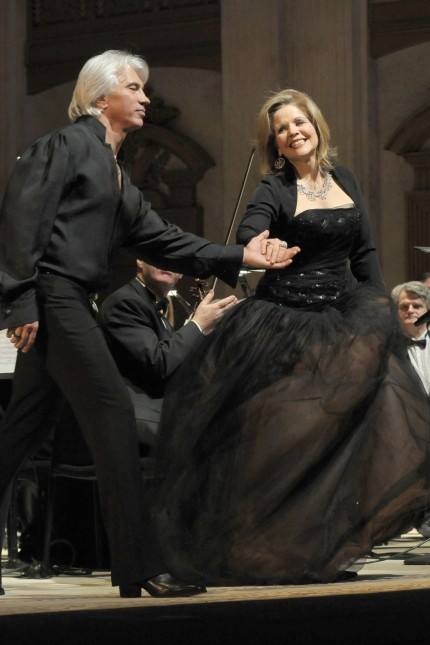
  • Dmitri Hvorostovsky Remembered

    Dmitri Hvorostovsky Remembered

    Beloved operatic baritone Dmitri Hvorostovsky has died, following a two-and-a-half year battle with brain cancer. His final operatic performance was in December of last year, though he continued to give recitals through at least June. He also made a surprise appearance at the Met’s five-hour 50th anniversary gala in May. At the time of his death, he was 55 years-old.

    I saw him only once, at the Met. He wasn’t singing; he passed me getting off of the elevator at a performance of “Rusalka,” starring his friend Renée Fleming. Even in the lobby, his was a striking presence.

    There “have been many beautiful voices,” Fleming said, “but none more beautiful than Dmitri’s.”

    R.I.P.

    https://www.nytimes.com/2017/11/22/arts/music/dmitri-hvorostovsky-dead.html

    Hvorostovsky and Fleming in “Eugene Onegin:”

    https://www.youtube.com/watch?v=i8mJsowhByo


    PHOTO: The couple during happier times, at a Lyric Opera of Chicago subscriber appreciation concert in 2012

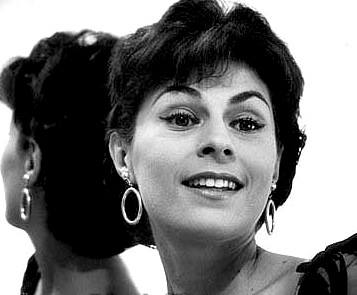
  • Roberta Peters Legendary Met Soprano Dies

    Roberta Peters Legendary Met Soprano Dies

    I am sorry to report that soprano Roberta Peters has died. Rushed to the Metropolitan Opera as a last-minute substitute with no rehearsal time in 1950, she was propelled to stardom.

    https://www.nytimes.com/2017/01/19/arts/music/roberta-peters-soprano-with-a-dramatic-entrance-dies-at-86.html?_r=0

    Here she is performing with her ex-husband, Robert Merrill, ten years after their amicable divorce:

    They were only married for ten weeks. They remained good friends and continued to perform quite well together.

  • Hanson’s Merry Mount: Puritanism & Opera

    Hanson’s Merry Mount: Puritanism & Opera

    Now that the feasting and the parades are past, it’s time to look beneath the quaint images of idealized Pilgrims to the dark underbelly of Puritan intolerance, fanaticism and repression. But that doesn’t mean the lesson has to be a bitter pill.

    Join me tomorrow for Sunday Morning Opera with Sandy, as once again I sit in for host Sandy Steiglitz to present Howard Hanson’s “Merry Mount.” Hanson cloaks his libretto – by Richard Stokes, loosely based upon Nathaniel Hawthorne’s short story, “The May-Pole of Merry Mount” – in the romantic idiom so characteristic of this composer of the “Romantic Symphony” (Hanson’s Symphony No. 2). No expense was spared for the work’s lavish premiere, at New York’s Metropolitan Opera, despite its having been mounted at the height of the Great Depression. No doubt Wrestling Bradford, the Puritan minister originally portrayed by Lawrence Tibbett, would not have approved.

    Coverage of the rehearsals in the New York Times questioned whether the candor and blunt Anglo-Saxonisms of the English libretto would slip past the censors. The plot seethes with sexual obsession and demonology. In fact, a good portion of Act II is set in Hell. Even so, there are stirring melodies and catchy tunes in abundance. The “Maypole Dances” are downright Polovtsian in their colorful excess.

    If the press is anything to go by, the opera was a smash. At its premiere in 1934, “Merry Mount” received no less than 50 curtain calls, with a headline in the Times proclaiming, “Reception of Hanson-Stokes Opera Most Enthusiastic of 10 Years at Metropolitan.” Yet, despite its initial success, the work is never done. It was dropped from the Met repertoire following the 1933-34 season and has rarely been heard since.

    Tastes changed. “Merry Mount” is never going to compete with “Carmen,” but I believe the pendulum has swung far enough that its voluptuous romanticism can again be enjoyed without a trace of Hawthornian guilt. We’ll be listening to a recording made from performances mounted in 1996, with soprano Lauren Flanigan (Lady Marigold Sandys), tenor Walter MacNeil (Sir Gower Lackland), baritone Richard Zeller (Wrestling Bradford), and bass Charles Robert Austin (Praise-God Tewke). The Seattle Symphony & Chorale are conducted by Gerard Schwarz.

    Before the morning is out, we’ll also have a chance to sample from Tibbett’s original characterization.

    Tune in tomorrow to see what all the fuss was about, with “Merry Mount,” on “Sunday Morning Opera,” from 7 to 10:00 EST, on WPRB 103.3 FM and at wprb.com.


    Learn about the historical Merrymount here:

    The Maypole That Infuriated the Puritans
  • Opera Ashes Halt Met Performance

    Opera Ashes Halt Met Performance

    I didn’t have a chance to post this yesterday, so you may very well have heard about it by now, but it seems an oddly appropriate story for Hallowe’en. In fact, it may be the craziest Metropolitan Opera news (from an audience standpoint) since an 82 year-old singing coach deliberately plunged to his death in 1988 during an intermission of a nationally broadcast performance of Verdi’s “Macbeth.”

    http://www.nytimes.com/2016/10/30/nyregion/metropolitan-opera-cancels-performance-white-substance.html

    http://nypost.com/2016/10/29/man-scattering-friends-ashes-during-opera-prompted-met-shutdown/

    The scattering of ashes into an orchestra pit is not unprecedented, by the way. Berlioz alleged, in the 1865 edition of his autobiography, that prior to a performance of his “Romeo and Juliet,” which he was about to conduct in Breslau in 1854, a lawyer poured the ashes of his wife into a tuba from a balcony.

    The latest incident comes a week after the Catholic Church banned the scattering of ashes, which it decried as “pantheistic or naturalistic or nihilistic.”

    Expect heightened security in the future. First we have to take off our shoes at the airport; now we’ll be cavity searched thanks to some nutbone (whom police name as Roger Kaiser, 52, a jeweler from Dallas), who thought he was honoring a friend and even bragged about it beforehand.

    The opera may have been “William Tell,” but nobody else did.

  • Yannick Nézet-Séguin New Met Music Director

    Yannick Nézet-Séguin New Met Music Director

    Yannick Nézet-Séguin has been named the new music director of the Metropolitan Opera. James Levine, who held the position for the past 40 years, agreed to step down at the end of this season because of health issues. Levine led his final performance as the Met’s music director, of Mozart’s “The Abduction from the Seraglio,” on May 7. He conducted the Met Orchestra in selections from Wagner’s “Ring” at Carnegie Hall on May 26.

    Yannick is a very fine conductor of opera and a seemingly unstoppable force, but even for such a fireball, maintaining his loyalty to Philadelphia (where his contract has been renewed through 2026) and the Orchestre Métropolitain in his native Montreal might be spreading things a bit thin. Congratulations, Yannick, and best of luck to you!

    Here’s the press release:

    YANNICK NEZET-SEGUIN NAMED THE METROPOLITAN OPERA’S MUSIC DIRECTOR

    The 41-year-old conductor will become only the third
    Music Director in the history of the Met

    New York, NY (June 2, 2016) – The Metropolitan Opera announced that the acclaimed conductor Yannick Nézet-Séguin will be the company’s new Music Director. The position has previously been held by only two artists in the company’s storied 133-year history—James Levine, who after 40 years in the position stepped down at the end of the recently concluded season to become the company’s first Music Director Emeritus, and Rafael Kubelik, who held the title briefly in the company’s 1973-74 season.

    In the Met’s 2017-18 season, Nézet-Séguin will assume the interim title of Music Director Designate. He will become Music Director in the 2020-21 season, the first season in which he is available to take over the full responsibilities of the position. However, he will immediately become involved in the company’s artistic planning, which happens many years in advance.

    As Music Director, Nézet-Séguin will be responsible for the overall musical quality of the Met. He will have artistic authority over the company’s orchestra, chorus, and music staff, and will work in tandem with Met General Manager Peter Gelb to oversee the planning and casting of each Met season, including repertoire choices, new productions (including the selection of creative teams), revivals, and commissions.

    Nézet-Séguin will initially conduct five different operas each season he is Music Director, as well as concerts with the Met Orchestra. In each of the seasons in which he is Music Director Designate, Nézet-Séguin will conduct two operas. Next season at the Met, he will conduct his first Wagner opera with the company, a revival of Der Fliegende Holländer.

    “Becoming the Music Director of the Metropolitan Opera is the fulfillment of a lifelong dream for me,” said Nézet-Séguin. “I am truly honored and humbled by the opportunity to succeed the legendary James Levine and to work with the extraordinary orchestra, chorus, and staff of what I believe is the greatest opera company in the world. I will make it my mission to passionately preserve the highest artistic standards while imagining a new, bright future for our art form.”

    “Yannick was the clear choice of the Company,” said Gelb. “He is the right artist at the right time to lead us forward into a new and what I believe will be a glorious chapter in the history of the Met.”

    “The Metropolitan Opera has been the great artistic love of my life, and it has been tremendously rewarding to see the company develop and improve over the past 45 years,” said Levine. “I offer my heartfelt congratulations to Yannick on taking the musical reins, and I look forward to seeing the good work continue under his watch.”

    “The MET Orchestra enjoys a tremendously fruitful, positive relationship with Maestro Nézet-Séguin, and we are delighted in his appointment as Music Director,” said Jessica Phillips, clarinetist and chair of the Met’s Orchestra committee. “He embodies the artistic leadership, musical excellence, and respect for rich tradition that opera lovers around the world have come to cherish. We eagerly look forward to working together to shape this new era at the Met.”

    “The singers and stage performers at the Met welcome Yannick Nézet-Séguin, joining the historic line of artists from James Levine’s great tenure back to Toscanini and Mahler,” said David Frye, tenor and chair of the Met’s chorus committee. “Yannick has led great performances with the company, and we’re eager to expand our collaboration.”

    Nézet-Séguin made his Met debut in the 2009-10 season, conducting a new production of Bizet’s Carmen. He has returned in every subsequent season, leading acclaimed performances of Verdi’s Don Carlo, Gounod’s Faust, Verdi’s La Traviata, and Dvořák’s Rusalka. He led the opening night performance of the Met’s 2015-16 season, a new production of Verdi’s Otello.

    Nézet-Séguin’s operatic career was launched when he was appointed Chorus Master and Assistant Conductor of the Montreal Opera at age 23. Since then, he has conducted a wide breadth of repertoire at a number of the leading companies, including the Vienna State Opera; the Royal Opera House, Covent Garden; La Scala; Dutch National Opera; and the Salzburg Festival, in addition to the Met. He is also a frequent guest conductor of the Berlin Philharmonic, the Vienna Philharmonic, the Bavarian Radio Symphony Orchestra, the London Philharmonic, and the Chamber Orchestra of Europe.

    Since 2012, Nézet-Séguin has been Music Director of the Philadelphia Orchestra, which announced today that he has extended his contract with them through 2025-26. (A separate press release on that announcement is available.) Given the close proximity of New York and Philadelphia, Nézet-Séguin will be able to easily commute between his two posts, and the Met and the Philadelphia Orchestra will also be exploring the possibilities for artistic collaboration between the two institutions.

    He is also the Music Director of Montreal’s Orchestre Métropolitain and of the Rotterdam Philharmonic, a position he will resign at the conclusion of the 2017-18 season.

    Each season, the Met presents more than 200 performances in its home at Lincoln Center and transmits 10 live performances to more than 2,000 movie theaters in 70 countries around the world.

Tag Cloud

Aaron Copland (92) Beethoven (95) Composer (114) Film Music (123) Film Score (143) Film Scores (255) Halloween (94) John Williams (187) KWAX (229) Leonard Bernstein (101) Marlboro Music Festival (125) Movie Music (138) Opera (202) Philadelphia Orchestra (89) Picture Perfect (174) Princeton Symphony Orchestra (106) Radio (87) Ralph Vaughan Williams (85) Ross Amico (244) Roy's Tie-Dye Sci-Fi Corner (290) The Classical Network (101) The Lost Chord (268) Vaughan Williams (103) WPRB (396) WWFM (881)

DON’T MISS A BEAT

Receive a weekly digest every Sunday at noon by signing up here


RECENT POSTS