
The Enlightenment isn’t exactly remembered for its flights of fancy. If the odd novel embraced a fantastic tone, it was frequently in the service of satire, an entertaining means to send-up contemporary mores and pursuits or to mock authority figures and good old reliable human frailty. This week on “Picture Perfect,” we’ll explore a few of these fantastic adventures of the 18th century.
“The Surprising Adventures of Baron Munchausen” (1785) pokes fun at one Hieronymus Karl Friedrich, Freiherr von Münchhausen, a German nobleman and veteran of the Russo-Turkish War, whose reputation for telling outrageous tall tales is lampooned by Rudolf Erich Raspe. Raspe, looking to avoid a libel suit, published the work anonymously, with the result that it was commonly believed that the Baron actually dictated the tales himself. Naturally, the real-life Munchausen was upset by the unwanted attention. Thanks to Raspe, his very name came to be associated with feigned illness and pathological lying.
The book has been adapted to film several times, beginning with a silent version by Georges Méliès, all the way back in 1911. We’ll be listening to music from two subsequent adaptations. The first, “Münchhausen” (1943), is undeniably entertaining and exceptionally well-made. However, undermining one’s enjoyment is a sense of unease in the knowledge that the film was a pet project of Joseph Goebbels, who wanted to celebrate the 25th anniversary of the UFA film studio by producing a lavish spectacle worthy to stand toe-to-toe with foreign efforts like “The Wizard of Oz” and “The Thief of Bagdad.”
Considering the source, one would have to look awfully hard to come up with anything resembling Nazi propaganda. The entire exercise comes across as a pastoral escape from the horrors of totalitarianism, total war, and the Final Solution. The elegant music, by Georg Haentzschel, would not be out of place in the concert hall. Haentzschel is regarded as perhaps the last representative of a generation of Middle European light music composers.
More than 40 years later, director Terry Gilliam undertook another production design-driven adaptation that resembles nothing if not a series of Doré illustrations brought to life. Contrary to received wisdom, “The Adventures of Baron Munchausen” (1988) managed to pull in a respectable amount of per-screen capital. The film was a casualty of a management turnover at Columbia Pictures, with the new regime eager to bury the projects of the old. Hence, it was never seen theatrically beyond a very limited release. The score, by Michael Kamen, while in a romantic heroic style, wittily contains abundant allusions to music of the 18th century.
“The Manuscript Found in Saragossa” (1805) is a transitional work, with its ecstatically lurid opening chapter – replete with gypsy storytellers, highwaymen, dueling skeletons, lesbian vampires, and a couple of corpses dangling in a gibbet – dragging the Enlightenment kicking and screaming into the Romantic age. It starts out as a masterpiece of surrealism, by way of Gothic convention, but the spell is eventually broken, sadly, by a large, cold bucket of Enlightenment water, in the form of a perfectly rational explanation at the end. But until then, the author, Jan Potocki, gets an A for effort. The interlocking structure, with stories inside stories inside stories looks ahead to postmodern experiments by writers like Italo Calvino and John Barth, to say nothing of Jorge Luis Borges.
The book was made into an acclaimed Polish film, “The Saragossa Manuscript,” in 1965. Its cult status led to a restoration financed by Jerry Garcia, Martin Scorsese, and Francis Ford Coppola that was released on VHS and DVD in 2001.
Who else could provide the perfect soundtrack to such a hallucinogenic experience but Krzysztof Penderecki? Penderecki intersperses spooky passages with neo-classical and baroque interludes.
Finally, we’ll hear music from one of the many adaptations of Jonathan Swift’s “Gulliver’s Travels” (1726). “The Three Worlds of Gulliver” (1960) simplifies the book’s narrative and dispenses with a great deal of the misanthropic humor in favor of children’s fantasy. You won’t catch Gulliver extinguishing a fire in the Lilliputian Emperor’s palace with his urine in this version. What you will find is a good deal of technical wizardry and a delightful score by Bernard Herrmann.
What, you doubt my veracity? Then surely the music must speak for itself. Join me for fantastic adventures in the 18th century, now in syndication on KWAX Classical Oregon!
——–
Clip and save the start times for all three of my recorded shows:
PICTURE PERFECT, the movie music show – Friday at 8:00 PM EST/5:00 PM PST
SWEETNESS AND LIGHT, the light music program – Saturday at 11:00 AM EST/8:00 AM PST
THE LOST CHORD, unusual and neglected rep – Saturday at 7:00 PM EST/4:00 PM PST
Stream them, wherever you are, at the link!
https://kwax.uoregon.edu
——–
PHOTO: A fancy flight with Baron Munchausen
Tag: Michael Kamen
-
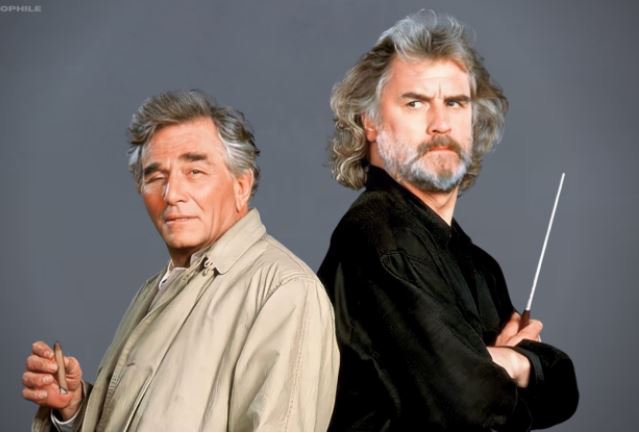
Columbo, Kamen, and Ghostwritten Scores
I know there are some “Columbo” fans out there. I watched an episode, now and again, if I happened to be in the room when it was on, and since my stepfather enjoyed the show, it meant I had plenty of opportunities. For me, as I assume it was for many, Falk was the whole show. No doubt someone will challenge me on that, and I’m fine with it. I’ve just never really been into the whole murder-of-the-week-with-celebrity-guests kind of thing.
That said, how have I never heard about “Murder with Too Many Notes?” This particular episode involves an Oscar-winning film composer (played by Billy Connolly) who stands to lose everything when his protégé threatens to reveal that most of his scores were, in fact, ghostwritten.
It’s been pointed out that Connolly bears an uncanny resemblance to Michael Kamen, composer of “Die Hard,” “Robin Hood: Prince of Thieves,” and “Mr. Holland’s Opus,” among others. But Kamen at least was open about employing assistants, who acted primarily as orchestrators. The practice is not unusual, nor is it particularly unethical, when the musicians are credited at the end of the film.
What it is unethical, to my thinking, is when a composer does little or even no work on a score as it’s heard in a movie, and the hard-working, underpaid composers who actually bring the music to fruition remain anonymous, with only the “big shot” appearing in the credits. And they get no points for originality.
Sure, Kamen did a lot of work in the popular sphere, working for instance on Pink Floyd’s “The Wall,” but he also had classical training, having studied English horn at Juilliard and composition with Vincent Persichetti and Jacob Druckman. He was not just some computer-noodler with garage-band experience and no idea how to string his ideas together in a convincing manner when dealing with larger forms. (He wrote ballets before he came to Hollywood.)
Kamen never won an Academy Award, but he was nominated for two, and won three Grammy Awards, two Golden Globes, and an Emmy. He actually seemed like a pretty good guy, setting up the Mr. Holland’s Opus Foundation to bring instruments and music education to kids in underserved communities. Furthermore, the foundation stepped up to create an emergency fund in the wake of Hurricane Katrina.
So any similarity to Kamen, I hope, was purely coincidental. Because this “Columbo” villain-of-the-week seems a lot more like a few other composers I can think of, including the one most responsible for the current lowest-common-denominator approach to film-scoring. You know, the one with the team of soundalikes that’s squashed the soul of cinema with its electronic cliches of ominous drones and hyperintense ostinati. I’m not hearing any John Williamses or Jerry Goldsmiths or Elmer Bernsteins emerging from the galley.
Kamen died of a heart attack at 55 on November 18, 2003. He was still alive when “Murder with Too Many Notes” aired on March 12, 2001.
It turns out the behind-the-scenes story of this particular episode is much more fascinating than anything that made it on-screen, as a much-compromised realization of screenwriter Jeffrey Cava’s original vision. Film music was Cava’s passion. And it pains me to think that Patrick McGoohan was largely responsible for a life-imitates-art appropriation of his work.
Columbo and The Prisoner? That’s right. I know it’s not the only time McGoohan was involved with the series. But it was his last, as the show was nearing the end of its run.
Thanks to Lukas Kendall for directing his readers to this a number of weeks ago on his blog. Kendall is the founder and longtime editor of Film Score Monthly.
The whole sordid tale on columbophile.com:
Peter Falk describes his working relationship with McGoohan:
http://web.archive.org/web/19981206185852/http://www.clark.net/pub/bjpruett/pmweb/columbo.htm
More of Kendall’s musings here:
Tag Cloud
Aaron Copland (94) Beethoven (95) Composer (114) Film Music (148) Film Score (143) Film Scores (255) Halloween (97) John Williams (196) KWAX (232) Leonard Bernstein (105) Marlboro Music Festival (125) Movie Music (163) Mozart (91) Opera (215) Philadelphia Orchestra (90) Picture Perfect (174) Princeton Symphony Orchestra (110) Radio (90) Ross Amico (244) Roy's Tie-Dye Sci-Fi Corner (290) The Classical Network (101) The Lost Chord (269) Vaughan Williams (107) WPRB (397) WWFM (881)