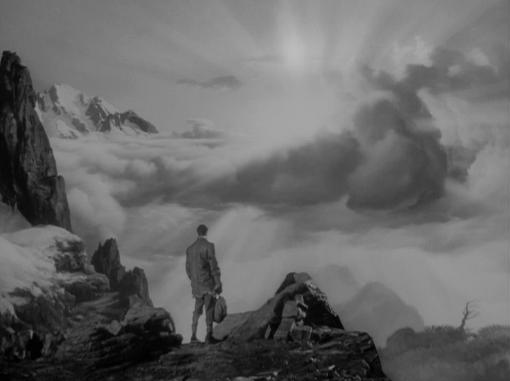
This week on “Picture Perfect,” we journey through the awe-inspiring landscapes of India and Tibet, even as we feel our way to the inner realms of spirit and psyche, with an hour of Himalayan adventures.
The Himalayas, in film, have frequently been the source of enlightenment; though occasionally their overwhelming influence has also led to madness. Intriguingly, the latter is the case in the Powell-Pressburger classic, “Black Narcissus” (1947). Psychological and emotional tensions abound in this tale of repressed nuns struggling to maintain their composure in a voluptuous Himalayan valley.
The stunning cinematography was by Jack Cardiff, and Brian Easdale (of “The Red Shoes” fame) wrote the music. Incredibly, the entire film was shot in England, mostly at Pinewood Studios. From a purely visual standpoint, “Black Narcissus” must be one of the most beautiful films ever made. It’s also one of the craziest, with unlikely object-of-desire Mr. Dean driving the sisters to the brink.
The Himalayas also form the backdrop to “Seven Years in Tibet” (1997), based on a memoir of Austrian mountaineer Heinrich Harrer. Harrer escapes from a British internment camp in India during the Second World War. He travels across Tibet to its capital, Lhasa, where he eventually becomes the tutor of the 14th Dalai Lama. In the film, Brad Pitt plays Harrer. John Williams wrote the music, and Yo-Yo Ma performs the cello solos.
“The Razor’s Edge” (1946) tells the story of a traumatized World War I veteran, who sets off in search of some kind of transcendent meaning to his existence. He finds it in India, at a Himalayan monastery. The 1946 adaptation of W. Somerset Maugham’s novel (which he claimed was thinly-veiled fact) features Tyrone Power, Gene Tierney, and Ann Baxter. The music is by Alfred Newman, who will conduct a selection from his score.
Finally, we’ll hear a suite from the Frank Capra classic, “Lost Horizon” (1937). Based on the book by James Hilton, the film stars Ronald Colman and an outstanding supporting cast, including Jane Wyatt, Thomas Mitchell, Edward Everett Horton, H.B. Warner, and Sam Jaffe. The novel, and the film, brought the term “Shangri-La” into popular usage, a Utopian paradise hidden in a secluded Himalayan valley, a place of ageless beauty and serenity.
“Lost Horizon” provided composer Dimitri Tiomkin (a pupil of Alexander Glazunov) with his first major project. The result is one of his most colorful scores. The recording is one of the gems of RCA’s Classic Film Scores series, originally issued in the early 1970s. Made in the presence of the composer, it features 157 performers, with the chorus standing on a platform behind the conductor, Charles Gerhardt, and the various percussionists stationed in the encircling balcony.
I can’t guarantee that you’ll find enlightenment, but there will be plenty to awe and inspire in these Himalayan adventures, on “Picture Perfect,” music for the movies, now in syndication on KWAX Classical Oregon!
——–
Clip and save the start times for all three of my recorded shows:
PICTURE PERFECT, the movie music show – Friday at 8:00 PM EST/5:00 PM PST
SWEETNESS AND LIGHT, the light music program – Saturday at 11:00 AM EST/8:00 AM PST
THE LOST CHORD, unusual and neglected rep – Saturday at 7:00 PM EST/4:00 PM PST
Stream them, wherever you are, at the link!
https://kwax.uoregon.edu
Tag: Michael Powell
-

Technicolor Moira Shearer, for Her Centenary, on “Sweetness and Light”
Dancer and movie star Moira Shearer was born on this date 100 years ago. The striking Scottish ballerina with fiery red hair first earned recognition through her work with the Sadler’s Wells Ballet, but soon achieved world fame through her appearances, in Technicolor, in indelible Powell-Pressburger classics such as “The Tales of Hoffmann” and “The Red Shoes.”
Once seen, who can forget the surreal sequence in which her life-like mechanized doll, Olympia, is dismembered and dismantled before our very eyes, mostly through the magic of practical effects? Zombie maestro George A. Romero, director of “Night of the Living Dead,” cited “The Tales of Hoffmann” as his favorite film of all time, and the one that set him on a career of making movies.
And then of course, there’s “The Red Shoes,” choreographed by Robert Helpmann, who seemed to devote his cinematic career to refining nightmare fuel, up to and including his appearance as the Child Catcher in “Chitty Chitty Bang Bang.” Robert Helpmann and Hans Christian Anderson – what could possibly go wrong?
Join me for music from “The Tales of Hoffmann” and “The Red Shoes,” as well as selections from two of Shearer’s ballet triumphs at the Sadler’s Wells, “The Sleeping Beauty” and “Coppélia” (the latter based on the same E.T.A. Hoffmann short story that inspired the doll sequence in the Powell-Pressburger adaptation of Offenbach’s opera).
Strap on your demonic dancing shoes. It’s an hour of music for Moira Shearer on “Sweetness and Light,” this Saturday morning at 11:00 EST/8:00 PST, exclusively on KWAX Classical Oregon!
Stream it, wherever you are, at the link:
https://kwax.uoregon.edu/ -
Manuel de Falla’s Bewitched Love a Powell Masterpiece
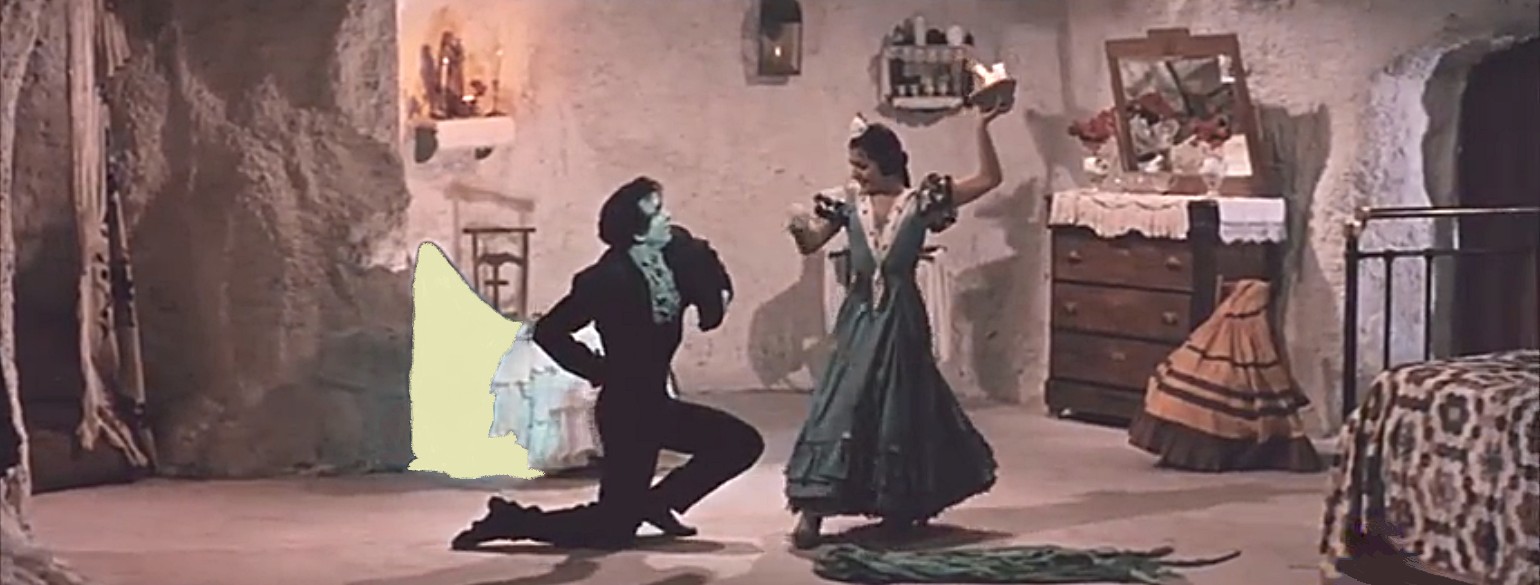
I have always been a great admirer of the team of Michael Powell and Emeric Pressburger, who made such strange, astonishing films as “The Red Shoes” (1948) and “The Tales of Hoffmann” (1951). Yet somehow I never encountered this one until a couple of years ago. It was made by Powell alone, after the two had amicably split to pursue their own projects.
“Honeymoon” (1959) reunited Powell with legendary Ballets Russes principal dancer and choreographer Léonide Massine, for a film based in part on Manuel de Falla’s ballet “El Amor Brujo” (here translated as “Bewitched Love”). Massine created the role of the Miller in Falla’s “The Three-Cornered Hat” with the Ballets Russes and a specially-assembled all-Spanish company, back in 1919. Naturally, after his turn as the sinister shoemaker in “The Red Shoes,” Massine assumes the role of the creepy Ghost. Sir Thomas Beecham conducts.
If you can’t be bothered to watch the whole thing – and you should – check out the freaky graveyard scene at 6:49 (linked below). It leads directly into the ballet’s most famous music, the “Ritual Fire Dance.” Like a Goya painting brought to life.
Alicia de Larrocha gives “Ritual Fire Dance” a whirl at the piano.
Manuel de Falla plays his Harpsichord Concerto, a very different piece.
Documentary, “When the Fire Burns: The Life and Music of Manuel de Falla” (1991)
¡Feliz cumpleaños, Manuel de Falla!
-
Powell’s Lost Falla Ballet Film Honeymoon
Wow! How did I never hear of this before?
On Manuel de Falla’s birthday, I’ve been bouncing around YouTube, looking for exceptional or unusual material, and as always, the effort – if anything so enjoyable could be described as such – has paid off.
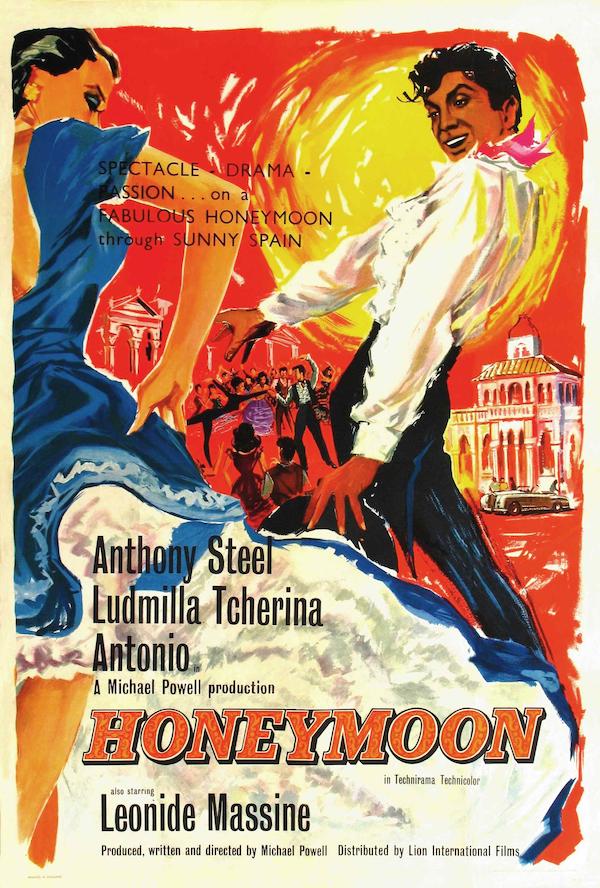
I have always been a great admirer of the filmmaking team of Michael Powell and Emeric Pressburger, who made such strange, astonishing films as “The Red Shoes” (1948) and “The Tales of Hoffmann” (1951), and yet somehow I have never encountered this one, apparently made by Powell alone, after the team had amicably split.
“Honeymoon” (1959) reunited Powell with legendary Ballets Russes principal dancer and choreographer Léonide Massine, for a film based in part on Falla’s ballet “El Amor Brujo” (here translated as “Bewitched Love”). Massine created the role of the Miller in Falla’s “The Three-Cornered Hat” with the Ballets Russes and a specially-assembled all-Spanish company, back in 1919. Naturally, after his turn as the sinister shoemaker in “The Red Shoes,” Massine here assumes the role of the creepy Ghost.
Supposedly the film is something of a Spanish travelogue with musical interludes. Mikis Theodorakis, of “Zorba the Greek” fame, wrote the aptly named “The Honeymoon Song.” It was later covered by The Beatles.
For the leads, Powell was hoping to reunite with his “Red Shoes” star Moira Shearer and Paul Scofield, of all people. Instead, he got Ludmilla Tchérina, once the youngest prima ballerina in history when she danced “Romeo and Juliet” in Paris in 1942, while still in her teens, for the Ballets Russes de Monte Carlo. Tchérina had worked with Powell in both of his previous dance films. For the male lead, the director was less fortunate, stuck with Anthony Steel, whom Powell despised. (He described him as “the archetypal British s**t.”)
Allegedly, “Honeymoon” is regarded as one of Powell’s least-impressive achievements. Unquestionably it is at least as much “Red Shoes” as it is authentic Falla. Still, I am grateful to have discovered it.
The “El Amor Brujo” sequence is posted here in two parts.
Happy birthday, Manuel de Falla!
Check out the freaky graveyard scene at 6:49 (here linked directly), which leads into the ballet’s most famous music, “The Ritual Fire Dance.” Like a Goya painting brought to life!
Tag Cloud
Aaron Copland (94) Beethoven (95) Composer (114) Film Music (148) Film Score (143) Film Scores (255) Halloween (97) John Williams (196) KWAX (232) Leonard Bernstein (105) Marlboro Music Festival (125) Movie Music (163) Mozart (91) Opera (215) Philadelphia Orchestra (90) Picture Perfect (174) Princeton Symphony Orchestra (110) Radio (90) Ross Amico (244) Roy's Tie-Dye Sci-Fi Corner (290) The Classical Network (101) The Lost Chord (269) Vaughan Williams (107) WPRB (397) WWFM (881)