Tag: Mikalojus Ciurlionis

  • Čiurlionis: Celebrating a Lithuanian Master

    Čiurlionis: Celebrating a Lithuanian Master

    Lo and behold! It’s the 150th birthday of Mikalojus Čiurlionis!

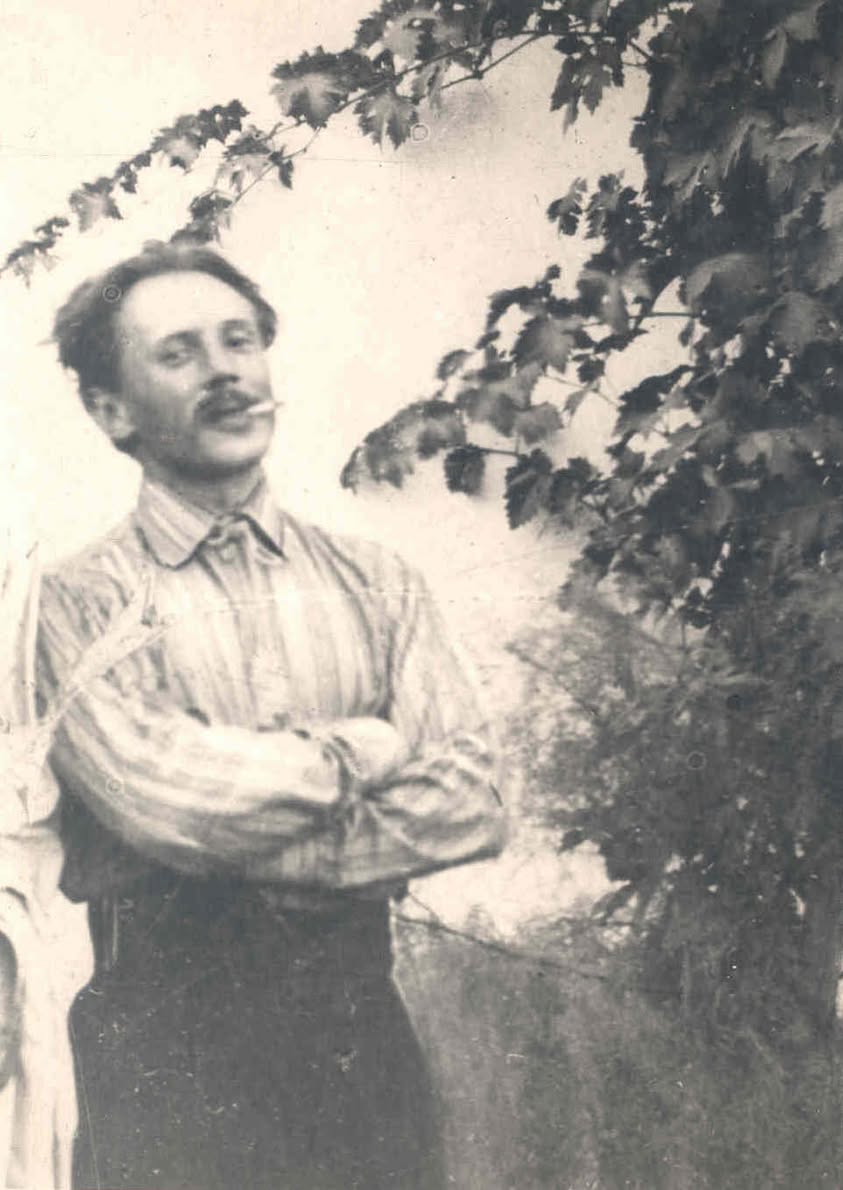
    It doesn’t seem right that someone so talented in one discipline should be equally if not more talented in another. But that’s precisely the case with Čiurlionis, a composer of opulent tone poems who also happened to be a major Symbolist painter. Oh yeah, he could write, too. In a creative effusion that lasted less than a decade, he managed to compose 400 pieces of music and to create about 300 paintings.

    Čiurlionis was born into a Polish-speaking family in the Lithuanian village of Senoji Varėna on this date in 1875. He studied at the Warsaw Conservatory and then the Warsaw School of Fine Arts.

    A passionate figure in the Romantic mold, he lived his life at a fever pitch. He was interested in photography, geology, history, chemistry, geometry, physics, astronomy, astrology, mythology, philosophy, dead and modern languages, and Eastern and Western religions.

    He enthusiastically embraced the Lithuanian national movement. He was the first composer to collect and publish Lithuanian folk music. He organized and participated in the first three exhibitions of Lithuanian artists. He was one of 19 founding members of the Lithuanian Artists Union. He declared to his brother that he intended to dedicate all of his past and future works to Lithuania.

    In 1909, he married the art critic Sofija Kymantaitė. Their time together would be brief. At the age of 33, Čiurlionis fell into a profound depression and was admitted to a psychiatric hospital in Marki, northeast of Warsaw. While recovering, he contracted pneumonia on a walk and died without ever having met his daughter.

    Čiurlionis was a synesthete, his perception of music and color inextricably linked. A number of his paintings bear musical titles. His music teeters between Romanticism and Modernism, and his paintings between Symbolism and Abstract Expressionism.

    Happy 150th birthday to this intense, doomed artist.


    Čiurlionis’ tone poem, “The Sea” (1903-1907)

    Paintings by Čiurlionis

    https://www.wikiart.org/en/mikalojus-ciurlionis


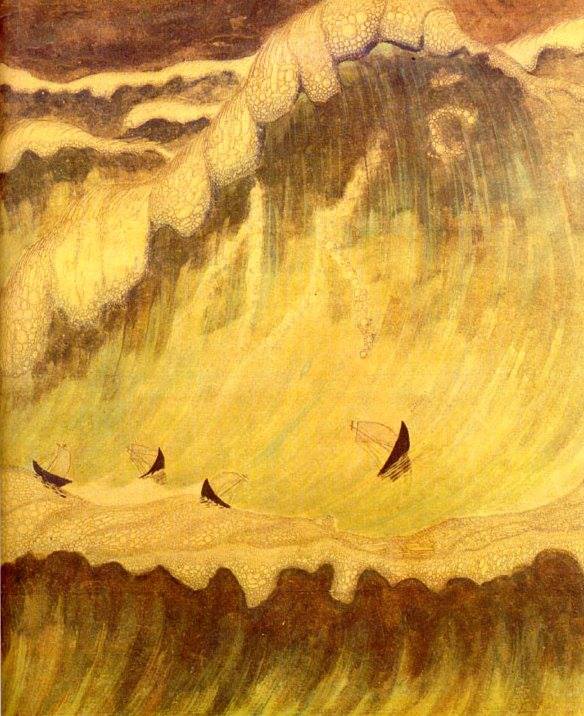
    TOP TO BOTTOM: “News” (1905), “Sonata of the Sea: Finale” (1908), “Sagittarius” (1907)
  • Composer Painters: Art & Music Collide

    Composer Painters: Art & Music Collide

    For some people, being a master in one field, it seems, just isn’t enough. This Sunday night on “The Lost Chord,” we’ll hear works by three successful composer-painters.

    Carl Ruggles (1876-1971), a friend of Charles Ives, lived 95 years. The cantankerous American modernist was the creator of a handful of meticulously-crafted, uncompromising works. His complete, authorized output amounts to four times the length of an LP side. We know this, because Michael Tilson Thomas recorded just about everything as part of a two-LP set, issued on the Columbia Masterworks label back in 1980.

    Ruggles’ method was described by musicologist Charles Seeger as “dissonant counterpoint,” a system wherein all the traditional rules of counterpoint are reversed, so that dissonance, rather than consonance, is the norm. The very practice smacks of contrarianism!

    Not surprisingly, he was beloved by Ives. When someone had the audacity to boo a work by Ruggles at a concert given in 1931, Ives berated the critic as a sissy. “Why can’t you stand up before fine, strong music like this, and use your ears like a man?” he challenged.

    In addition to his activities as a composer, Ruggles created hundreds of paintings. They were deemed to be successful enough that he was invited to hang shows and even sold many of his canvases.

    His musical composition “Sun-Treader” was inspired by Robert Browning’s poem, “Pauline” – in particular the line, “Sun-treader, light and life be thine forever!”

    In contrast to Ruggles, a gifted dilettante who tossed off paintings in an afternoon, Mikalojus Čiurlionis (1875-1911) is considered every bit as important a painter as he was a composer.

    In his 35 years, Čiurlionis managed to compose about 400 pieces of music and to paint about 300 canvases. A pioneer of abstract art in Europe, he was an exemplar of the symbolist and art nouveau movements, a representative of the fin de siècle epoch, and a major figure in Lithuanian culture. Interestingly, Čiurlionis was also a synesthete; that is to say, he perceived colors and music simultaneously. We’ll hear his vibrant symphonic poem, “The Sea.”

    Lyonel Feininger (1871-1956), on the other hand, is known almost exclusively as a visual artist. Born and raised in New York, he moved to Germany at the age of 16. There, he became a leading practitioner of German Expressionism and the Bauhaus. With the rise of the Nazis in the 1930s and the party’s campaign against modern art, Feininger was driven out of Germany, and after 50 years returned to the United States, where he met with great success.

    Feininger had no formal music studies, beyond a few years of violin lessons. Regardless, he composed thirteen fugues (with extant sketches for a fourteenth). These, he wrote by ear, with the music of Johann Sebastian Bach being an undisguised influence. Feininger claimed that the influence of Bach was equally evident in his paintings.

    Prepare to see double this week. It’s an hour of music by ambidextrous artists. Join me for “Fixtures at an Exhibition,” this Sunday night at 10:00 EDT, on WWFM – The Classical Network and wwfm.org.


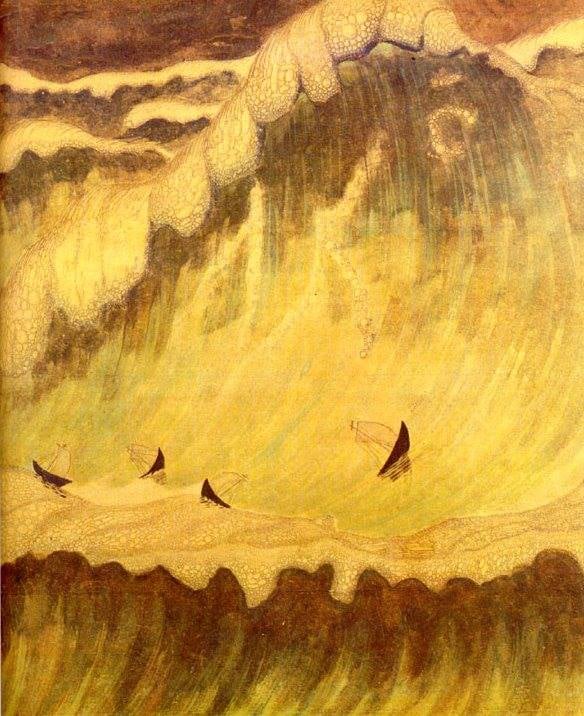
    “Sonata of the Sea: Finale” (1908), by Mikalojus Čiurlionis

  • Composer Painters Music and Art

    Composer Painters Music and Art

    For some people, being a master in one field, it seems, just isn’t enough. This Sunday night on “The Lost Chord,” we’ll hear works by three successful composer-painters.

    Carl Ruggles (1876-1971), a friend of Charles Ives, lived 95 years. The cantankerous American modernist was the creator of a handful of meticulously-crafted, uncompromising works. His complete, authorized output amounts to four times the length of an LP side. We know this, because Michael Tilson Thomas recorded just about everything as part of a two-LP set, issued on the Columbia Masterworks label back in 1980.

    Ruggles’ method was described by musicologist Charles Seeger as “dissonant counterpoint,” a system wherein all the traditional rules of counterpoint are reversed, so that dissonance, rather than consonance, is the norm. The very practice smacks of contrarianism!

    Not surprisingly, he was beloved by Ives. When someone had the audacity to boo a work by Ruggles at a concert given in 1931, Ives berated the critic as a sissy. “Why can’t you stand up before fine, strong music like this, and use your ears like a man?” he challenged.

    In addition to his activities as a composer, Ruggles created hundreds of paintings. They were deemed successful enough that he was invited to hang shows and even sold many of his canvases.

    His musical composition “Sun-Treader” was inspired by Robert Browning’s poem, “Pauline” – in particular the line, “Sun-treader, light and life be thine forever!”

    In contrast to Ruggles, a gifted dilettante who tossed off paintings in an afternoon, Mikalojus Čiurlionis (1875-1911) is considered every bit as important a painter as he was a composer.

    In his 35 years, Čiurlionis managed to compose about 400 pieces of music and paint about 300 canvases. A pioneer of abstract art in Europe, he was an exemplar of the symbolist and art nouveau movements, a representative of the fin de siècle epoch, and a major figure in Lithuanian culture. Interestingly, Čiurlionis was also a synesthete; that is to say, he perceived colors and music simultaneously. We’ll hear his vibrant symphonic poem, “The Sea.”

    Lyonel Feininger (1871-1956), on the other hand, is known almost exclusively as a visual artist. Born and raised in New York, he moved to Germany at the age of 16. There, he became a leading practitioner of German Expressionism and the Bauhaus. With the rise of the Nazis in the 1930s and the party’s campaign against modern art, Feininger was driven out of Germany, and after 50 years returned to the United States, where he met with great success.

    Feininger had no formal music studies, beyond a few years of violin lessons. Regardless, he composed thirteen fugues (with extant sketches for a fourteenth). These, he wrote by ear, with the music of Johann Sebastian Bach being an undisguised influence. Feininger claimed that the influence of Bach was equally evident in his paintings.

    Prepare to see double this week. It’s an hour of music by ambidextrous artists. Join me for “Fixtures at an Exhibition,” this Sunday night at 10:00 EDT, on WWFM – The Classical Network and wwfm.org.


    “Sonata of the Sea: Finale” (1908), by Mikalojus Čiurlionis

  • Beach Music Seascape on WPRB

    Beach Music Seascape on WPRB

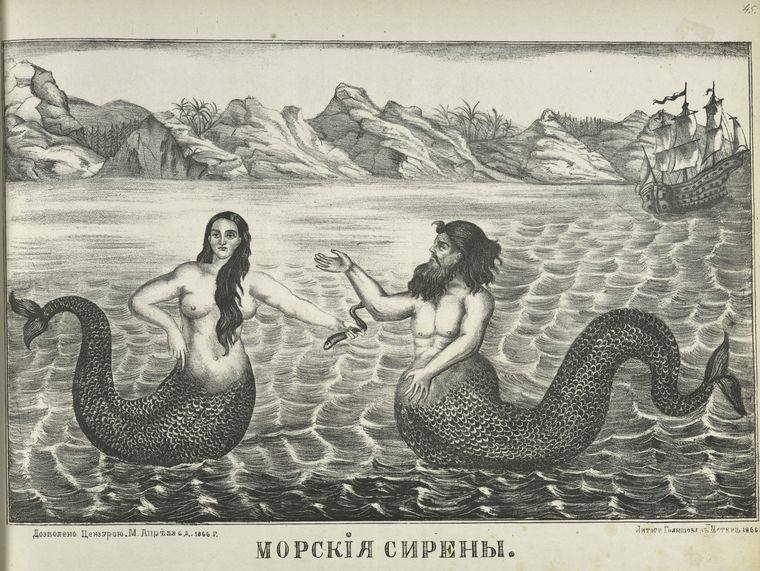
    Flip-flops should only be worn at the beach. I make that proclamation while sitting here, dressed in my Sea Monkey garb.

    I hope you’ll join me this Thursday morning for music inspired by the sea and the shore, with a few shanties tossed into the chowder. We’ll hear Mikalojus Ciurlionis’ “The Sea,” Ernest Chausson’s “Poème de l’amour et de la mer,” Cyril Scott’s “Neptune,” Howard Hanson’s “Bold Island Suite,” and Paul Gilson’s “The Sea,” a work that Claude Debussy obviously had very much in mind when he went to compose “La Mer.”

    I’ll be picking my teeth with my trident this morning, from 6 to 11 EDT, on WPRB 103.3 FM and wprb.com. It’s all that swimming gives me this physique, on Classic Ross Amico.

  • Classic Ross Amico’s August Surf & Sand Special

    Classic Ross Amico’s August Surf & Sand Special

    Classic Ross Amico doesn’t take vacations. Nor does he much care for the beach. That said, for this first week of August, it seems like as good a time as any to celebrate surf and sand.

    Join me this Thursday morning to hear Mikalojus Ciurlionis’ “The Sea,” Ernest Chausson’s “Poème de l’amour et de la mer,” Cyril Scott’s “Neptune,” Howard Hanson’s “Bold Island Suite,” and Elie Siegmeister’s cycle of piano pieces “Sunday in Brooklyn” (with its concluding movement, “Coney Island”). In addition, there is bound to be a sea shanty or two.

    Brace yourself for plenty of salt air and bandshells, this Thursday morning from 6 to 11 EDT, on WPRB 103.3 FM and wprb.com. Sea you real soon, on Classic Ross Amico.


    Great composers hit the beach: (counter-clockwise from top): George Gershwin, Claude Debussy, Giacomo Puccini, and Benjamin Britten

Tag Cloud

Aaron Copland (92) Beethoven (95) Composer (114) Film Music (123) Film Score (143) Film Scores (255) Halloween (94) John Williams (187) KWAX (229) Leonard Bernstein (101) Marlboro Music Festival (125) Movie Music (138) Opera (202) Philadelphia Orchestra (89) Picture Perfect (174) Princeton Symphony Orchestra (106) Radio (87) Ralph Vaughan Williams (85) Ross Amico (244) Roy's Tie-Dye Sci-Fi Corner (290) The Classical Network (101) The Lost Chord (268) Vaughan Williams (103) WPRB (396) WWFM (881)

DON’T MISS A BEAT

Receive a weekly digest every Sunday at noon by signing up here


RECENT POSTS