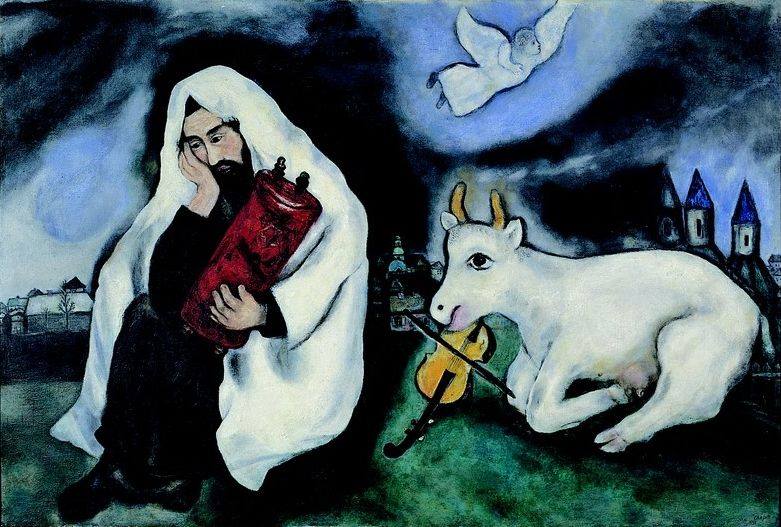
Yom Kippur begins tomorrow night at sundown. The Day of Atonement marks the culmination of ten days of awe and repentance. Observed with fasting and prayer, it is the holiest day on the Jewish calendar.
This week on “The Lost Chord,” we offer best wishes for a happy, healthy, and sweet new year with two complementary works inspired by the High Holidays.
Jacob Weinberg’s String Quartet, Op. 55, of 1950, falls into three movements: “Rosh Hashana” (the Jewish New Year), “Yom Kippur,” and “Sukkot.” “Yom Kippur” is based on the cantorial chant “Kol Nidre.” You know, the same melody employed by Max Bruch in his famous cello piece.
Ernest Bloch’s “Israel Symphony,” composed between 1912 and 1917, is more like an orchestral rhapsody in three sections – “Prayer in the Desert,” “Yom Kippur,” and “Succoth” [sic] – played continuously and culminating in parts for four vocal soloists.
Sukkot, which follows Yom Kippur by only five days, is the harvest festival, during which temporary dwellings (or sukkot) are erected to commemorate the Jews’ 40 years wandering in the desert after the Exodus from Egypt. In modern times, these are decorated with fruits and vines. In contrast to the austerity and fasting of Yom Kippur, Sukkot is a celebration of life and abundance. But in ancient Israel, it was a solemn affair, with sacrifices offered at the temple.
Welcome the year 5787, with musical reflections of the High Holidays, and then some, on “Totally Awesome,” on “The Lost Chord,” now in syndication on KWAX Classical Oregon.
G’mar chatima tova.
———-
Clip and save the start times for all three of my recorded shows:
PICTURE PERFECT, the movie music show – Friday at 8:00 PM EDT/5:00 PM PDT
SWEETNESS AND LIGHT, the light music program – Saturday at 11:00 AM EDT/8:00 AM PDT
THE LOST CHORD, unusual and neglected rep – Saturday at 7:00 PM EDT/4:00 PM PDT
Stream them, wherever you are, at the link.
https://kwax.uoregon.edu/
Tag: Milken Archive
-
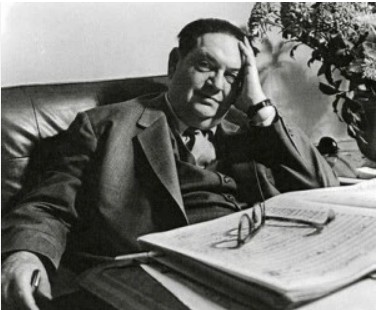
Shana Tova & Milhaud’s Jewish Music
Shana tova! Wishing a sweet 5786 to all who celebrate.
As a classical music radio host, I’ve had many opportunities to broadcast selections from a fascinating 50-CD box set assembled from the Milken Archive of American Jewish Music for Naxos Records. (I believe these were also issued separately.) I do not own the box, but over the years, I’ve managed to collect most of the individual discs for my own library. Of course, the set was not intended to be comprehensive – how could it be? – but Milken (founded in 1990) continues its mission to document, preserve, and disseminate a vast body of music related to the American Jewish experience – including, among others, historical and traditional music associated with synagogue and seder, songs of a more secular nature for the Yiddish theater, and classical concert music.
One Milken revelation was a string quartet by Darius Milhaud, best known in classical music circles as one of the group of iconoclastic French composers that gained notoriety in Paris in the 1920s as “Les Six.” This loose collective followed in the footsteps of Erik Satie in subverting the pretensions of the concert hall. Les Six pushed back against miasmic Wagnerism of the fin de siècle era, employing the lighter textures and lucid forms of neoclassicism, and often emulating the breezy, contemporary ambience of café, boulevard, and circus. In Milhaud’s case, he also really leaned into the popular music of Brazil, which he encountered while serving as secretary to ambassador Paul Claudel. Another enthusiasm was the music of his native Provence (hence, the “Suite provençale”).
Less well-known is his connection to his Jewish heritage. Milhaud was born into a long-established family of the Comtat Venaissin (County of Venaissin, an enclave surrounding the city of Avignon), with roots traceable to the Middle Ages. The Comtat’s Carpentras synagogue, built in the 14th century, is the oldest in France. Interestingly, Milhaud’s lineage on his father’s side was neither Ashkenazi nor Sephardi, but rather uniquely Provençal – possessing its own historical and cultural traditions – as the settlement dates to the early Common Era. Milhaud’s mother was partly Sephardi on HER father’s side, by way of an Italian forebear.
Milhaud wrote several works on Jewish themes. His “Études sur des themes liturgiques du Comtat Venaissin” (“Studies on Comtat Venaissin Liturgical Themes”) incorporates melodies from the region’s Rosh Hashanah and Yom Kippur observances. It was composed on a commission from the Braemer Foundation of Philadelphia. In light of his unusual heritage, Milhaud was asked to distill his memories of family celebrations and services at the synagogue in Aix-en-Provence into a string quartet. The work received its premiere at Congregation Adath Jeshurun in Elkins Park, just outside Philadelphia, in 1973. Milhaud died in 1974 at the age of 81.
Enjoy the music here:
Learn more about it:
More from the Milken Archive:
-
Ernst Toch’s Bitter Herbs: A Passover Gem
On a bad day, Ernst Toch’s music can be a bit like trying to chew through a dry brisket. But he wrote in a wide variety of styles, employing a broad range of musical expression, so if you search long enough, chances are that you’ll find the Toch for you.
Clearly he was “on” for the “Cantata of the Bitter Herbs,” a deeply personal piece, written in an accessible, even engaging idiom. While the primary inspiration is the Haggadah, the core of which is a telling of the Exodus story, read during the Seder on the first night of Passover, Toch strove for a more universal significance, no doubt influenced by the millions suffering from injustice and oppression under fascism in Europe.
The genesis of the work was in a chance meeting in 1937 between the composer and Rabbi Jacob Sonderling of Fairfax Temple, a Reform congregation in Los Angeles, who did much to enrich Jewish music by providing commissions for European exiles like Arnold Schoenberg, Erich Wolfgang Korngold, and Erich Zeisl. Sonderling contributed to the text of Toch’s cantata, which was first performed as part of a service at Fairfax Temple in 1941. The official concert premiere took place at Los Angeles City College.
Interesting that Dana Andrews was the speaker. In this recording, from the Milken Archive of American Jewish Music, the narration is spoken by Theodore Bikel. It’s a multi-movement work, so be sure to let it play through (skipping ads as necessary).
You can learn more about the piece here:
https://www.milkenarchive.org/music/volumes/view/odes-and-epics/work/cantata-of-the-bitter-herbs/
A three-minute documentary about the recording:
A great deal more about Toch:
His Pulitzer Prize winning Symphony No. 3, which I always thought could use a little more horseradish:
But Toch could have fun, too. He composed a “Pinocchio” overture, a fantasy on “Peter Pan,” and this – perhaps his most frequently encountered work – a “Geographical Fugue,” which prefigures minimalism.
Passover begins at sunset. Chag Sameach!
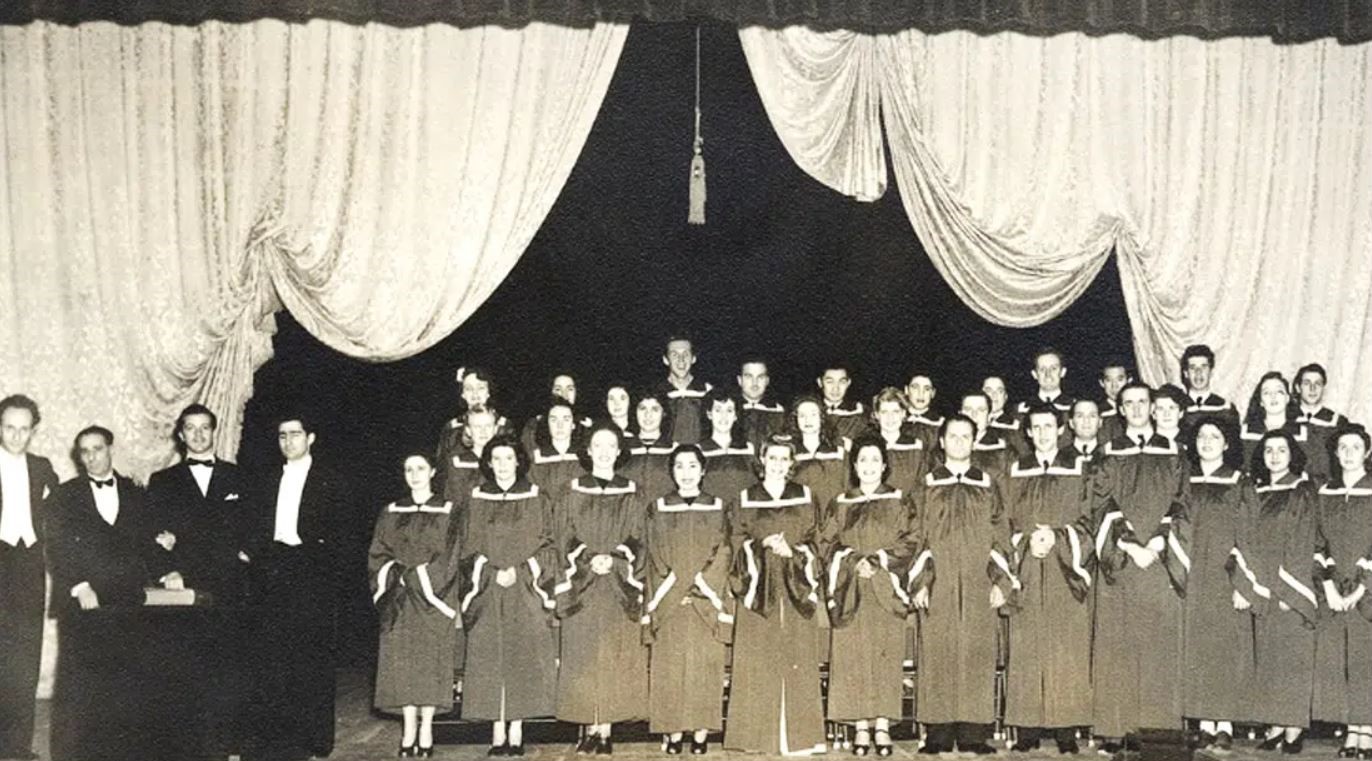
PHOTO: At the Los Angeles City College premiere of “Cantata of the Bitter Herbs,” with the composer and Dana Andrews, center left
-
Brubeck’s Bridge: Jazz, Faith, and Justice
We all recognize Dave Brubeck as one of the titans of jazz. What is perhaps not so widely known is that Brubeck (like Burt Bacharach and the Grateful Dead’s Phil Lesh) was a pupil of Darius Milhaud. He also took a few private lessons with Arnold Schoenberg, though ultimately they didn’t see eye to eye.
When Brubeck disbanded his famous Quartet at the end of 1967, it allowed him more time to focus on extended orchestral and choral works. In 1968, he composed an oratorio, “Light in the Wilderness.” The next year, he wrote “The Gates of Justice,” a cantata on Biblical and Hebrew liturgical texts and excerpts from the speeches of Martin Luther King, Jr. African-American spirituals also provided inspiration, as did the words of the Jewish sage Hillel. Brubeck’s wife, Iola, supplied additional lyrics.
Brubeck was distressed in the late 1960s by what he saw as strained relations between blacks and Jews, after all that had been accomplished by the Civil Rights Movement. Following the assassination of Martin Luther King, there was much anger, fear and distrust. In general, it was a turbulent time, with the war in Vietnam and riots on university campuses lending fuel to political, generational and racial tensions in American society.
Brubeck described “The Gates of Justice” as humanistic and universal, his plea for tolerance and understanding. Brubeck himself was not Jewish, but rather a devout Catholic, from 1980 onward. However, it was his experiences in the Second World War that really triggered a spiritual awakening. He believed profoundly in the brotherhood of man, and set himself the mission of building a musical bridge between what he saw as parallel cultures.
This Sunday night on “The Lost Chord,” we’ll hear a recording of “Gates of Justice,” from the Milken Archive of American Jewish Music, on the Naxos label. Brubeck himself appears as pianist, in improvisatory passages with the rhythm section of his quartet.
There are obvious Hebraic flourishes all over the piece, including several shofar blasts at the work’s opening. It was Brubeck’s desire that, whenever possible, the tenor should be sung by a cantor, and the baritone by a black singer steeped in the tradition of spirituals and blues. The Milken recording features Cantor Alberto Mizrahi and baritone Kevin Deas.
I hope you’ll join me for “Just Brubeck” – Dave Brubeck’s “The Gates of Justice” – this Sunday night at 10:00 EST, on WWFM The Classical Network and wwfm.org.
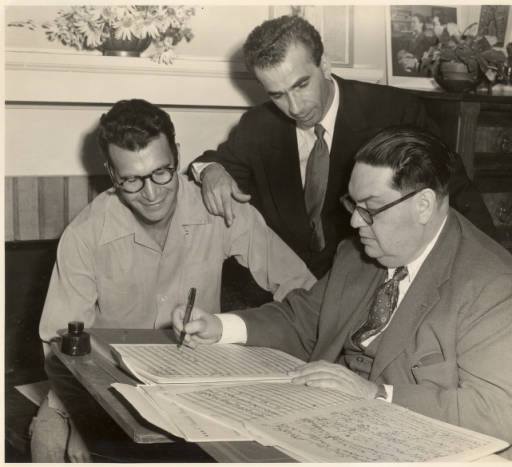
PHOTO (left to right): Dave Brubeck, Michael Random, and Darius Milhaud
-

Herman Berlinski a Composer’s Life
Today is the anniversary of the birth of Antonio Salieri (born in 1750), but since he’s used to being dissed anyway, I’ll write about Herman Berlinski.
Berlinski was born on this date in 1910, in Leipzig, the son of Polish Jews who had fled political instability, with growing discontent in Poland against Russian rule. His family retained its Polish nationality for fear of being declared stateless by the Germans, who were not generous with granting citizenship to outsiders. This at least allowed them to retain the rights of foreigners legally resident in the country.
Berlinski, the youngest of six children, was brought up in an Orthodox household. His father was a haberdasher, and the family spoke Yiddish. The boy showed an early aptitude for the piano and later the clarinet. A series of private teachers (beginning with his mother) led to his acceptance into the Leipzig Conservatory.
Berlinski would attend Friday evening concerts at the Thomaskirche, where Johann Sebastian Bach had acted as cantor and given the premiere of so many of his sacred works two centuries earlier. Overhearing Berlinksi rehearse the “Goldberg Variations,” the current cantor, Karl Straube, offered to give him organ lessons at the Institut der Evangelisch-Lutherischen Landeskirche Sachsen, but since Berlinski wasn’t Christian he was denied entrance to the program.
In 1933, the Nazis took control of Germany, and Berlinski decided to get out while the getting was good. First, he returned to Poland, but since he didn’t speak Polish, he felt himself at a disadvantage and the Jewish community in which he had settled was mired in misery. So he took off for Paris, where he studied with Nadia Boulanger and Alfred Cortot.
Ultimately, he became dissatisfied with Boulanger’s musical approach. He was much happier studying Jewish liturgical music at the Schola Cantorum. Through studies with Jean-Yves Daniel-Lesur, founder of the group La Jeune France, he met Olivier Messiaen, who encouraged him to explore his Jewish heritage in music, much the way he himself had decided to embrace Catholicism.
He became an important part of the city’s Yiddish theater community until the outbreak of World War II in 1939, when he enlisted in the Foreign Legion. He survived fighting at the Maginot Line, but when France fell to the Germans, he was declared undesirable and denied the right to work. Fortunately, he was able to get a visa, and he arrived in New York in 1941. There, he reunited with his father and other members of his family who were living in New Jersey.
Musically, an influential meeting with Moshe Rudinow, cantor of Temple Emanu-El, one of New York’s leading Reform synagogues, led to an invitation in 1944 to join the Jewish Music Forum, a body set up to promote all aspects of Jewish music, including the performance of new works. This brought him into contact with many key musicians, composers and musicologists.
In the meantime, he met up with Messiaen again at Tanglewood and continued his studies in composition with him. In 1954, he was hired as an organist at Emanu-El, where he composed much music for his instrument and chorus. He undertook post-graduate studies at the Jewish Theological Seminary of America. He also studied privately with Hugo Weisgall. Despite suffering a heart attack, Berlinski was able to complete his doctorate in 1960, becoming the first person ever to earn the highest degree in sacred music from the JTSA.
In 1963, Berlinski’s career brought him to Washington, DC, where he served as music director of the Reform Hebrew Congregation. This was a fertile period for the composer. He wrote much sacred music, including large scale vocal works and pieces for organ and voice or organ and other instruments. His abilities as an organist brought him back to Europe for recitals at Leipzig’s Thomaskirche and Notre Dame in Paris.
He retired from the Congregation in 1977, founding the Shir Chadash Chorale, which performed annually at the Kennedy Center and Washington Cathedral.
Berlinski died in 2001, at the age of 91. He lived long enough to work with the Milken Archive to have some of his works documented and released as part of the Milken Archive of American Jewish Music series, issued on the Naxos label. His music has broader appeal than its ties to the synagogue or the specificity of his Jewish heritage would suggest.
Here’s Berlinski at the recording sessions for “Avodat Shabbat,” with Gerard Schwarz conducting.
https://www.youtube.com/watch?v=m2kQVp61CHQ
Also, Berlinski’s “Symphonic Visions”:
Mov’t I: https://www.youtube.com/watch?v=PvNfrF6DqGw
Mov’t II: https://www.youtube.com/watch?v=u6d3HIYu8S0
Mov’t III: https://www.youtube.com/watch?v=inw6pmQ5KrEHappy birthday, Herman Berlinski!
Tag Cloud
Aaron Copland (94) Beethoven (95) Composer (114) Film Music (149) Film Score (143) Film Scores (255) Halloween (97) John Williams (197) KWAX (232) Leonard Bernstein (105) Marlboro Music Festival (125) Movie Music (164) Mozart (91) Opera (215) Philadelphia Orchestra (90) Picture Perfect (174) Princeton Symphony Orchestra (110) Radio (90) Ross Amico (244) Roy's Tie-Dye Sci-Fi Corner (290) The Classical Network (101) The Lost Chord (269) Vaughan Williams (107) WPRB (397) WWFM (881)