Tag: Modern Times

  • Labor Day Movie Music Working Stiff Cinema

    Labor Day Movie Music Working Stiff Cinema

    Heigh-ho! This week on “Picture Perfect,” we celebrate Labor Day with music from movies about the working stiff.

    “The Molly Maguires” (1970), set in and around the anthracite mines of Pennsylvania, illustrates the unfair labor practices imposed on immigrant workers there, which triggered violent strikes and acts of sabotage. Sean Connery is the ringleader and Richard Harris the Pinkerton detective brought in to infiltrate the gang.

    The film was directed by Martin Ritt, a number of whose projects deal with labor, corruption, and intimidation, and his own experiences living through the era of the Hollywood blacklist – among these, “Edge of the City,” “The Front,” and “Norma Rae.”

    The music is by Henry Mancini, a far cry from his work on “The Pink Panther,” “Peter Gunn,” and “Breakfast at Tiffany’s,” with a decidedly Celtic lilt.

    Charlie Chaplin was a brilliant comedian, of course, but his perfectionism often resulted in uncomfortably close supervision over every aspect of his films. The young David Raksin found this out the hard way, when he accepted the job of assisting Chaplin in the writing of the score to “Modern Times” (1936).

    Chaplin, a violinist and cellist himself, would whistle tunes and then stand over Raksin’s shoulder as he figured out how to make them fit the action. Alfred Newman, a much more seasoned hand, resented the micromanagement and stormed out of the film’s recording sessions. Raksin was actually fired once, after only a week and a half, but he was quickly rehired. Despite the creative friction, Chaplin and Raksin became friends, and Raksin recollected his work on “Modern Times” as some of the happiest days of his life.

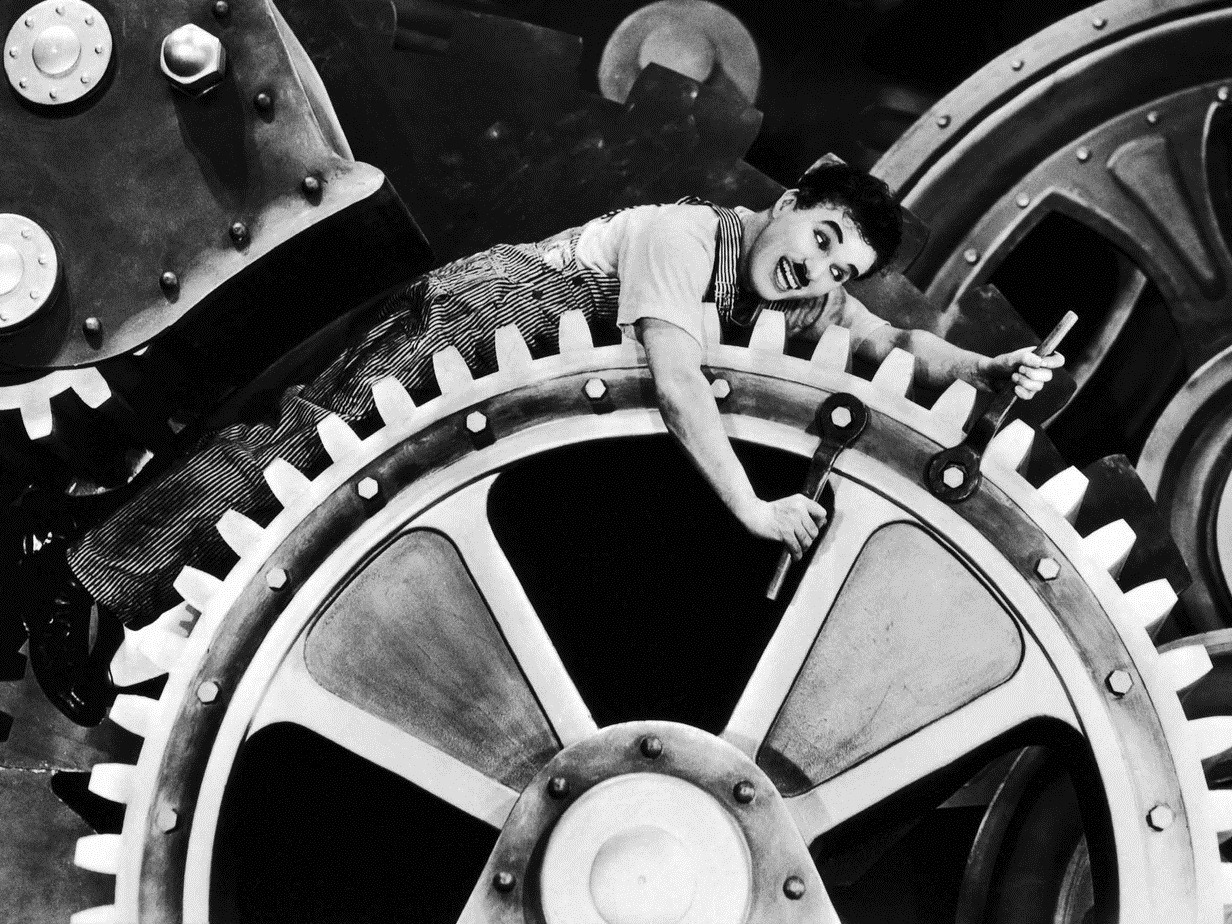
    The film begins with an iconic factory scene, Chaplin working an assembly line at an increasingly hectic pace, literally being put through the gears of the machinery. He suffers a breakdown, goes berserk, and throws the entire mechanized dystopia into chaos.

    Speaking of dystopias, few can match the OSHA-flouting nightmare of Fritz Lang’s “Metropolis” (1927). One of the landmarks of silent cinema, “Metropolis,” unfortunately, is eerily prescient of a world divided between the haves and the have-nots. Once seen, the subterranean hell of the workers’ hive is not soon to be forgotten.

    Lang’s vision continues to resonate in more ways than one, with its iconography shamelessly recycled by dewy-eyed fans and film students down the generations. Similarly, Gottfried Huppertz’s influential, Straussian score led the way for the opulent symphonic canvases of Max Steiner, Erich Wolfgang Korngold, and John Williams.

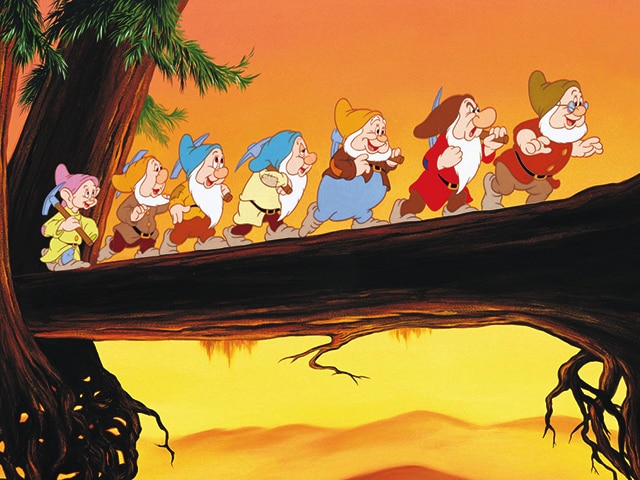
    Finally, we’ll accept a helping hand – as well as claw, tail, beak, and tongue – from the benevolent woodland creatures of “Snow White and the Seven Dwarfs” (1937). Frank Churchill and Larry Morey’s songs are justifiably immortal.

    The “picks” are all “mine” for Labor Day. Whistle while you weekend, on “Picture Perfect,” music for the movies, now in syndication on KWAX, the radio station of the University of Oregon!


    Clip and save the start times for all three of my recorded shows:

    PICTURE PERFECT, the movie music show – Friday at 8:00 PM EDT/5:00 PM PDT

    SWEETNESS AND LIGHT, the light music program – ALL NEW! – Saturday at 11:00 AM EDT/8:00 AM PDT

    THE LOST CHORD, unusual and neglected rep – Saturday at 7:00 PM EDT/4:00 PM PDT

    Stream them, wherever you are, at the link!

    https://kwax.uoregon.edu/

  • David Raksin Hollywood’s Golden Age Composer

    David Raksin Hollywood’s Golden Age Composer

    Thanks to his unusual longevity and abundant wit, film composer David Raksin was, for years, the mouthpiece of a faded era, the man to whom historians and journalists would turn when seeking a well-turned quote or anecdote about his long-past contemporaries of the Golden Age of Hollywood.

    Raksin was born in Philadelphia on this date in 1912. This week on “Picture Perfect,” we’ll celebrate the occasion by revisiting some of his music written for the silver screen.

    Raksin received his early musical training from his father, who played in concert bands and theater orchestras, and was also a member of the Philadelphia Orchestra. The younger Raksin formed his own dance band, taught himself orchestration, and put himself through the University of Pennsylvania by playing gigs. After graduation, he went to New York, where he played and sang with a number of ensembles and worked as an arranger.

    It was pianist Oscar Levant who brought him to the attention of his friend, George Gershwin. Gershwin was so impressed with Raksin’s arrangement of “I Got Rhythm,” that it wasn’t long before the boy from Philadelphia was orchestrating for musical theater and receiving invitations to Hollywood.

    While Raksin would go on to compose all sorts of music, for the stage and concert hall, he is best recognized as a composer for film. He wrote over 100 film scores in all, and 300 scores for television. He was twice nominated for an Academy Award – for “Forever Amber,” in 1947, and “Separate Tables” in 1958.

    Raksin’s haunting theme for the noir classic “Laura” (1944), after lyrics were added by Johnny Mercer, became a sensation. It’s said that during the composer’s lifetime it was the second most-recorded song in history, behind only Hoagy Carmichael’s “Stardust.”

    Raksin’s first Hollywood job, believe it or not, was working for Charlie Chaplin. Chaplin hired Raksin to assist him on the score for his last silent film, and one of the most famous, “Modern Times” (1936). “Modern Times” had actually been conceived as a sound picture (it would have been Chaplin’s first), but he soon realized that his “Little Tramp” would lose his universal appeal, should the character be allowed to talk. So he reverted to his usual silent format, though punctuated by evocative sound effects and one notable gibberish song.

    Chaplin exercised close control over every aspect of his productions, right down to more-or-less composing the music. He had experience as a violinist and cellist, who had practiced sometimes four to six hours a day. He had good musical instincts and a certain melodic fecundity, which, with the help of his orchestrators, he would use to underscore his feature films.

    Raksin later revealed it was he who had essentially scored “Modern Times,” with Chaplin whistling tunes and asking him to make them fit the action.

    Such close and exacting supervision could be a challenge for Chaplin’s collaborators. Raksin was actually fired once, after only a week and a half, though quickly rehired. When the music director, Alfred Newman, stormed out of one of the recording sessions, Raksin refused to take up the baton in his stead, which led to further acrimony. The rift was eventually mended, and decades later Raksin would recollect his work on “Modern Times” as some of the happiest days of his life.

    The recording we’ll hear was conducted by none other than Carl Davis, who on occasion served a similar function, as when he collaborated with Paul McCartney on his “Liverpool Oratorio.” Davis, a prolific film composer himself, died yesterday at the age of 86.

    As was the case with “Laura,” the love theme from “Modern Times” was later outfitted with lyrics, and became a popular standard as “Smile,” attracting countless vocal artists, including Nat King Cole. Again, what cohesion there is to the film score is largely thanks to Raksin.

    Although Raksin had taught himself a great deal, he did receive instruction from Harl McDonald at the University of Pennsylvania, Isadore Freed in New York, and later Arnold Schoenberg in Los Angeles.

    At times he found himself frustrated when dealing with the musical ignorance of Hollywood producers. He was fond of relating a story about having finally found one that was musically literate. The producer claimed he didn’t want anything “Hollywood” for his film, but rather “something different, really powerful – like ‘Wozzeck.’”

    Raksin, elated, invited the producer to dinner at his home. As the two were conversing over drinks, the producer remarked suddenly, “What’s that crap you’re playing?” “That crap,” Raksin responded, “is ‘Wozzeck.’”

    For “The Man with a Cloak” (1951), a story influenced by elements drawn from the life and stories of Edgar Allan Poe, Raksin slyly worked twelve-tone elements into his score – one of the first instances of a composer having done so for a Hollywood film. A few years later, Leonard Rosenman would take modernistic techniques to a whole other level. Raksin employs the language of the Second Viennese School in scenes featuring the Poe character, who in the film goes by the name of his fictional creation, Dupin. The character is given a leitmotif consisting of a tone row made up of the notes E-D-G-A and D-flat (which could be read as “Re”), effectively revealing the identity of Dupin as Edgar, right in the music. For all that, the score retains its accessibility and manages to wed the language of Schoenberg to the necessities of Hollywood storytelling.

    The film, based on a novel of John Dickson Carr, had quite a cast: Joseph Cotten, Barbara Stanwyck, Louis Calhern, Leslie Caron, and even Jim Backus.

    We’ll conclude the hour with one of Raksin’s greatest scores, that for “The Bad and the Beautiful” (1952), Vincent Minelli’s extraordinarily cynical view of Hollywood. Kirk Douglas plays a character Raksin must have known well: a ruthless producer who uses and abuses everyone around him. The film, which also stars Lana Turner, Walter Pigeon, and Dick Powell, won a whole slew of Oscars, including one for Gloria Graham as Best Supporting Actress.

    Raksin died in 2004, at the age of 92. His music was beautiful, but never bad. I hope you’ll take an hour to sample some of it with me on Raksin’s birthday, on “Picture Perfect,” music for the movies, now in syndication on KWAX, the radio station of the University of Oregon!


    Keep in mind, KWAX is on the West Coast, so there’s a three-hour difference for the Trenton-Princeton area. Here are the respective air-times of my recorded shows (with East Coast conversions in parentheses):

    PICTURE PERFECT, the movie music show – Friday on KWAX at 5:00 PACIFIC TIME (8:00 PM EDT)

    THE LOST CHORD, unusual and neglected rep – Saturday on KWAX at 4:00 PACIFIC TIME (7:00 PM EDT)

    Stream them here!

    https://kwax.uoregon.edu/
  • Chaplin’s Musical Genius Revealed

    Chaplin’s Musical Genius Revealed

    I missed Charlie Chaplin’s birthday by ten days, but I only just stumbled across this footage of Chaplin conducting (at the link below).

    While Chaplin was musically illiterate (by which I mean, he couldn’t read sheet music), he taught himself to play piano, violin and cello as a child, which served him well in his early days in the music hall. Later, he composed, or rather worked very closely with trained musicians, to produce the original scores for all of his features and some of his shorter films.

    David Raksin, best remembered for his score to “Laura” (1944), assisted Chaplin on the silent classic “Modern Times” (1936). Raksin later revealed that it was he who had essentially scored the film, with Chaplin whistling all the tunes and asking him to make them fit the action.

    However, he stressed the process was more complicated than it might at first seem. Chaplin was very much involved with every aspect of his films, and oversaw the development of the music as closely as he did any of the other elements. As a result, such a collaboration could take months, and there wasn’t a note in his scores that he didn’t approve.

    Emotions could run high. Raksin recalled he was actually fired once, after only a week and a half, though quickly rehired. When music director Alfred Newman stormed out of one of the recording sessions, Raksin again defied Chaplin, refusing to take up the baton, which only led to further acrimony. The rift was eventually mended and decades later Raksin recollected his work on “Modern Times” as some of the happiest days of his life.

    Chaplin’s scores yielded three popular hits: “Smile” from “Modern Times,” a hit for Nat King Cole in 1954; “Terry’s Theme” from “Limelight,” popularized by Jimmy Young as “Eternally” in 1952; and “This Is My Song” from “A Countess in Hong Kong,” recorded by Petula Clark in 1967.

    Through a fluke – the belated release of “Limelight” in the United States, on a single screen in Los Angeles, twenty years after it was filmed, coinciding with the disqualification of music from “The Godfather,” after it was learned that Nino Rota had recycled a theme from one of his earlier scores (for the Italian film “Fortunella” in 1958) – Chaplin walked away with his only competitive Oscar, as a composer (!), one month before his 84th birthday.

    Previously, he received two honorary Academy Awards, in 1929 and 1972.

  • Modern Times Smile Still Resonates Today

    Modern Times Smile Still Resonates Today

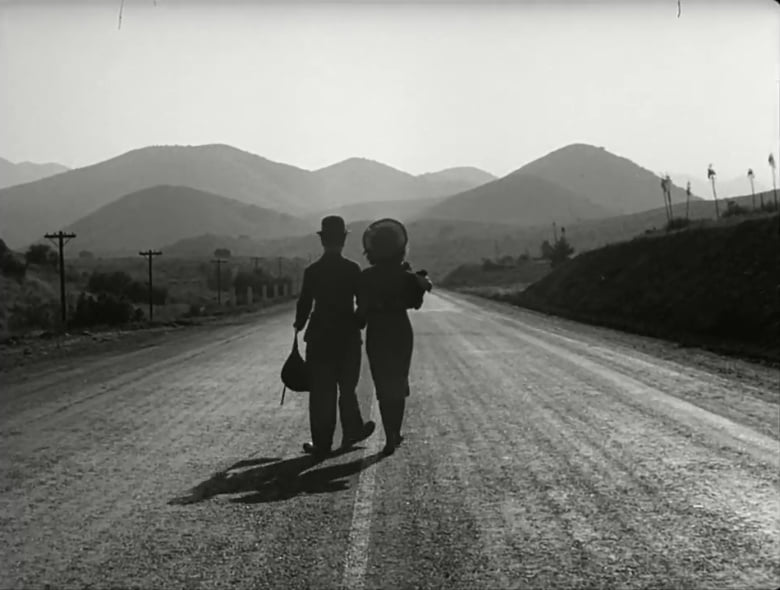
    Charlie Chaplin’s “Modern Times” opened 85 years ago today. The romantic theme, “Smile,” is Chaplin’s own and went on to be become a popular standard, memorably recorded by Nat King Cole and others. 1936 was already well into the era of “talking pictures,” and this was to be Chaplin’s swan song as the Little Tramp. The concluding image of Chaplin and Paulette Goddard walking down a road, hand-in-hand, is one of the most iconic in cinematic history. Its message of hope in uncertain times springs from the struggles of the Depression. It’s a lesson that’s still relevant today.

  • Labor Day Movie Music on Picture Perfect

    Labor Day Movie Music on Picture Perfect

    It’s nice to be able to look forward to a three-day weekend, when nobody expects you to get your butt in gear. Unless you’re Charlie Chaplin, that is.

    This week on “Picture Perfect,” we’ll have music from films about the working stiff, for Labor Day.

    “The Molly Maguires” (1970), set in and around the anthracite mines of Pennsylvania, illustrates the unfair labor practices imposed on immigrant workers there, which led to violent strikes and acts of sabotage. Sean Connery is the ringleader and Richard Harris the Pinkerton detective brought on to infiltrate the gang.

    The film was directed by Martin Ritt, a number of whose projects deal with labor, intimidation, and corruption, and his own experiences living through the era of the Hollywood blacklist – among these, “Edge of the City,” “The Front,” and “Norma Rae.”

    The music is by Henry Mancini, a far cry from his work on “The Pink Panther,” “Peter Gunn,” and “Breakfast at Tiffany’s,” with a decidedly Celtic lilt.

    Charlie Chaplin was a brilliant comedian, of course, but his perfectionism could manifest itself in uncomfortably close supervision over every aspect of his films. The young David Raksin found this out the hard way, when he accepted the job of assisting Chaplin in the writing of the score to “Modern Times” (1936).

    Chaplin, a violinist and cellist himself, would whistle tunes and then stand over Raksin’s shoulder as he figured out how to make them fit the action. Alfred Newman, a much more seasoned hand, stormed out of the recording sessions. Raksin was actually fired once, after only a week and a half, though he was quickly rehired. Despite the creative friction, the two men became friends, and Raksin recollected his work on “Modern Times” as some of the happiest days of his life.

    The film begins with an iconic factory scene, with Chaplin working an assembly line at an increasingly hectic pace, finally being put through the gears of the machinery. He suffers a breakdown, goes berserk, and throws the entire mechanized dystopia into chaos.

    Speaking of dystopias, few can match the OSHA-flouting nightmare of Fritz Lang’s “Metropolis” (1927). One of the landmarks of silent cinema, “Metropolis,” unfortunately, is eerily prescient of a world divided between the haves and the have-nots. Once seen, the subterranean hell of the workers’ hive is not soon to be forgotten.

    Lang’s vision continues to resonate in more ways than one, with its iconography shamelessly recycled by dew-eyed fans and film students down the generations. Similarly, Gottfried Huppertz’s influential, Straussian score led the way for the opulent symphonic canvases of Max Steiner, Erich Wolfgang Korngold, and John Williams.

    Finally, we’ll accept a helping hand – as well as claw, tail, beak, and tongue – from the benevolent woodland creatures of “Snow White and the Seven Dwarfs” (1937). Frank Churchill and Larry Morey’s songs are justifiably immortal.

    Whistle while you work, even as you look forward to a long weekend, on “Picture Perfect” – music for the movies – this Friday evening at 6:00 EDT, on WWFM – The Classical Network and wwfm.org.

Tag Cloud

Aaron Copland (92) Beethoven (95) Composer (114) Film Music (123) Film Score (143) Film Scores (255) Halloween (94) John Williams (187) KWAX (229) Leonard Bernstein (101) Marlboro Music Festival (125) Movie Music (138) Opera (202) Philadelphia Orchestra (89) Picture Perfect (174) Princeton Symphony Orchestra (106) Radio (87) Ralph Vaughan Williams (85) Ross Amico (244) Roy's Tie-Dye Sci-Fi Corner (290) The Classical Network (101) The Lost Chord (268) Vaughan Williams (103) WPRB (396) WWFM (881)

DON’T MISS A BEAT

Receive a weekly digest every Sunday at noon by signing up here


RECENT POSTS