Tag: Morton Gould

  • Paul Freeman A Musical Celebration

    Paul Freeman A Musical Celebration

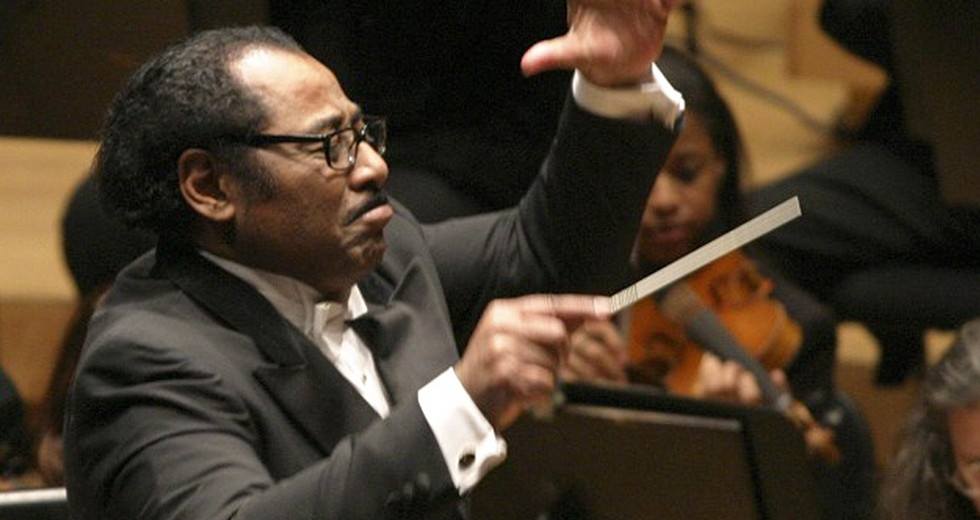
    Paul Freeman has always been a conductor after my own heart. A champion of unusual and neglected repertoire, Freeman recorded prolifically – some 200 albums. I won’t get into whether or not the color of his skin had a negative impact on his career. Freeman was a positive force who always found a way.

    He held posts with the Dallas Symphony Orchestra, the Detroit Symphony, and the Helsinki Philharmonic. He was music director of the Chicago Sinfonietta, the Czech National Symphony Orchestra, and the Victoria Symphony in British Columbia.

    Freeman retired from conducting in 2011. He died on July 21, at the age of 79. We celebrate his artistry and love of music this week on “The Lost Chord,” by way of his extensive and varied discography.

    From his series, “Paul Freeman Introduces,” on the Albany label, we’ll hear music by Richard Yardumian, former composer-in-residence with the Philadelphia Orchestra . “Veni, Sancte Spiritus” was one of a number of Yardumian works to be documented by Ormandy and the Philadelphians during the LP era. Atonishingly, none of them ever made it to compact disc. Leave it to Freeman to fill in the gap.

    Adophus Hailstork, one of the artists Freeman favored as part of his landmark “Black Composers Series,” set down for Columbia Records back in the 1970s, will also be represented. His “Sonata da Chiesa” for string orchestra grew out of Hailstork’s love for cathedrals.

    Freeman was always an enthusiastic champion of new music and works by African-American composers. He was also a sensitive and sympathetic accompanist, as borne out by his many concerto recordings. Of those, we’ll hear what is probably the strangest of them all – Morton Gould’s “Tap Dance Concerto.”

    Finally, we’ll have selections from the “African Suite,” by Nigerian composer Fela Sowande, a work Freeman recorded twice, for Columbia in the 1970s, and decades later for Cedille Records, as part of the three-volume “African Heritage Symphonic Series.”

    It’s a nice assortment, though of course it only scratches the surface. It is with mixed emotions that I bid “Farewell to Freeman,” tonight at 10 ET, with a repeat Wednesday evening at 6. You can also listen to it later as a webcast, at wwfm.org.

  • Memorial Day Military Symphonies on The Lost Chord

    Memorial Day Military Symphonies on The Lost Chord

    This Sunday night on “The Lost Chord,” in anticipation of Memorial Day, we’ll have two symphonies composed for the armed forces.

    Morton Gould wrote his Symphony No. 4 for the United States Military Academy at West Point. It was his first large scale piece for symphonic band. The score calls for a “marching machine,” but the recording we’ll hear, issued on the Mercury label, employs the feet of 120 musicians of the Eastman School Symphony Band. Frederick Fennell directs the Eastman Wind Ensemble.

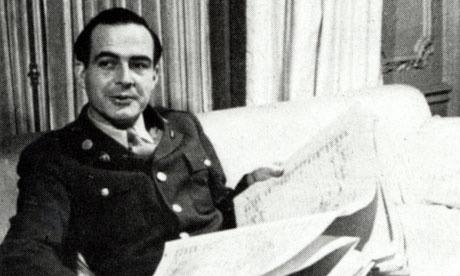
    Samuel Barber composed his Symphony No. 2 in 1943, while he was serving in the U.S. Army Air Force. 20 years later, he revised and published the slow movement as a separate opus, titled “Night Flight,” and then jettisoned – and actually tried to destroy – the rest. The work was reconstituted after the composer’s death, and is now back in circulation. We’ll hear a recording with Marin Alsop and the Royal Scottish National Orchestra.

    I hope you’ll join me for “Orchestrated Maneuvers” – American military symphonies for Memorial Day – tonight at 10 ET, with a repeat Wednesday evening at 6; or that you’ll listen to it later as a webcast, at http://www.wwfm.org.

    PHOTO: Corporal Samuel Barber with the score of his Second Symphony

  • Godzilla Vegetarian? Morton Gould’s Dinosaur Music

    Godzilla Vegetarian? Morton Gould’s Dinosaur Music

    You mean to tell me Godzilla was a vegetarian?

    http://news.yahoo.com/blogs/sideshow/-world-s-biggest-dinosaur–discovered-in-argentina-203028038.html

    Which reminds me, were there two Morton Goulds? Gould was awarded the Pulitzer Prize in 1995 for his virtuosic “StringMusic.” I can only assume the awards committee was ignorant of the fact that, in 1993, he had composed a “hip-hop opera” titled “The Jogger and the Dinosaur.” Of course, Gould had never shied from incorporating popular music into his works, but it seems a bit of a stretch from rhumba to rap. Come to think of it, in 1956, he did compose the “Jekyll and Hyde Variations.” Sadly(?), there don’t appear to be any sound clips of “The Jogger and the Dinosaur” online.

    Instead, here’s “My Friend, the Brachiosaurus,” from John Williams’ score for “Jurassic Park.”

    https://www.youtube.com/watch?v=Nmx5TPoXPdI

Tag Cloud

Aaron Copland (92) Beethoven (95) Composer (114) Film Music (119) Film Score (143) Film Scores (255) Halloween (94) John Williams (185) KWAX (229) Leonard Bernstein (99) Marlboro Music Festival (125) Movie Music (134) Opera (198) Philadelphia Orchestra (87) Picture Perfect (174) Princeton Symphony Orchestra (106) Radio (87) Ralph Vaughan Williams (85) Ross Amico (244) Roy's Tie-Dye Sci-Fi Corner (290) The Classical Network (101) The Lost Chord (268) Vaughan Williams (102) WPRB (396) WWFM (881)

DON’T MISS A BEAT

Receive a weekly digest every Sunday at noon by signing up here


RECENT POSTS