Tag: Movie Scores

  • Thanksgiving Movie Music

    Thanksgiving Movie Music

    “Do any human beings ever realize life while they live it? Every, every minute?”

    This poignant observation, from Thornton Wilder’s “Our Town,” stands as a timely reminder that there are things we should all be thankful for, while they – and we – are here to appreciate them.

    This week on “Picture Perfect,” we’ll set the table for Thanksgiving.

    None other than Aaron Copland wrote the music for the big screen adaptation of Wilder’s Pulitzer Prize winning play. The composer was at the height of his “populist” period. “El Salon Mexico” and “Billy the Kid” had already been written, and “Fanfare for the Common Man,” “Lincoln Portrait,” “Rodeo” and “Appalachian Spring” would follow within just a few years. Clearly, there was no better choice in capturing the essence of small town America.

    The concert version of “Our Town” has been in circulation for decades, but it was only in 2011 that a complete recording of the score was made available, briefly, as a digital download.

    Gary Cooper and Dorothy McGuire star in “Friendly Persuasion” (1956), based on the novel by Jessamyn West. The film’s portrayal of family and the resolution of moral conflict, as pacifist Quakers deal with issues both big and small – from the American Civil War, to the introduction of a “sinful” musical instrument into the household – make “Friendly Persuasion,” in my opinion, a good choice for this time of year.

    The film was up for six Oscars, with Dimitri Tiomkin’s score nominated twice. The title song went on to become the popular hit “Thee I Love.” Only Dimitri Tiomkin would use balalaikas to depict Quaker life!

    “Witness” (1985) may seem like an unusual choice for Thanksgiving, with its themes of police corruption and violence, but when honest cop Harrison Ford goes on the lam, he experiences the “plain” lifestyle of a close-knit Amish community. The highlight of Maurice Jarre’s score is a sequence called “Building the Barn,” in which the community comes together to raise a barn for a newly married couple.

    Finally, we’ll hear selections from “Plymouth Adventure” (1952), with its depictions of William Bradford, John Alden, Miles Standish and Priscilla Mullins. Spencer Tracy stars as the cynical captain of The Mayflower, Gene Tierney is his forbidden love interest, Van Johnson appears as Alden, and Lloyd Bridges is the first mate.

    The music is by Miklós Rózsa, who already, at this stage of his career, was MGM’s go-to composer for historical drama. Seven years later, Rózsa would take home his third Academy Award for his classic score to “Ben-Hur.”

    It’s never too early to give thanks. There’s not a turkey among them, this Friday evening at 6:00 EST, on WWFM – The Classical Network and wwfm.org.


    Martha Scott and William Holden in “Our Town” (1940)

  • Elmer Bernstein a Hollywood Legend

    Elmer Bernstein a Hollywood Legend

    Over the course of an enviable career that spanned some 50 years, Elmer Bernstein composed music for dozens of movies, many of them still much-beloved, including “The Ten Commandments” (1956), “The Magnificent Seven” (1960), “To Kill a Mockingbird” (1962), and “The Great Escape” (1963).

    In addition, he was one of the first film composers to incorporate jazz elements into his work for dramatic purposes, in movies like “The Man with the Golden Arm” (1955), “Sweet Smell of Success” (1957), and “Walk on the Wild Side” (1962).

    Coming out of the Swinging Sixties, when the industry clearly favored a more “popular” sound over purely orchestral scores (until John Williams changed everything), Bernstein kept right on working. Thanks to a generation of younger filmmakers who had grown up on his classics, he never lacked for opportunities. Suddenly he found himself much in demand as a comedy composer, providing the underscores for “Animal House” (1978), “The Blues Brothers” (1980), “Airplane!” (1980), “Stripes” (1981), and “Ghostbusters” (1984).

    For Martin Scorsese, he composed music for “The Age of Innocence” (1993), “Bringing Out the Dead” (1999), and “The Gangs of New York” (2002), though his score for the latter was ultimately rejected. He also adapted Bernard Herrmann’s music for Scorsese’s remake of “Cape Fear” (1991).

    Oh yeah, along the way, he also composed the iconic National Geographic theme – clearly by the same man who wrote “The Magnificent Seven.”

    In all, Bernstein was nominated for 14 Academy Awards, but claimed the Oscar only once, fairly early on, for his work on “Thoroughly Modern Millie” (1967), of all things. His final nomination was for his very last score, for “Far from Heaven” (2002). Elmer Bernstein died on August 18, 2004 at the age of 82.

    No relation to Leonard Bernstein (or “Bern-STINE”), Elmer pronounced his name “Bern-STEEN.” The two were sometimes further differentiated as “East Coast Bernstein” and “West Coast Bernstein.”

    In the year 2000, Elmer Bernstein composed a guitar concerto and expressed regret that he hadn’t contributed more to the concert hall. At least it was good one. David Hurwitz of classicstoday.com describes it as “incontestably the finest piece ever composed for this combination” (i.e. guitar and orchestra), going so far as to hold it up to Joaquin Rodrigo’s “Concierto de Aranjuez.” I don’t know if I’d take it that far, but it is pretty damn good.

    https://www.youtube.com/watch?v=eOxXLDdWZF8&list=PLjRpv3cr2epHnVUvbZhp8v0de0pXaOjkY

    Happy birthday, Elmer Bernstein. You are very much missed!

  • John Williams Presidential Movie Scores

    John Williams Presidential Movie Scores

    Presidents Day is on the way.

    Over the course of his 60-year career, John Williams has had opportunities to score just about every kind of film. Not surprisingly, this would include several fictionalized accounts of American presidents. This week on “Picture Perfect,” we’ll sample music from four of them.

    “JFK” (1991) is one of three collaborations between Williams and director Oliver Stone. The film has more to do with conspiracy theories surrounding Kennedy’s assassination than anything to do with his presidency. A controversial feature, no doubt – still, a compelling piece of cinema. It certainly inspired an effective score.

    Kevin Costner plays New Orleans district attorney Jim Garrison, Sissy Spacek, his wife, and Gary Oldman, Lee Harvey Oswald. Tommy Lee Jones and Joe Pesci are unforgettable as a pair of outlandish conspirators, and Donald Sutherland is a government whistleblower who identifies himself only as “X.”

    Williams and Stone had previously worked together on “Born on the Fourth of July.” Later, they would team on a second presidential collaboration, a character study of Richard Milhous Nixon – called, well, “Nixon” (1995). Anthony Hopkins plays the president, heading an impressive cast, which includes Joan Allen, Powers Boothe, Ed Harris, Bob Hoskins, E.G. Marshall, David Hyde Pierce, Paul Sorvino, Mary Steenburgen, and James Woods.

    Williams also wrote the music for Steven Spielberg’s “Amistad” (1997). The film, about a mutiny on board a slave ship in 1839 and the resulting courtroom drama, features two American presidents: Nigel Hawthorne plays Martin van Buren, the sitting president; and again, Anthony Hopkins appears, in a memorable supporting turn, as aging former president John Quincy Adams. Adams argues the defense of the Africans who took part in the mutiny.

    Daniel Day-Lewis plays the nation’s 16th president, in Spielberg’s “Lincoln” (2012). He’s lent able support by Sally Field as Mary Todd Lincoln, David Strathairn as Secretary of State William Steward, and Tommy Lee Jones as Thaddeus Stevens.

    It’s a bold assessment, but Day-Lewis elevates “Lincoln,” the film, to greatness, with arguably one of the most amazing performances in cinematic history. Day-Lewis’ gentle but shrewd Man of Destiny would go to any lengths to hold the country together. Williams taps into America’s proud musical heritage, clearly influenced by Copland and the folksier side of Ives, to create a score of stirring nobility.

    I hope you’ll join me as John Williams does the presidents on “Picture Perfect,” music for the movies, this Friday evening at 6:00 EST, on WWFM – The Classical Network and wwfm.org.


    PHOTOS: (clockwise from left) Day-Lewis as Lincoln; Hopkins as Nixon; poster for “JFK;” Hopkins as John Quincy Adams

  • Steampunk Movie Scores on Picture Perfect

    Steampunk Movie Scores on Picture Perfect

    This week on “Picture Perfect,” things get pretty steamy, though not in the way you might think. We’ll have an hour of scores from films exemplifying the science fiction subgenre known as “steampunk.”

    Generally speaking, steampunk employs forward-looking technologies and gadgetry – in many cases literally powered by steam – in incongruous, quasi-Victorian settings.

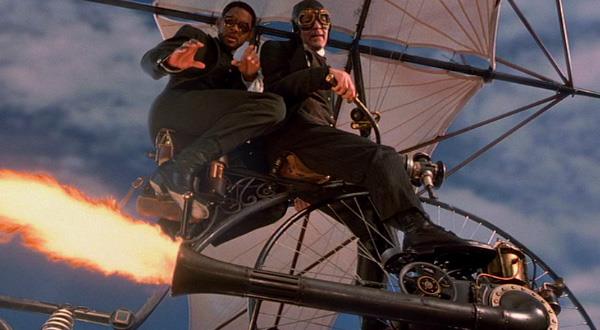
    We’ll hear selections from Martin Scorsese’s “Hugo” (2011), with its abundant gears, steam, and free-writing automaton, with music by Howard Shore; “The Golden Compass” (2007), with its carriages, old-fashioned air ships and vintage arctic gear, with music by Alexandre Desplat; “Wild Wild West” (1999), with its cowboys, proto-James Bond gadgetry and Gustave Eiffel-style iron spider, with music by Elmer Bernstein; and “Time After Time” (1979), with one of the genre’s spiritual fathers, H.G.Wells, as an actual character, who pursues Jack the Ripper to the present day via a time machine of his creation, with music by Miklós Rózsa.

    We’re powered by steampunk this week, on “Picture Perfect,” music for the movies, this Friday evening at 6:00 EST, on WWFM – The Classical Network and at wwfm.org.


    PHOTO: Battling a giant iron spider from a flying bicycle? It must be steampunk!

Tag Cloud

Aaron Copland (92) Beethoven (95) Composer (114) Film Music (120) Film Score (143) Film Scores (255) Halloween (94) John Williams (185) KWAX (229) Leonard Bernstein (100) Marlboro Music Festival (125) Movie Music (135) Opera (198) Philadelphia Orchestra (88) Picture Perfect (174) Princeton Symphony Orchestra (106) Radio (87) Ralph Vaughan Williams (85) Ross Amico (244) Roy's Tie-Dye Sci-Fi Corner (290) The Classical Network (101) The Lost Chord (268) Vaughan Williams (103) WPRB (396) WWFM (881)

DON’T MISS A BEAT

Receive a weekly digest every Sunday at noon by signing up here


RECENT POSTS