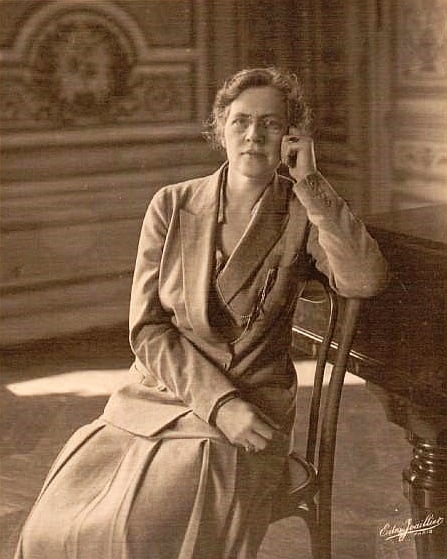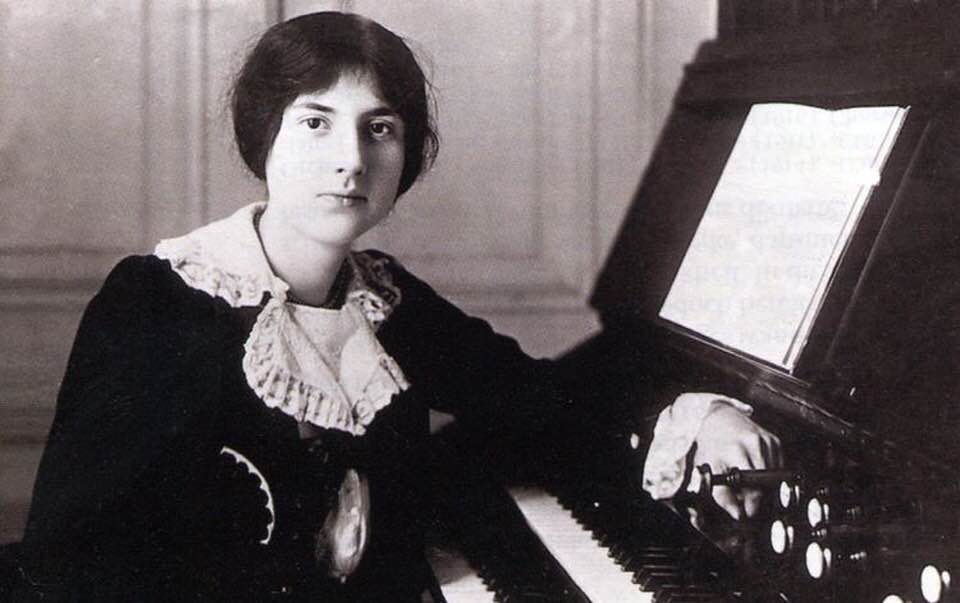
Lili Boulanger (1893-1918), the younger sister of the renowned pedagogue Nadia – who taught Aaron Copland, Elliot Carter, Astor Piazzolla, Philip Glass, Michel Legrand, Quincy Jones, and just about everyone else – was one of the great hopes of French music, the first woman to win the Prix de Rome composition prize. She won the prize in 1913, at the age of 19, for her cantata “Faust et Hélène.” It was actually Lili’s second attempt. The year before, she collapsed during her performance.
Lili suffered from chronic ill health, having contracted bronchial pneumonia at the age of 2. Her compromised immune system left her vulnerable to Crohn’s disease, which ended her life in 1918 at the age of 24. (Nadia’s life was as long as her sister’s was brief. She died in 1979 at the age of 92.)
Nadia too had had ambitions to compose. She herself attempted to attain the Prix de Rome (as their father had done in 1835), but was repeatedly frustrated. She got as far as second place in 1908. It became evident that her sister was the real deal in that regard, so Nadia pursued organ and, of course, pedagogy.
Both sisters were greatly influenced by Gabriel Fauré, who was director of the Paris Conservatory – Lili, a musical prodigy, had been accompanying her sister to the conservatory from before the age of 5 – and of course Debussy’s impact in those days was inescapable. Like Debussy, Lili gravitated toward a kind of indirection in her music, more characteristic of Symbolism than the evocative sorts of atmospheres often attempted by the Impressionists (a classification, by the way, Debussy disliked).
Lili was greatly affected by the death of her father in 1900, and many of her works are marked by grief and loss. Ernest fathered his children quite late in life. He was 72 when Nadia was born, and 77 at the time of Lili’s birth. The girls’ mother was 41 years his junior. Despite the inherent melancholy that pervades much of her music, Lili displayed a colorful mastery of harmony and orchestration.
Often she was perceived as destined for greatness. Her music has actually been programmed fairly frequently for a woman composer of her era. But now with greater sensitivity to male dominance in the world’s concert halls, we are starting to hear even more Lili Boulanger. It’s just a pity she didn’t leave us more.
Happy birthday, Lili Boulanger.
Deux morceaux for violin and piano: Nocturne and Cortège
“Faust et Hélène”
“D’un soir triste” (“Of a Sad Evening”)
“D’un matin de printemps” (“Of a Spring Morning”)
“Vieille prière bouddhique” (“Old Buddhist Prayer”)