Tag: Nazi Germany

  • Furtwängler Nazi Germany’s Conducting Enigma

    Furtwängler Nazi Germany’s Conducting Enigma

    I’m sure we’ve all wondered what we’d do if we found ourselves living under a totalitarian regime. Would we speak out against injustice and atrocity, even if it meant arrest or execution? Would we flee, even if it meant never seeing our homes or loved ones again? Or would we keep our heads down, hoping not to be denounced, and pray for better days?

    I don’t think any of us who haven’t actually lived through it can understand the fear, the courage, and the sacrifices that were experienced every day by those who remained in Hitler’s Germany. So try not to be too hard on Wilhelm Furtwängler, indisputably one of the greatest conducting talents of the 20th century.

    Furtwängler, who succeeded Arthur Nikisch and Richard Strauss as director of Germany’s finest orchestras – including, most notably, the Berlin Philharmonic, from 1922 to 1945 and again from 1952 to 1954 – remained in Germany throughout the National Socialist regime.

    Widely perceived as politically naïve, Furtwängler engaged in a dangerous game with the Third Reich, arguing vociferously in favor of Jewish musicians within his orchestra, those who could be considered his rivals (Bruno Walter, Otto Klemperer), and even those who were long dead (Joseph Joachim, Felix Mendelssohn). He went so far as to threaten to tender his resignation should the Nazis insist on the removal of Jews from the cultural sphere. Goebbels complained, “Can you name me a Jew on whose behalf Furtwängler has not intervened?”

    Either he possessed an accurate grasp of his own worth to German culture, or he didn’t realize how close he trod to the flame. Himmler wanted to send him to a concentration camp. Goebbels and Göring were in favor of concessions. Encouraged, the conductor felt himself to be a force for positive change. But of course, he was just being played. The Nazi racial policies remained in place and the situation only grew worse.

    What Furtwängler didn’t seem to realize was that he was being used as a propaganda tool, held up to the world as a paragon of Teutonic superiority. Wishing to appease one of the country’s most visible artists, the authorities allowed Jews to remain in the Berlin Philharmonic, though privately they grumbled about Furtwängler lacking “national sentiment.”

    Revealingly, Furtwängler never joined the Nazi Party. He refused to conduct Nazi anthems, and while he retained a semblance of authority he would not appear in halls adorned with swastikas. He did not give the Nazi salute, even in his private dealings with Hitler. He rejected the Führer’s gifts and was able to get around shaking his hand by always having a baton at the ready. It was only after getting into a shouting match with Hitler himself that Furtwängler realized the enormity of the struggle. When Hitler finally was able to engineer a handshake, the Nazi photographers were all over it.

    In 1934, he publicly declared Hitler an “enemy of the human race” and referred to the political situation in Germany as a pigsty. He conducted Hindemith’s “Mathis der Maler,” which had been banned by the Nazis on account of the composer’s allegedly “degenerate” (modernist) tendencies. The concert created a sensation and triggered a political firestorm. Furtwängler was forced to resign from his artistic posts, and the authorities seized the opportunity to Aryanize the Berlin Philharmonic. Fortunately, Furtwängler had already found positions for most of the Jewish personnel in foreign orchestras.

    He was told that if he himself were to leave the country, he would never be allowed back in. Not wanting to be separated from his family, he decided to remain. What followed was a years-long game of cat-and-mouse between the conductor and the Reich. Furtwängler was publicly granted privileges, while penalized in ways never apparent to the foreign press. It was only through political sleight-of-hand that the Reich could get anything worthy of pro-German propaganda out of him.

    With the rise of an opportunistic young conductor by the name of Herbert von Karajan, Furtwängler became marginalized. Karajan did everything for himself; Furtwängler had done everything for the sake of culture and humanity.

    It’s so easy for biographical details to get in the way of a proper appreciation of Furtwängler’s art. For him, music was something that existed beyond the notes on the page and involved active, subjective intervention on the part of the conductor in order to be realized. More than most, a Furtwängler interpretation rises and falls on the strength of the performer.

    “He once said to me that the most important thing for a performing artist was to build up a community of love for the music with the audience, to create one fellow feeling among so many people who have come from so many different places and feelings. I have lived with that ideal all my life as a performer.”

    — Dietrich Fischer-Dieskau

    Happy birthday, Wilhelm Furtwängler.


    One of the great performances of the Schumann 4th

    Brahms, Symphony No. 3

    Bruckner, Symphony No. 5

    Nazi 9th: fiery Beethoven for the Führer’s birthday in 1942, complete with swastika banners and Goebbels handshake

    The complete symphony, from 1951

    Brünnhilde’s immolation

    From the documentary “The Art of Conducting”
  • Richard Strauss: Nazi Puppet or Pragmatist?

    Richard Strauss: Nazi Puppet or Pragmatist?

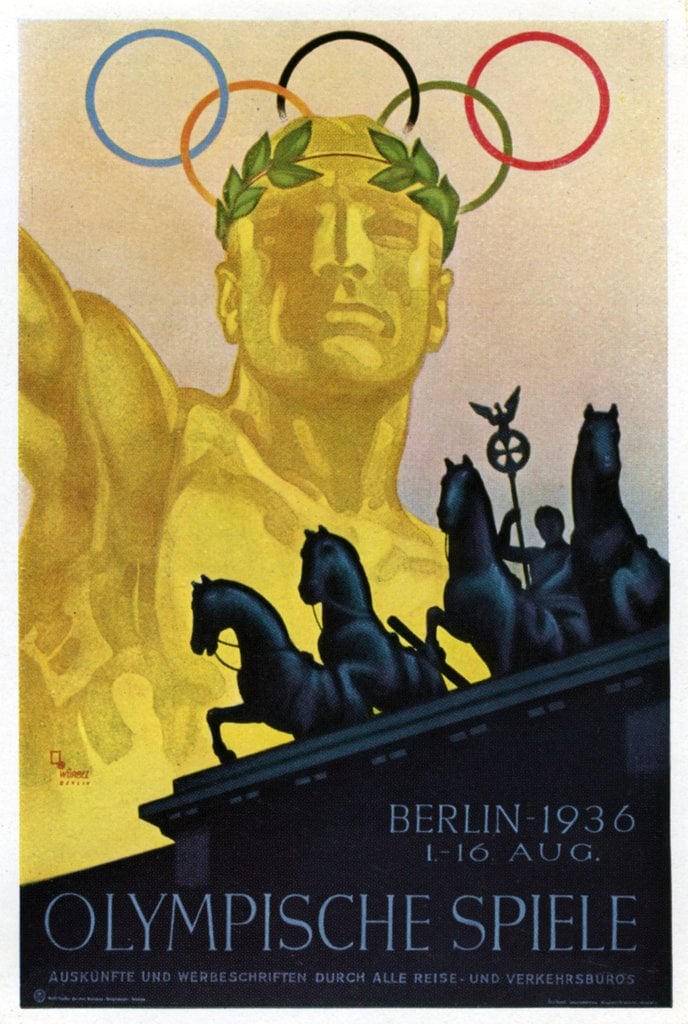
    When Richard Strauss wrote and conducted his “Olympic Hymn” for the 1936 Berlin Games, his seeming willingness to act as a puppet for the Third Reich earned him international criticism. But Strauss was no Nazi.

    In 1933, Strauss was named president of the newly instituted Reichsmusikkammer. He was not consulted on the appointment and accepted it as what he saw as a preventative measure, hoping to head-off reorganization of German musical life by “amateurs and ignorant place-seekers.”

    Professionally, he did what he could to preserve musical culture, extending copyrights, conducting works by banned composers (like Mendelssohn and Mahler), and continuing to collaborate with Jewish artists (like Stefan Zweig). In fact, he became such a thorn in the side to the Nazi regime that Goebbels wrote in his diary, “Unfortunately we still need him, but one day we shall have our own music and then we shall have no further need of this decadent neurotic.” For his part, Strauss referred to Goebbels as a “pipsqueak.”

    Unfortunately, the composer’s subversive correspondence was intercepted by the Gestapo and forwarded to Hitler himself. Strauss was quietly demoted (on the grounds of “ill health”), dismissed from his position in the Reichsmusikkammer, and trotted out thereafter only for propaganda purposes, most notably at the 1936 Games. His music was appropriated by filmmaker Leni Reifenstahl for her paean to German athletic prowess, “Olympia.”

    Part of Strauss’ motivation in playing along was to protect those closest to him, including his daughter-in-law, Alice Grab Strauss (née von Hermannswörth), and his grandchildren, all Jewish. Late in the war, Alice was arrested, and Strauss was barely able to secure her release. Thereafter, everyone was kept under house arrest. Strauss could do nothing to save to her relations. 32 members of Alice’s family died in concentration camps.

    Strauss never joined the Nazi Party and refused to give the Nazi salute. He may have been naïve to think he could do anything to stem the regime’s calamitous torrent, but he wasn’t stupid. With the rise of Hitler, he believed, or rather hoped, that he could keep his head down and quietly accomplish what good he was able until the storm had passed.

    In 1948, at the age of 84, he was cleared of any wrongdoing by a denazification tribunal. Still, for many, a pall hung over his reputation. The demonstratively anti-fascist Toscanini, who resigned his position as director of the Bayreuth Festival in 1933 (to be replaced by Strauss), is said to have told Strauss to his face, “For Strauss the composer, I take my hat off. For the Strauss the man, I put it on again.”

    It was in the final months of World War II that Strauss composed his “Metamorphosen,” a lament for strings spanning nearly half an hour. In the work, he ruminates on the funeral march from Beethoven’s “Eroica” Symphony. At the bottom of the score is inscribed “In Memoriam.”

    Though Strauss never commented on the inspiration for the piece, it’s generally been interpreted as an elegy for German civilization, as symbolized by the opera house in Munich, city of his birth, laid waste by bombs. Strauss had a deep personal connection to the theater. He had attended performances there since boyhood and enjoyed many successful productions of his own works. His father played first horn in the orchestra for 39 years. Further, the destruction of the Vienna State Opera took place on the very eve of Strauss putting pen to paper.

    It may have been Allied bombs that brought physical devastation to the structures of Munich and Vienna, but Strauss harbored no illusions as to what was truly responsible for the ruination of all he loved.

    The composer confided in his diary, “The most terrible period in human history is at an end, the twelve year reign of bestiality, ignorance and anti-culture under the greatest criminals, during which Germany’s 2,000 years of cultural evolution met its doom.”


    Strauss’ “Olympic Hymn”

    “Metamorphosen”

  • Inner Emigration Composers Under the Nazis

    Inner Emigration Composers Under the Nazis

    Is it really “emigration” when you don’t go anywhere?

    This Sunday night on “The Lost Chord,” we’ll have music by flagrantly anti-fascist composers who remained in Germany during the Nazi regime. This type of opposition was described by Thomas Mann as “inner emigration.”

    There were plenty of opportunists who joined the Nazi Party as a means to curry favor, in the hopes of securing prominent posts. Then there were those who, while critical of the Nazis, nevertheless joined the Party to protect their families and to continue working.

    A group which seems to have faded from memory is that made up of composers who remained, opposed the regime, and yet somehow survived. These artists were condemned by the Nazis, their music labeled degenerate and banned from performance. They were either prevented from escape or remained of their own accord. Some justified the decision to stay as an act of social consciousness. Some were active in resistance circles. Others simply withdrew into ostentatious silence.

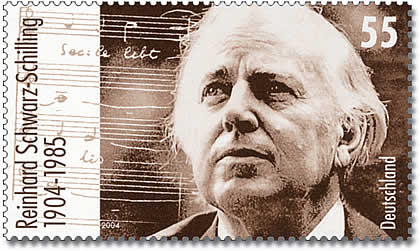
    Reinhard Schwarz-Schilling is not a terribly well-known composer, largely for the reasons I just mentioned. Schwarz-Schilling had been a professor of music at the Berlin Academy of Music. During Hitler’s reign, his family was subjected to frequent interrogations by the Gestapo. Luckily, it was never found out that Schwarz-Schilling’s wife, the concert pianist Dusza von Hakrid, was of Jewish descent. It was only through the beneficence and courage of a sympathetic official who falsified documents that the Schwarz-Schillings escaped arrest.

    Schwarz-Schilling may have survived the Nazis, but following the war, he had to deal with the musical establishment, which had grown hostile to such flagrantly tonal music. Something like his Violin Concerto of 1953 couldn’t be taken seriously. It starts out sounding a bit like Hindemith, but embraces Korngoldian sentiment at its candy core. If you can’t stick around for the whole show, I hope at least you’ll stay tuned for the gorgeous slow movement of this concerto.

    We’ll also hear music by Karl Amadeus Hartmann, regarded in some circles as the most important German symphonist of the mid-20th century, yet is now largely overlooked. In his 30s, Hartmann was viewed as politically undesirable in his homeland. He completely withdrew from musical life during the Nazi era. On the rare occasion any of his works would have been permitted performance, Hartmann would not allow it. Alas, most of his greatest champions were also his contemporaries. Therefore, performances of his music nearly died with them.

    After the war, Hartmann was one of the few prominent surviving anti-fascists in Bavaria whom the Allied Forces could promote to a position of responsibility. Hartmann used that trust to reintroduce the world to music which had been banned since 1933 under National Socialist aesthetic policy. He remained in Munich for the rest of his life, where his administrative duties cut heavily into what would have been his compositional time and energy. He died in 1963. We’ll hear Hartmann’s Symphony No. 6, composed between 1951 and 1953.

    I hope you’ll join me for “Staying Power” – music by anti-fascist composers who remained in Nazi Germany – this Sunday night at 10:00 EDT, on WWFM – The Classical Network and wwfm.org.

  • “Inner Emigration” Composers Under the Nazis

    “Inner Emigration” Composers Under the Nazis

    Is it really “emigration” when you don’t go anywhere?

    This Sunday night on “The Lost Chord,” we’ll have music by flagrantly anti-fascist composers who remained in Germany during the Nazi regime. This type of opposition was described by Thomas Mann as “inner emigration.”

    There were plenty of opportunists who joined the Nazi Party as a means to curry favor, in the hopes of securing prominent posts. Then there were those who, while critical of the Nazis, nevertheless joined the Party to protect their families and to continue working.

    A group which seems to have faded from memory is that made up of composers who remained, opposed the regime, and yet somehow survived. These artists were condemned by the Nazis, their music labeled degenerate and banned from performance. They were either prevented from escape or remained of their own accord. Some justified the decision to stay as an act of social consciousness. Some were active in resistance circles. Others simply withdrew into ostentatious silence.

    Reinhard Schwarz-Schilling is not a terribly well-known composer, largely for the reasons I just mentioned. Schwarz-Schilling had been a professor of music at the Berlin Academy of Music. During Hitler’s reign, his family was subjected to frequent interrogations by the Gestapo. Luckily, it was never found out that Schwarz-Schilling’s wife, the concert pianist Dusza von Hakrid, was of Jewish descent. It was only through the beneficence and courage of a sympathetic official who falsified documents that the Schwarz-Schillings escaped arrest.

    Schwarz-Schilling may have survived the Nazis, but following the war, he had to deal with the musical establishment, which had grown hostile to such flagrantly tonal music. Something like his Violin Concerto of 1953 couldn’t be taken seriously. It starts out sounding a bit like Hindemith, but embraces Korngoldian sentiment at its candy core. If you can’t stick around for the whole show, I hope at least you’ll stay tuned for the gorgeous slow movement of this concerto.

    We’ll also hear music by Karl Amadeus Hartmann, regarded in some circles as the most important German symphonist of the mid-20th century, yet is now largely overlooked. In his 30s, Hartmann was viewed as politically undesirable in his homeland. He completely withdrew from musical life during the Nazi era. On the rare occasion any of his works would have been permitted performance, Hartmann would not allow it. Alas, most of his greatest champions were also his contemporaries. Therefore, performances of his music nearly died with them.

    After the war, Hartmann was one of the few prominent surviving anti-fascists in Bavaria whom the Allied Forces could promote to a position of responsibility. Hartmann used that trust to reintroduce the world to music which had been banned since 1933 under National Socialist aesthetic policy. He remained in Munich for the rest of his life, where his administrative duties cut heavily into what would have been his compositional time and energy. He died in 1963. We’ll hear Hartmann’s Symphony No. 6, composed between 1951 and 1953.

    I hope you’ll join me for “Staying Power” – music by anti-fascist composers who remained in Nazi Germany – this Sunday night at 10:00 EST, on WWFM – The Classical Network and wwfm.org.

Tag Cloud

Aaron Copland (92) Beethoven (95) Composer (114) Film Music (123) Film Score (143) Film Scores (255) Halloween (94) John Williams (187) KWAX (229) Leonard Bernstein (101) Marlboro Music Festival (125) Movie Music (138) Opera (202) Philadelphia Orchestra (89) Picture Perfect (174) Princeton Symphony Orchestra (106) Radio (87) Ralph Vaughan Williams (85) Ross Amico (244) Roy's Tie-Dye Sci-Fi Corner (290) The Classical Network (101) The Lost Chord (268) Vaughan Williams (103) WPRB (396) WWFM (881)

DON’T MISS A BEAT

Receive a weekly digest every Sunday at noon by signing up here


RECENT POSTS