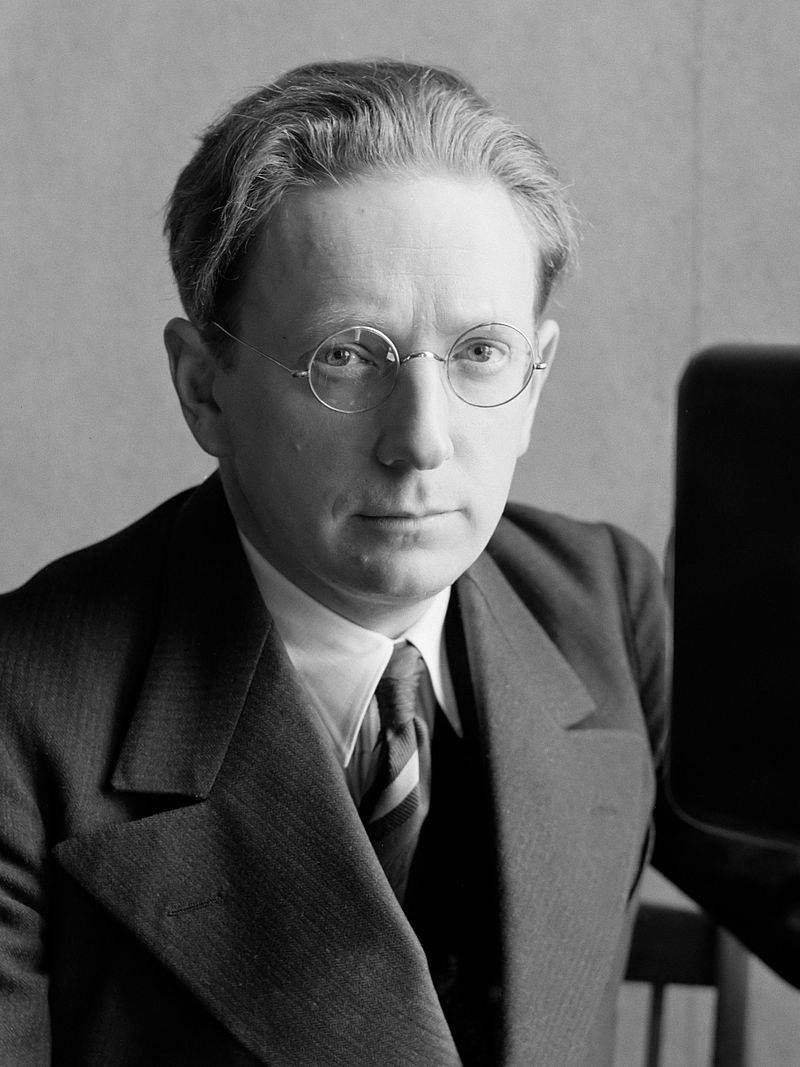
Jón Leifs’ music can be austere to the Nth degree, its severity reflective of the unforgiving yet sublime Icelandic landscape and the stoicism of the heroes of the Icelandic sagas. His is a wholly unique voice in 20th century music, which deserves to be much better known.
Leifs, who studied at the Leipzig Conservatory, was caught in Nazi Germany through much of World War II. On the surface, his celebration of Norse heroism should have been just the thing to endear him to the National Socialists. However two things worked against him: the modernistic language of his music, and the fact that his wife and children were Jewish.
Performances of Leifs’ music were derided or discouraged. This, apparently, he took in his stride, delighting in re-reading the Icelandic Sagas and living vicariously through the exploits of their heroes. Because of his family’s precarious safety, Leifs tried not to draw a lot of attention to himself. He was still useful for propaganda purposes in Germany’s relations with Scandinavia.
For the record: despite their shared interest in Nordic themes, Leifs found Wagner’s “Ring Cycle” repellent, feeling that Wagner had completely misunderstood the essence and artistic tradition of the North. In fact, he went so far as to state that much of his output was written as a specific protest against Wagner.
Leifs finally managed to obtain permission to leave Germany in 1944. His family temporarily settled in Sweden. He and his wife divorced, and Leifs returned to Iceland, where he found himself regarded with suspicion for his “Nazi assocations.”
It didn’t help that much of his music was conceived on such a gargantuan scale – and scored for such outlandish instruments – there was no way it could be practically performed. A lot of it simply went unheard in his lifetime.
His works are notable for their sparsity, their passages of stasis, and for their unconventional use of wooden hammers, tree stumps, chains, anvils, shields and Viking long horns.
Leifs had a tendency to write on a scale worthy of his subject matter: the heroism of the Norse sagas and the grandeur of the Icelandic landscape, with its geysers, waterfalls and volcanoes. His orchestral work “Hekla,” about a volcanic eruption, has the reputation of being the loudest piece of orchestral music ever written. Here it is:
Happy birthday, Jon Leifs (1899-1968).