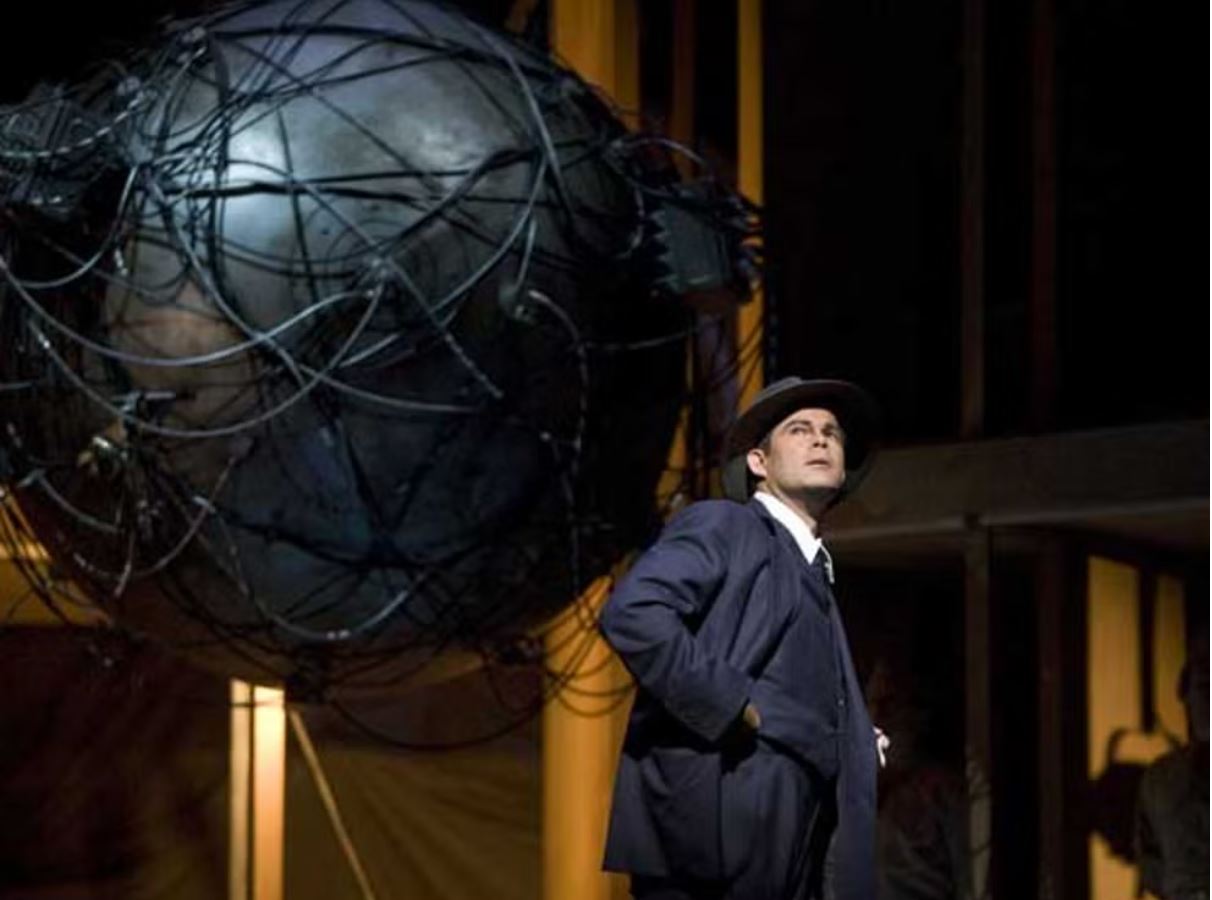
Renata Scotto has died. I saw her at my first opera at the Met, a long, long time ago, as Cio-Cio-San, in a production of “Madama Butterfly” that she directed. In my memory, it was the longest and rowdiest ovation I ever witnessed. I know there have been longer and rowdier, but I wasn’t there for those! The stage was pelted with flowers and confetti and whatever else happened to be at hand, as she curtsied graciously in her kimono, and the applause only intensified. This would have been back in the 1980s.
It was as Butterfly that she made her belated Met debut in 1965. She made her professional debut in 1952 and within months was singing at La Scala. She sang professionally into the new century, as she transitioned increasingly to directing.
She was a giant of the Pavarotti generation and a recurring presence on the “Live from the Met” television broadcasts. For opera lovers, life was good.
Scotto died earlier today. She was 89 years old.
As Mimi
With lucky Luciano
Vintage “Butterfly”
Complete studio recording
The elixir of lovely
Tokyo “Traviata”
When the arts were still on the periphery of the mainstream: on “The Merv Griffin Show” with Ethel Merman, Ann Miller, Lillian Gish, and Myrna Loy!
Okay, so I’m a little late to the table. Following on the heels of yesterday’s post about classical music relating to the current Barbenheimer phenomenon (including works inspired by Oppenheimer and, believe it or not, Barbie), I learned that the Metropolitan Opera is streaming John Adams’ Oppenheimer opera, “Doctor Atomic” (2005), free through Thursday. Watch it here.
Bard SummerScape once again makes history, with the first major U.S. production of Camille Saint-Saëns’ grand opera “Henry VIII.”
A seven-week arts festival consisting of opera, dance, theater, film, music, and cabaret, Bard SummerScape is held every year on the idyllic campus of Bard College in Annandale-on-Hudson, NY.
In common with all of Bard’s operas, “Henry VIII” is rarely staged. In fact, you’re unlikely to encounter any of Saint-Saëns’ operas other than, of course, “Samson and Delilah.” I was lucky enough to hear this one, also at Bard, in a concert performance during a festival devoted specifically to Saint-Saëns in 2012.
This year’s fully-staged production, held at the Sosnoff Theater in the Frank Gehry-designed Fisher Center for the Performing Arts, opened on Friday. Remaining performances will take place at the following times:
TODAY AT 2 PM
JULY 26 AT 2 PM
JULY 28 AT 4 PM
JULY 30 AT 2 PM
Livestreams will also be made available on July 26 AT 2 PM and July 29 AT 5 PM.
Eleven of Bard’s past operas – again, many of them U.S. premieres – are now available for streaming, free, and can be accessed on YouTube through the festival’s archive at the link below.
2022 – Richard Strauss, “Die Schweigsame Frau” (“The Silent Woman”)
2021 – Ernest Chausson, “Le roi Arthus” (“King Arthur”)
2019 – Erich Wolfgang Korngold, “Das Wunder der Heliane” (“The Miracle of Helen”)
2018 – Anton Rubinstein, “Demon”
2017 – Antonin Dvořák, “Dmitrij”
2016 – Pietro Mascagni, “Iris”
2015 – Ethel Smyth, “The Wreckers”
2014 – Carl Maria von Weber, “Euryanthe”
2013 – Sergei Taneyev, “Oresteia”
2012 – Emmanuel Chabrier, “Le roi malgré lui” (“The King in Spite of Himself”)
2011 – Richard Strauss, “Die Liebe der Danae” (“The Love of Danae”)
Arguably, the crown jewel of Bard SummerScape is the Bard Music Festival (August 4-13), two weeks devoted to a specific composer and his or her world – their contemporaries, those they were influenced by, and those they influenced. This year (its 33rd) the focus is on none other than Ralph Vaughan Williams.
Highlights will include performances of “Job, A Masque for Dancing,” the “Sinfonia Antartica” [sic], the Symphonies Nos. 4 & 8, the Concerto for Two Pianos, the Concerto Accademico for violin and orchestra, “Flos Campi” for viola, chorus and orchestra, and a concert performance of the Falstaff opera “Sir John in Love,” alongside old favorites like “The Lark Ascending,” the “Fantasia on a Theme by Thomas Tallis,” “Five Variants of Dives and Lazarus,” and the “Serenade to Music.”
With the composer largely neglected in the United States during his sesquicentennial year, all I can say is… it’s about bloomin’ time!
Of course, there will be works by many other composers, as well, though all of the music will be connected in one way or another with RVW.
The Bard Music Festival is an intensive regimen of concerts, panels, and pre-concert talks. One basically gets out of it whatever one puts into it. If total immersion is what you desire, there’s no place like Bard for a scholarly crash course. But if you prefer to cherry-pick, and just go and casually experience some worthwhile, often rarely-heard music, you can do that, too. One thing’s for certain: the lavish program book will keep you busy for days after the festival’s end. There is also always a tie-in book of scholarly essays and many recordings available for purchase.
For more information on Bard SummerScape and the Bard Music Festival, visit here:
Think you don’t know “The Barber of Seville?” Rossini’s comic opera is one of the most famous of all time. Even if you’ve never seen it, it’s been referenced and parodied in countless movies, cartoons, television shows, and commercials. I’ve included ten such examples at the bottom of this post.
You’ll have three chances to laugh, delight, and walk out humming its hit tunes, tonight, Sunday, and Tuesday at The Princeton Festival, now taking place on the grounds of Morven Museum & Garden, at 55 Stockton Street/Route 206.
The opera will be presented in an all-new production, stage-directed by James Marvel, with fun, Cubist set designs by Blair Mielnik suggesting the timeless, madcap nature of the story. Rossen Milanov will conduct the Princeton Symphony Orchestra.
Andrew Garland will portray the resourceful barber and jack-of-all-trades, Nicholas Nestorak the lovestruck and resolute Almaviva, and Kelly Guerra the beautiful and game Rosina, with Steven Condy providing the requisite impediment to young love as the slow-witted and lascivious Dr. Bartolo. Filling out the cast will be Festival veterans Eric Delagrange and Cody Müller, along with Kaitlyn Costello-Fain and the Festival Opera Chorus. Elaborate disguises, conspiracy, and close shaves inform the action, set to Rossini’s spritely and dynamic score.
Tonight’s presentation, under the festival pavilion, will begin at 7:00. The opera will be repeated on Sunday at 4 p.m. and Tuesday at 7 p.m. A pre-concert talk, “The Funny Thing About Figaro,” will be offered by Dr. Timothy Urban at Morven’s Stockton Education Center at 3:00, prior to the Sunday performance.
The Princeton Festival will continue through June 25. Yet to come: a program for string quartet and interpretive dance featuring the Attacca Quartet and members of American Repertory Ballet; a recital of songs by Black composers sung by Metropolitan Opera singer Will Liverman; a “Mazel Tov Cocktail Party” with klezmer clarinetist David Krakauer and friends; Vivaldi’s “The Four Seasons” performed by The Sebastians (across the street at Trinity Church Princeton); Andrew Lippa’s musical theater oratorio “I Am Harvey Milk;” and a vaudeville-inspired family concert including “Peter and the Wolf” with Michael Boudewyns of Really Inventive Stuff.
Ancillary events, including talks, a film screening, an art installation, Yoga in the Garden sessions, and kid-friendly activities, will also be offered.
The festival’s state-of-the-art pavilion is 11,000 square-feet, clear-span (no poles or obstructed views), and open-sided, allowing for easy access to refreshments, ample picnicking opportunities, a garden stroll, or the simple enjoyment of a late-spring/early-summer evening.
The Princeton Festival is the premier summer arts program of the Princeton Symphony Orchestra. For more information, tickets, and a complete schedule, visit princetonsymphony.org/festival.
Did you know:
Rossini’s “The Barber of Seville” (1816) is frequently confused with Mozart’s “The Marriage of Figaro” (1786). Both operas were based on comedies by the French playwright Pierre Beaumarchais, which were considered subversive, even politically incendiary, when they were written in the last quarter of the 18th century, a time of roiling social unrest, as they enact a kind of class warfare, with wily servants getting over on their aristocratic masters. “The Marriage of Figaro” was particularly edgy, facing challenges from censors and causing many a noble’s head to rest uneasily on his satin pillow. A third play, called “The Guilty Mother,” followed in 1791, by which time the Ancien Régime had already been abolished and the French Revolution was in full swing.
All the principal characters of Rossini’s opera appear in Mozart’s. Though Mozart’s was written first – 30 years earlier, in fact – it’s actually based on the second of Beaumarchais’ “Figaro” plays, so the action takes place later, AFTER that of “The Barber of Seville.” Got it?
Other operas to include characters from Beaumarchais’ trilogy include Jules Massenet’s “Chérubin,” Darius Milhaud’s “La mère coupable,” and John Corigliano’s “The Ghosts of Versailles.” There was also an earlier opera based on “The Barber of Seville,” from 1782, by Giovanni Paisiello.
But Rossini’s is far and away the most famous musical adaptation of Beaumarchais’ “Barber,” and now regarded as his quintessential work. It is quicksilver, farcical, and often very silly – the archetypal opera buffa.
It also contains some of the most recognizable and oft-referenced music in all of opera. Figaro’s “Largo al factotum” (Fi-ga-ro! Fi-ga-ro!), Rosina’s “Una voce poco fa,” and of course the overture are most frequently encountered. Here are ten instances of their use and abuse:
And this year’s Pulitzer Prize for Music goes to… Rhiannon Giddens and Michael Abels for the opera “Omar.”
“Omar” was inspired by the memoir of an enslaved Muslim man, Omar ibn Said, whose autobiography was written, mostly in Arabic, in 1831. In 1807, Said was captured during a military conflict, taken from his home in Futa Toro (in what is now Senegal), and sold to slavers. He was 37 years-old. He was also from a wealthy family and highly educated.
In the U.S., he had contrasting experiences under a cruel master and one who realized his exceptional nature. It was the latter who encouraged him to write his story down. Said was offered the chance to return home, but doubtful about the fate of his people, he chose to remain in North Carolina.
The opera was commissioned by Spoleto Festival USA. Giddens wrote the libretto and composed the music, and then handed it off to co-composer Abels for him to orchestrate it. According to The New York Times, the score is “a melting pot inspired by bluegrass, hymns, spirituals, and more, with nods to traditions from Africa and Islam. It’s an unforced ideal of American sound: expansive and ever-changing.”
And according to the Pulitzer committee, it’s “an innovative and compelling opera about enslaved people brought to North America from Muslim countries, a musical work that respectfully represents African as well as African American traditions, expanding the language of the operatic form while conveying the humanity of those condemned to bondage.”
Here are some clips and promotional material from the West Coast premiere with LA Opera: