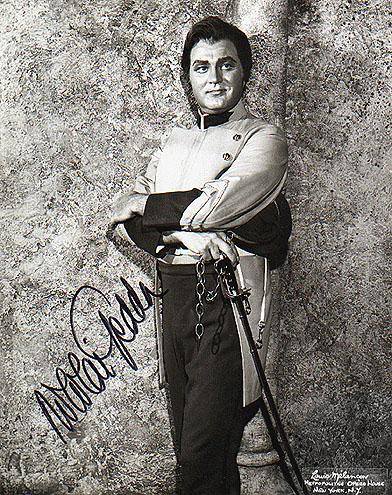
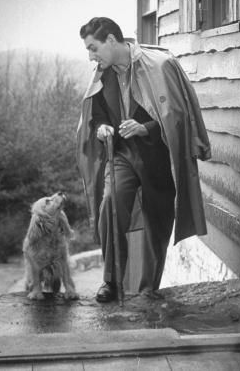
As was the case with Mark Twain, reports of the death of Swedish tenor Nicolai Gedda were greatly exaggerated. Gedda was reported to have passed in May. In the Age of Social Media, the news swept opera lovers like a pandemic, only to be retracted the next day when it was reported that Gedda was indeed alive and well.
It must have been a shock to the artist to find news of his demise posted all over the internet. Yet how many of us will be so lucky as to be able to eavesdrop on the kind comments and tributes delivered on our own passing?
Nicolai Gedda on his 90th birthday is doubly blessed, to have lived a good life and to have survived a good death.
Okay, today is the birthday anniversary of the seething Austrian genius Gustav Mahler (1860-1911), who declared on a walk with Sibelius that “the symphony must be like the world; it must embrace everything” and confided to his wife, “My time will come.” We all know about him.
It is also the birthday of Italian-American Gian Carlo Menotti (1911-2007), a prolific composer of opera and the recipient of two Pulitzer Prizes (for “The Consul,” in 1950, and “The Saint of Bleecker Street,” in 1955); yet somehow Menotti is basically remembered for his one-act Christmas opera, “Amahl and the Night Visitors,” written for NBC in 1951.
“Amahl,” broadcast live on Christmas Eve, was the first opera commissioned for television. The composer continued to work on the score until perilously close to air time. In fact, his partner, Samuel Barber, had to be brought in to help complete the orchestrations. Despite the time crunch, the opera was a ratings smash, and for the next 15 years “Amahl” became a Christmas broadcast tradition.
Chet Allen, who originated the role of Amahl, was a chorister with the Columbus Boychoir, which was founded in Columbus, OH, in 1937. By the time of the opera’s telecast, the choir had relocated to Princeton, NJ. In 1980, the group would be renamed The American Boychoir. Since the opera fell a few minutes short of the top of the hour, the choir was brought on to perform carols appropriate for the season.
Though he wrote the work for television, Menotti shrewdly realized its potential for the stage. Allen would reprise the role of Amahl at the New York City Opera in 1952. Since then, “Amahl” has enjoyed a robust history of professional and community performances.
Menotti will always be remembered as an opera composer (in his day, he was regarded as the heir of Puccini, admiringly by some, derisively by others), but his concert works are certainly worthy of interest. Join me on WPRB 103.3 FM, or at wprb.com, this Thursday morning between 6 and 11 ET to hear Menotti’s Piano Concerto from 1945, in a 1961 performance by the great Earl Wild.
In the meantime, for you lovers of licorice, “This is my box”:
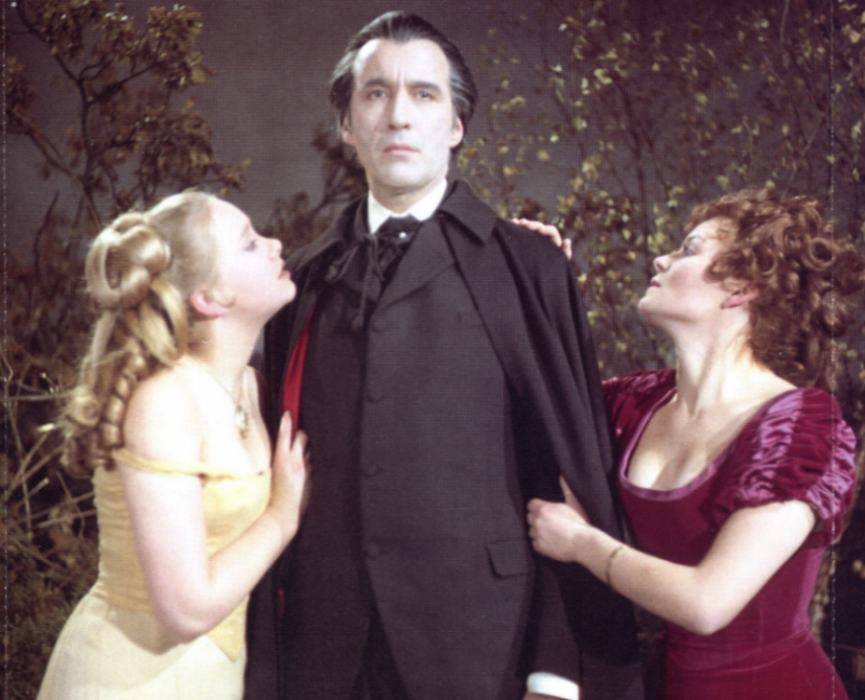
Christopher Lee, who died on Sunday – but whose passing was only just announced today (in order to allow time for the notification of family) – was a lifelong opera lover. In fact, in his autobiography, “Lord of Misrule” (previously released as “Tall, Dark and Gruesome”), he relates how he relished a stint in Scandinavia early in his career, since it gave him the opportunity to steal away with a regional opera company.
On the recommendation of Jussi Björling, he auditioned for the Swedish Opera, and was accepted, but unfortunately he could not afford the training.
He liked to claim his singing talent was genetic. His great grandparents founded the first opera company in Australia.
In recent years, he stated his one regret in life was that he had not pursued singing professionally. But then he added philosophically that if he had, he most certainly would have had to give it up years ago, whereas as an actor, he just kept right on going.
Opportunities to hear Lee employ his singing voice in film are sadly rare. Here’s a clip from 1970:
A few days ago, on the occasion of Nikolai Rimsky-Korsakov’s birthday anniversary, I was going on about his operas. This Sunday night on “The Lost Chord,” you’ll have a chance to sample one of them, as we welcome spring with selections from “The Snow Maiden.”
Based on an allegorical Russian fairy tale of humans, quasi-mythological creatures, and the eternal forces of nature, it’s the story of a star-crossed love that brings about the end of a 15-year winter. The orchestral suite – which climaxes with the “Dance of the Tumblers” – is fairly popular, but the opera, as with all of Rimsky’s 16 efforts in the form, is virtually unknown in the West.
The recording, on the Capriccio label, which features the Bulgarian Radio Symphony conducted by Stoyan Angelov, doesn’t hold a candle to the best Rimsky opera recordings by conductors like Nikolai Golovanov, but it’s enough to give a taste of what American opera lovers are missing.
I hope you’ll join me for “Thaw of the Wild,” tonight at 10 ET, with a repeat Wednesday evening at 6, or that you’ll listen to it later as a webcast at http://www.wwfm.org.