Today is the 150th anniversary of the birth of French composer Charles Koechlin. If anyone can find even a single mention, anywhere on the internet, of an official sesquicentennial observance, I would be very curious to know. Alas, it would seem he is the very definition of a neglected composer.
You can refer to my Saturday post on this fascinating polymath to learn more about his eclectic interests and his close associations with Gabriel Fauré and Claude Debussy. Things will only get more Koechlin-intensive as the week progresses and I pull out all the stops. (You certainly won’t catch me pulling at that beard.)
For today, I hope you will join me for a selection from Koechlin’s music inspired by Rudyard Kipling’s “The Jungle Book” and some of his very famous work as an orchestrator. The music will be recognizable, even if, apparently, the orchestrator is not.
We’ll be crushing on Koechlin, among our featured composers, this Monday from 4 to 7 p.m. EST, on WWFM – The Classical Network and wwfm.org.
Monday marks the 150th anniversary of the birth of the remarkable French composer Charles Koechlin – whose name, it turns out, I have been mispronouncing for years (as if the “oe” were the equivalent of an umlauted “o” and the “ch” sounded like “sh”). In reality, the “oe” is said like an accented “e” (é) and the “ch” is hard, like a “k.” Who knew? Chalk it up to the composer’s German ancestry. Everyone repeat after me, then: Kake-LAN.
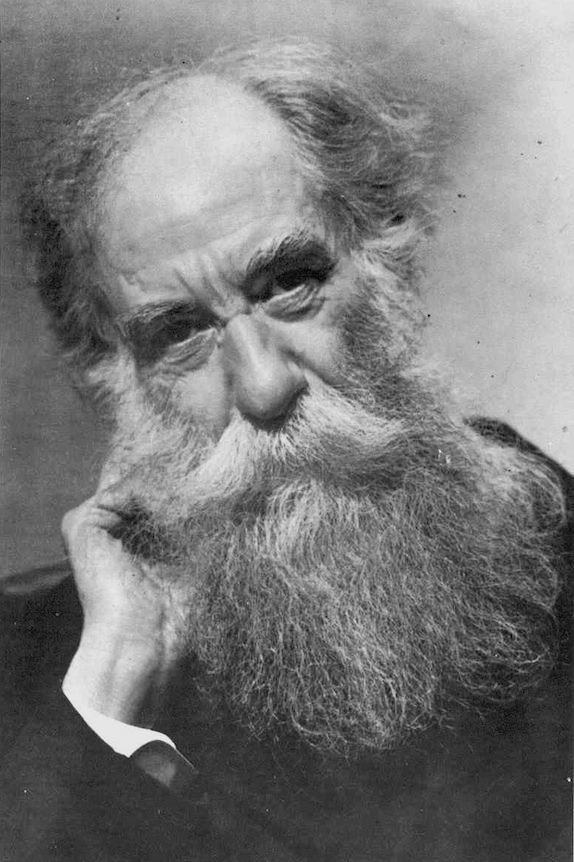
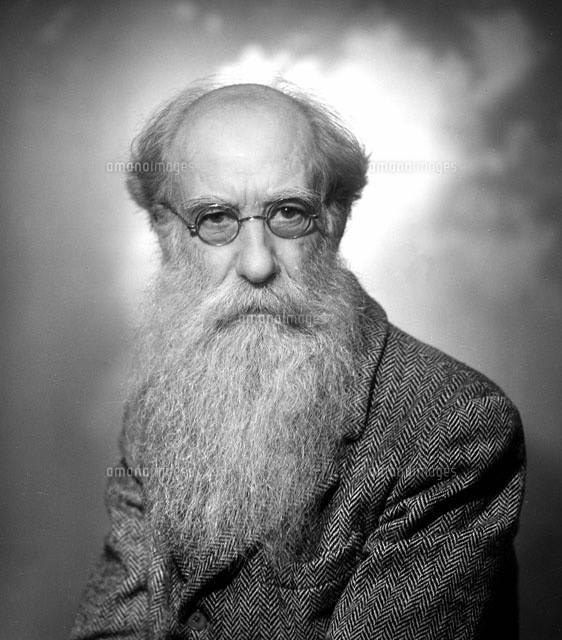
Koechlin had many enthusiasms. He was interested in medieval music, Bach, travel, and stereoscopic photography. He was a communist sympathizer, a pantheist, and an athlete. He was also extraordinarily prolific, perhaps due to all the time he saved by not shaving. Koechlin had one of the most enviable beards in all of classical music. Children would ask him why he grew his beard so long, and he would respond, “Because I like it!”
He was especially interested in early film stars (he wrote works in tribute to Ginger Rogers, Douglas Fairbanks, Charles Chaplin and especially Lillian Harvey, who he basically stalked) and the “Jungle Books” of Rudyard Kipling. He wrote a series of orchestral works inspired by Kipling, which span most of his creative life. These were composed in a wide array of styles. Koechlin’s language could encompass impressionism, neo-classicism, polytonality and even quasi-serialism.
Despite being a figure of such energetic creativity, Koechlin is associated in most people’s minds with his orchestrations, especially those for Fauré’s “Pélleas and Mélisande” and Debussy’s “Khamma.” He also orchestrated Cole Porter’s ballet “Within the Quota.”
Naturally, I’ll be playing some of his original music on WWFM The Classical Network and wwfm.org, late Monday afternoon, to mark the big day, but it’s on Thursday morning that I’ll really be doing it up right, with FIVE HOURS of Koechlin’s music and orchestrations, on WPRB 103.3 FM and wprb.com. Curious to hear what he did with Schubert’s “Wanderer Fantasy?” Tune in then. We’ll also hear his wacky “Seven Stars Symphony” (like Messiaen, he had a weakness for the ondes martenot), and much more.
As for the pronunciation of his name, I’ll keep working on it. However, I can’t imagine that there’s that much “kake” in “Koechlin,” even if it is his 150th birthday.
This Sunday night on “The Lost Chord,” it’s music by French composers better known for their skill as orchestrators of others’ works. We’ll hear original compositions by Henri Rabaud (orchestrator of Gabriel Fauré’s “Dolly Suite”), André Caplet (orchestrator of Claude Debussy’s “Children’s Corner,” “Clair de lune,” “Le Martyre de saint Sébastien,” and “La Boite à joujoux”), Henri Büsser (orchestrator of Debussy’s “Petite Suite” and “Printemps”) and Charles Koechlin (orchestrator of Fauré’s “Pelléas et Mélisande” and Debussy’s “Khamma”).
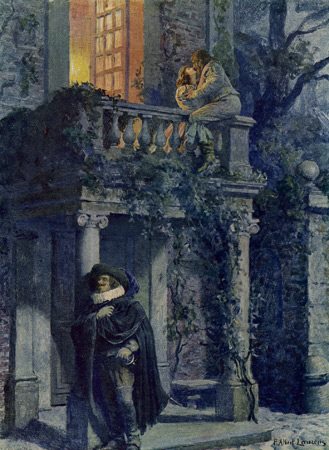
These musical Cyranos emerge from the shadow of Roxane’s balcony, on “French Connections,” this Sunday night at 10:00 EDT, on WWFM – The Classical Network and wwfm.org.
The work began as a piano piece, one of the movements from Debussy’s “Suite bergamasque.” However, the lovely orchestral version was produced by André Caplet.
One of the reasons superior sorts tend to look down their noses at film music is that the composers frequently work with orchestrators (though the better composers are very meticulous about notating their requirements). However, the practice is not exclusive to Hollywood.
The Dutch masters were not always responsible for all the elements in the paintings attributed to them. For a famous example, see Rubens’ “Prometheus Bound” (which you can view in person, if you are reading this locally, at the Philadelphia Museum of Art). Similarly, successful authors sometimes set up studios, kind of like architects, with anonymous collaborators doing a lot of the heavy lifting. The practice dates back to at least Alexandre Dumas, who churned out novels at a dizzying rate.
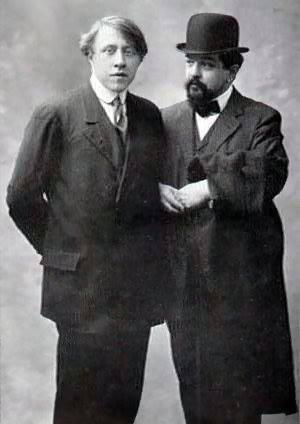
In classical music, many of the orchestral works of Grieg and Liszt received ample assistance from others (though Liszt gained confidence – and autonomy – as time went on). Charles Koechlin worked behind the scenes with Debussy and Gabriel Fauré.
Caplet, a winner of the esteemed Prix de Rome, provided orchestrations for Debussy’s “Children’s Corner,” “Clair de lune,” “The Martyrdom of Saint Sebastian” and “La Boiîte à joujoux.”
He directed the Boston Opera from 1910 to 1914. While serving in the First World War, he was caught in a gas attack, which resulted in the pleurisy that plagued him for the remainder of his short life. Caplet died in 1925, at the age of 44.
Why is it so important to us, I wonder, that a work of art emerge seemingly from a single source – the “auteur,” as it were? While most of Caplet’s own music languishes in obscurity, his work for Debussy lives on.
Happy birthday, André Caplet!
Caplet’s orchestration of “Clair de lune”:
His own “Septuor” for string quartet and three female voices:
This Sunday night on “The Lost Chord,” we honor the accomplishments of Gordon Jacob.
Jacob’s is perhaps a name most frequently encountered these days as an orchestrator. He did a popular arrangement for full orchestra of Vaughan Williams’ “English Folk Song Suite,” originally composed for symphonic band; he orchestrated Sir Edward Elgar’s Organ Sonata; and his arrangement of the ballet “Les Sylphides” has been eclipsed only by that of Roy Douglas.
But he was also a prolific composer himself. In all, he wrote some 400 works. In fact, when weighing the size of his output against his reputation, it’s tempting to underestimate – as the Angel did his Biblical namesake – Jacob’s tenacity.
We’ll be listening to an example of his work as an arranger, his “William Byrd Suite,” in a classic recording on the Mercury label, and his rarely-heard Symphony No. 1, dedicated to the memory of his brother, who died in the First World War, in its world premiere recording on the Lyrita label.
I hope you’ll join me as we grapple with the range of Jacob’s accomplishments, in “Wrestling Jacob,” tonight at 10 ET, with a repeat Wednesday evening at 6 – or that you’ll enjoy it later as a webcast at http://www.wwfm.org.
In the meantime, follow the link for a witty survey ranking the various depictions of Jacob wrestling the angel in Western Art: