For some, it may be difficult to leave the holidays behind and face the prospect of a long, bleak winter. That would not be me.
But if it describes you, this week on “Sweetness and Light,” I’ll have some Victor Borge to brighten your day. “The Unmelancholy Dane” was born on this date in 1909.
Borge always proved to be quick on his feet, comfortable in his own skin, and unusually personable. Born into a family of Jewish musicians in Copenhagen (his birth name was Børge Rosenbaum), he was already before the public, giving recitals at the age of 8. He received a scholarship to the Royal Danish Academy of Music, and later studied with pupils of both Liszt (Frederic Lamond) and Busoni (Egon Petri).
After a few years of presenting straight classical concerts, he began to develop his act. His mix of music and comedy proved to be popular in Scandinavia, but some of his gibes didn’t exactly sit well with Hitler. When German forces occupied Denmark, Borge hopped a U.S. Army transport out of Finland – though he would return, not long after, disguised as a sailor, to visit his dying mother.
He arrived in the United States in 1940, with 20 dollars in his pocket and no understanding of English. But he was a fast learner, and he taught himself the language by going to American movies.
By 1941, he was already appearing with Rudy Valee and Bing Crosby, and adapting his jokes for U.S. audiences. In 1942, he was named “best new radio performer of the year.” By 1946, he had his own radio show and developed many of his signature routines.
He became a naturalized American citizen in 1948. His Broadway show, “Comedy in Music,” entered the Guinness Book for its unprecedented run, from 1953 to 1956. In the 1960s, he was one of the highest-paid entertainers in the world.
Borge continued to expand his popularity through appearances on television programs ranging from “What’s My Line?” to “The Muppet Show.” He continued to entertain to a ripe old age. He died in 2000, a few days shy of his 92nd birthday.
As he was fond of observing, “Laughter is the closest distance between two people.”
Join me for a selection of Borge at his improvisatory best, working the audience, as he grants requests, from a recording of his record-breaking Broadway show. The program will also include classic bits by Anna Russell and Peter Schickele (“discoverer” of P.D.Q. Bach) and a few more selections from the first of the notorious and uproarious Hoffnung Music Festival concerts.
Enter the new year laughing with an hour of musical humorists on “Sweetness and Light,” this Saturday morning at 11:00 EST/8:00 PST, exclusively on KWAX Classical Oregon!
Stream it, wherever you are, at the link:
Tag: P.D.Q. Bach
-

Welcome 2026 with a Smile on “Sweetness and Light”
-
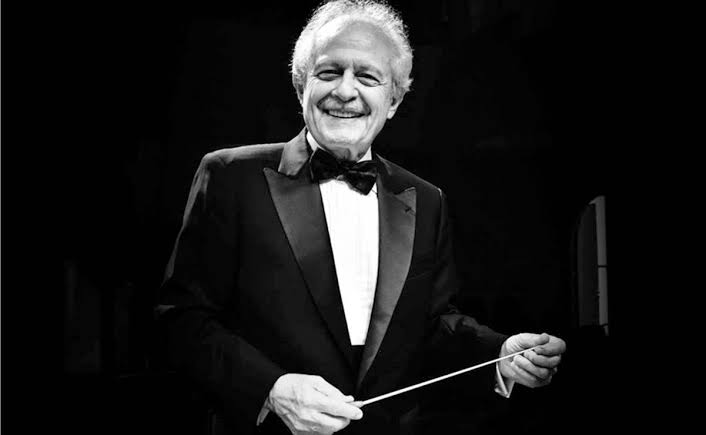
Happy 90th Birthday Jorge Mester!
Today is the 90th birthday of Mexican-born conductor Jorge Mester.
Mester is perhaps best-known to collectors as music director of the Louisville Orchestra, where he served from 1967 to 1979 and oversaw first performances of dozens of works by composers from all over the world. These were released on the much sought-after Louisville First Editions label. Mester conducted 72 recordings of new or neglected music during his first stretch in Louisville. For all I know, some of these may now be available through digital streaming (a number of them have been posted to YouTube), but only a handful of them ever made it to compact disc – which means, for decades, the records have been Holy Grails for classical music lovers with adventurous taste.
Of course, it’s also possible you may recognize Mester for having conducted some P.D.Q. Bach concerts. The man appears to have had his lighter side.
27 years after his departure from Louisville, he returned for a second tenure, while the orchestra sought another music director, with Mester also serving on the search committee.
His other posts have included directorships with the Aspen Symphony Orchestra, the Pasadena Symphony Orchestra, and the Naples Philharmonic in Naples, Florida.
He made his conducting debut with the National Symphony Orchestra of Mexico in 1955. In 1998, he became music director of the Mexico City Philharmonic.
He appears to still be active, as music director of the Orquesta Filarmónica de Boca del Río, Veracruz, an ensemble he has conducted since its founding in 2014.
Mester studied with Jean Morel at the Juilliard School (he regards Morel as “the greatest conducting teacher of them all”), with Leonard Bernstein at the Berkshire Music Center, and with Albert Wolff. He himself joined Juilliard’s conducting faculty, and for a time was head of the department. He served at Juilliard for the better part of 30 years.
Mester settled in the U.S. and became a naturalized American citizen in 1968.
I very much enjoyed getting to know him through this interview with Bruce Duffie – conducted during a layover at O’Hare Airport. He comes across as much more congenial than his flawed colleague and compatriot Enrique Bátiz, who died on March 30.
https://www.bruceduffie.com/mester.html
By coincidence, he also refers to the conductor John Nelson, one of his students, who died on March 31.
Happy birthday, Jorge Mester! Many happy returns.
From vinyl: Carlos Chávez’s ballet “Horsepower” and Enrique Granados’ symphonic poem “Dante”
Ernest Guiraud’s “The Fantastic Hunt”
Peter Mennin’s Cello Concerto with Janos Starker
An old favorite: Gian Carlo Menotti’s Piano Concerto with Earl Wild
“An Hysteric Return: P.D.Q. Bach at Carnegie Hall”
Mester speaks in 2020
-
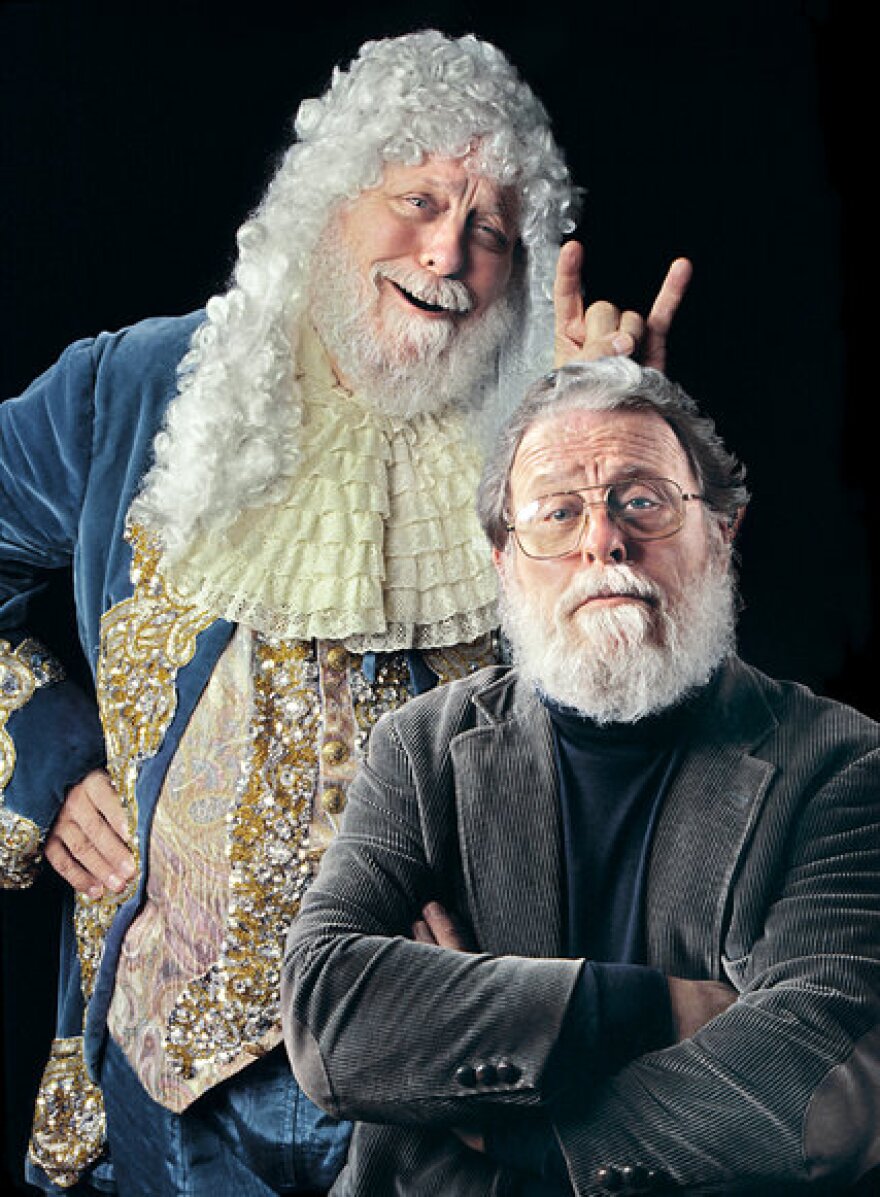
Peter Schickele, P.D.Q. Bach Creator, Dies
Composer and parodist Peter Schickele has died.
Schickele was best known for his “discovery” of P.D.Q. Bach, whom he slyly promoted as the last and least of Johann Sebastian Bach’s progeny – “the 21st of Bach’s 20 children.” P.D.Q.’s manuscripts invariably turned up in the most undignified of places (leaky-ceilinged castles, the bottoms of bird cages, and as coffee maker filters). The music was introduced in performance and on record by “Professor” Peter Schickele, an equally amusing, unreliable source. The combination entertained for more than 50 years, a veritable automat of freewheeling parody, excruciating puns, and good old-fashioned, pie-in-the-face slapstick.
Some of the gags flirted with tedium, but there was always a diamond or two in the rough. If nothing else, you could always count on Schickele’s Jekyll-and-Hyde act to skewer the solemn conventions of classical music.
Frustratingly, his comic success undermined Schickele the “serious” composer. He studied with two of America’s most respected symphonists, Roy Harris and Vincent Persichetti. Under his own name, he produced over 100 works. These could be wildly pluralistic in nature, drawing on folk, jazz, blues, or rock influences. A number of his contemporaries pursued similar impulses (William Bolcom, for one, and it didn’t keep him from winning a Pulitzer), but Schickele never escaped the long shadow of low humor. Which is a shame, as his music is ceaselessly vital, conveying exuberance, invention, and a kind of genial wit.
Schickele also wrote scores for film (“Silent Running”) and songs for Broadway (“O Calcutta!”). For 15 years, he hosted his own syndicated radio show, “Schickele Mix.”
I interviewed him once and met him at a concert at the College of New Jersey in 2014. By that time, he was no longer swinging onto stage by a rope, as he did at Carnegie Hall. Instead, his comic creations were executed by others as he oversaw the shenanigans like something of a dignified lion – albeit a wry lion – providing commentary by way of brief and informal exchanges with Wayne Heisler, TCNJ Associate Professor of Historical and Cultural Studies in Music.
P.D.Q. was classical music’s most prolific dad joke, perpetrating groaners like “No-No Nonette,” “Unbegun Symphony,” and “Pervertimento for Bagpipe, Bicycle and Balloons.”
An obituary in the New York Times encapsulates it very well: “In creating P.D.Q.’s oeuvre and putting it onstage, Mr. Schickele cannily deconstructed the classical music of Mozart’s time and just as cannily reassembled it in precisely the wrong configuration.”
It was humor that could engage on two levels, appealing to anyone who ever laughed at someone slipping on banana peel, but also to those who understood the enormity of his musical crimes.
He was rewarded with five Grammy Awards (one for him, and four for P.D.Q.) and by audiences full of chortling fans for over five decades.
Schickele died on Tuesday at the age of 88 – coincidentally the number of keys on a short-tempered clavier.
R.I.P.
On “The Tonight Show”
With Itzhak Perlman and John Williams
Part 1
Part 2
In better definition, and still entering on a rope in Houston in his 70s
Playing it straight: Quartet for Clarinet, Violin, Cello and Piano
String Quartet No. 1 “American Dreams,” etc.
Joan Baez sings Schickele in “Silent Running”
The composer interviewed by Bruce Duffie
-
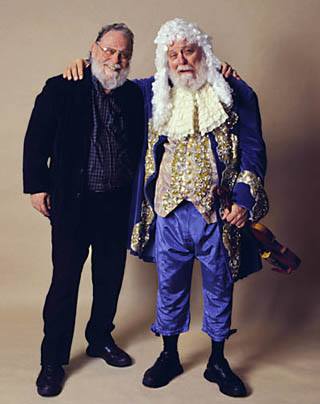
Peter Schickele Birthday Bash on WWFM
Peter Schickele is best known for his “discovery” of the last and least of Bach’s alleged progeny, P.D.Q. Bach (the 21st of Bach’s 20 children). P.D.Q. Bach has been the vessel for musical parody ranging from high to low (frequently low) for more than 50 years – this often at the expense of Schickele the “serious” composer. Schickele, a pupil of Roy Harris, has composed over 100 works. It seems strange to describe them as serious, since, although they are not outright comic, they often convey a kind of genial wit. We’ll enjoy two faces of Peter Schickele today, on his birthday.
We’ll also hear Samuel Barber’s “Knoxville: Summer of 1915,” after James Agee’s nostalgic reminiscence. It’s a coin toss as to whether it will be sung by Eleanor Steber, who commissioned the work, or Dawn Upshaw, who made one of the finest recordings of the digital age. Both singers were born on this date.
In addition, there will be music by August Söderman, Woijiech Kilar and Donald Francis Tovey, all with birthday anniversaries on July 17.
That’s a lot of candles to blow out. I’m saving my breath for between 4 and 7 p.m. EDT, on WWFM – The Classical Network and wwfm.org.
-

Christmas Music Advent Calendar & More
Since it appears I am no longer doing live air shifts at WWFM, other than the odd pledge drive – and therefore have no outlet for my love of Christmas music, beyond the limited scope of my specialty shows – I thought I would make the most of Facebook and, this being the first day of Advent, initiate kind of a musical Advent calendar.
Every day through Christmas, I will try to offer something seasonal, if not in the body of my regular post, then as a special “Advent calendar” supplement.
I’ll kick things off with music of Sergei Lyapunov. After all, today is his birthday (see my main post). Here is his “Fêtes de Noël” (“Christmas Festival”), Op.41:
It falls into four tableaux:
No. 1 “Nuit de Noël” (“Christmas Night”)
No. 2 “Cortège de mages” (“Procession of the Magi”)
No. 3 “Chanteurs de Noël” (“Christmas Carolers”)
No. 4 “Chant de Noël” (“Christmas Carol”)And since my guest tonight on “The Lost Chord” is Peter Schickele, here is P.D.Q. Bach’s “Consort of Christmas Carols.”
No. 1 “Throw the Yule Log On, Uncle John”
No. 2 “O Little Town of Hackensack”
No. 3 “Good King Kong Looked Out”The “Consort of Christmas Carols” will be among the works performed on Dec. 5, when Schickele appears at The College of New Jersey in Ewing. “The Lost Chord” can be heard at 10 p.m. ET, with a repeat Wednesday evening at 6, at http://www.wwfm.org.
Happy Holidays!
Tag Cloud
Aaron Copland (94) Beethoven (95) Composer (114) Film Music (148) Film Score (143) Film Scores (255) Halloween (97) John Williams (196) KWAX (232) Leonard Bernstein (105) Marlboro Music Festival (125) Movie Music (163) Mozart (91) Opera (215) Philadelphia Orchestra (90) Picture Perfect (174) Princeton Symphony Orchestra (110) Radio (90) Ross Amico (244) Roy's Tie-Dye Sci-Fi Corner (290) The Classical Network (101) The Lost Chord (269) Vaughan Williams (107) WPRB (397) WWFM (881)