Tag: Paderewski

  • Paderewski Virtuoso Statesman Legend

    Paderewski Virtuoso Statesman Legend

    The Polish virtuoso Ignacy Jan Paderewski is one of those rare interpreters from classical music’s past – in the company of Paganini, Caruso, Toscanini, and perhaps a few others – that still flits around the periphery of the public consciousness.

    A star pupil of Theodor Leschetizky (who studied with Czerny, who in turn studied with Beethoven), Paderewski exuded a magnetism that enthralled audiences. Beyond his technical prowess, he possessed an extraordinary stage presence. His striking looks, immense charisma, and an almost Pre-Raphaelite combo of unruly mane, mustache, and soul patch made him one of classical music’s true matinee idols. His enormous success on the concert stage lent wings to his political and philanthropic activities.

    Later, he would be appointed Prime Minister of Poland and Minister of Foreign Affairs. His signature is on the Treaty of Versailles that ended World War I. His own compositions promoted a romantic image of his homeland. One of these, “Fantasie Polonaise,” provided the basis for Sir Edward Elgar’s orchestral work “Polonia,” written for a Polish Relief Fund concert organized by Paderewski in London in 1916. The concert was but one of Paderewski’s numerous – far too numerous to enumerate in a mere Facebook post – charitable and patriotic contributions. The same could be said of the extent of his honors. I’m a little pressed for time this morning, so it will have to do!

    In addition, Paderewski was once a regular presence in Princeton. For a time, he taught at the university, before accepting the presidency of City College of New York. One of his recitals here, in 1925, included Beethoven’s “Waldstein” Sonata and one of Liszt’s Hungarian Rhapsodies, perhaps No. 2. Princeton University Concerts continues to hold an annual Paderewski Memorial Concert in his honor.

    It’s been said that by the time the pianist was making recordings and appearing in films that his technique had become a shadow of its former self. (After hearing Paderewski play at the end of one of his exhausting American tours, the Polish pianist Moriz Rosenthal quipped, “Yes, he plays well, I suppose, but he’s no Paderewski.”) Still, there are glimmers of the artist – and the presence – that he once was.

    Happy birthday, Jan Ignacy Paderewski (1860-1941)!


    Paderewski plays Chopin (film: “Moonlight Sonata,” 1937)

    Paderewski plays Chopin (1912), with interview (1940)

    Liszt’s “Hungarian Rhapsody No. 2” (film: “Moonlight Sonata,” 1937)

    Paderewski, Symphony in B minor “Polonia”

    Paderewski, “Fantasie Polonaise,” performed by Earl Wild, with the London Symphony Orchestra conducted by Arthur Fiedler

    Elgar’s “Polonia”

    Paderewski plays his once-famous “Minuet” (1937)

    More Chopin (recorded 1923-30)

    Over an hour of his earliest recordings. (Paderewski was already in his early 50s.)
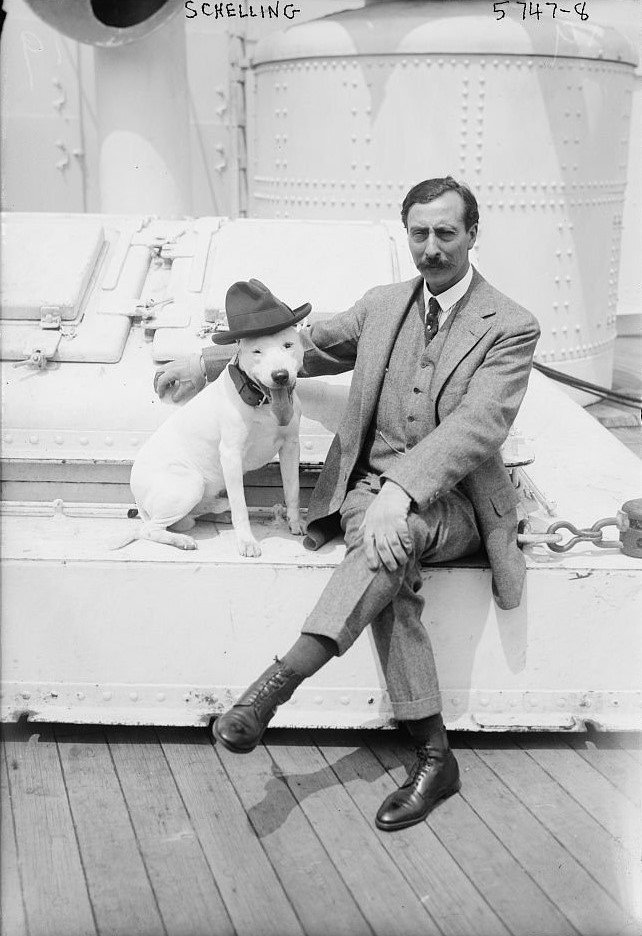
  • Ernest Schelling: Jersey Boy and Granados’ Fate

    Ernest Schelling: Jersey Boy and Granados’ Fate

    You might say that Ernest Schelling was a Jersey boy who made good. He also happened to be responsible, in part, for the death of Enrique Granados.

    Schelling, a celebrated pianist who for a period of three years became the exclusive pupil of Ignacy Paderewski, was born in Belvidere, NJ on this date in 1876.

    A child prodigy, he made his debut at Philadelphia’s Academy of Music at the age of 4. At 7, he was admitted to the Paris Conservatory. Among the other notable musicians he worked with were Hans Huber, Moritz Moszkowski, and Theodor Leschetizky. Leschetizky was the pupil of Carl Czerny, who of course studied with Beethoven.

    As a conductor, Schelling became music director of the Baltimore Symphony Orchestra, which he led from 1935 to 1937. Well before Bernstein, he conducted the New York Philharmonic Young People’s Concerts, beginning in 1924. They were such a success, he took them on tour, with stops in Philadelphia, Los Angeles, London, and Rotterdam.

    Schelling gave the U.S. premiere of Granados’ piano cycle “Goyescas.” In fact it was he who encouraged the composer to craft the music into an opera. Granados liked the idea, and “Goyescas” was given its first performance at the Metropolitan Opera in 1916.

    It created such a sensation that Woodrow Wilson – former president of Princeton University and former governor of New Jersey – invited the composer to the White House, an offer Granados could hardly refuse. Granados postponed his homeward journey. A few weeks later, he was drowned in the English Channel, after his ship, the S.S. Sussex, was torpedoed by a German submarine.

    Thanks a lot, Ernest Schelling – and by the way, happy birthday.


    Schelling plays Liszt’s Sonata in B minor:

    Willem Mengelberg conducts Schelling’s “A Victory Ball:”

    A selection from Schelling’s “Suite Fantastique:”


    PHOTO: Shipboard with Ernest Schelling and friend

Tag Cloud

Aaron Copland (92) Beethoven (95) Composer (114) Film Music (119) Film Score (143) Film Scores (255) Halloween (94) John Williams (185) KWAX (229) Leonard Bernstein (99) Marlboro Music Festival (125) Movie Music (134) Opera (198) Philadelphia Orchestra (87) Picture Perfect (174) Princeton Symphony Orchestra (106) Radio (87) Ralph Vaughan Williams (85) Ross Amico (244) Roy's Tie-Dye Sci-Fi Corner (290) The Classical Network (101) The Lost Chord (268) Vaughan Williams (102) WPRB (396) WWFM (881)

DON’T MISS A BEAT

Receive a weekly digest every Sunday at noon by signing up here


RECENT POSTS