As an animal lover, I’ve always had a soft spot for St. Francis of Assisi. (Also, I was fortunate enough to visit his hometown before the devastating earthquakes of 1997.)
Today is Saint Francis’ feast day. This is a saint who was never too busy to chat with the birds or to befriend a wolf. He introduced the crèche to Christmas, complete with livestock. He even lobbied for a special law so that people would provide for the birds and the beasts. How could you not love this guy?
Regardless of one’s creed, no one, I should think, would take umbrage at the idea of love and respect for the natural world. Take a moment today to be kind to the animals. Hug your pet. Water the birds. Let a cricket out of the house. Bless all animals! Then enjoy some of the music below, only a fraction of the music inspired by St. Francis.
———-
Franz Liszt’s “Saint Francis of Assisi Preaching to the Birds” (piano)
Liszt’s “Saint Francis of Assisi Preaching to the Birds” (orchestra)
Francis Poulenc’s “Quatre petites prières de saint François d’Assise”
Paul Hindemith’s “Nobilissima Visione” (suite, conducted by the composer)
Concert pianist Paul Wittgenstein lost his right arm during World War I. Rather than abandon his career, he began commissioning keyboard works for the left hand from some of the day’s leading composers – including Maurice Ravel, whose Concerto for the Left Hand became the most successful of its kind in the repertoire.
In 1922, Wittgenstein approached Paul Hindemith, at 27, a rising star of German modernism – indeed of the radical avant-garde – to produce his “Klaviermusik mit Orchester.”
Wittgenstein’s reaction to the piece is unknown, although we can easily surmise. He wasn’t even satisfied with the Ravel, gravitating instead toward the more Romantic – I hesitate to say heart-on-the-sleeve – temperaments of Franz Schmidt and Erich Wolfgang Korngold. Wittgenstein never played the Hindemith in public. Furthermore, since he had secured exclusive performance rights, he wouldn’t allow anyone else to play it, either.
Following the pianist’s death in 1961, Wittgenstein’s widow relocated to a farmhouse in Pennsylvania, where for decades she kept all of her husband’s belongings in a single room. When the estate was finally catalogued in 2002, a copy of the Hindemith concerto was discovered among Wittgenstein’s effects, along with other scores, correspondence, and items of interest, including locks of both Beethoven’s and Brahms’ hair.
It was Leon Fleisher who gave the belated premiere of the concerto, some 80 years after it was written, with the Berlin Philharmonic, conducted by Sir Simon Rattle. Somebody posted the audio on YouTube.
The U.S. premiere also featured Fleisher, with the San Francisco Symphony, conducted by Herbert Blomstedt. What do you know, that’s been posted too.
I was present at the U.S. East Coast premiere, with Fleisher and the Curtis Symphony Orchestra, conducted by Christoph Eschenbach. If you listen carefully to the recording, made at Philadelphia’s Verizon Hall, at the Kimmel Center for the Performing Arts, on April 27, 2008, and issued on the Ondine label, you might even be able to hear me applaud. It’s posted here as a YouTube playlist, over multiple videos.
Wittgenstein may not have thought much of Hindemith, but Glenn Gould clearly adored him. Here Gould elaborates on the nature of the fugue, illustrating his points with a selection from Hindemith’s Piano Sonata No. 3.
Gould at the keyboard for Hindemith’s Trumpet Sonata
And for his “Marienleben”
Get all keyed-up for Paul Hindemith on his birthday!
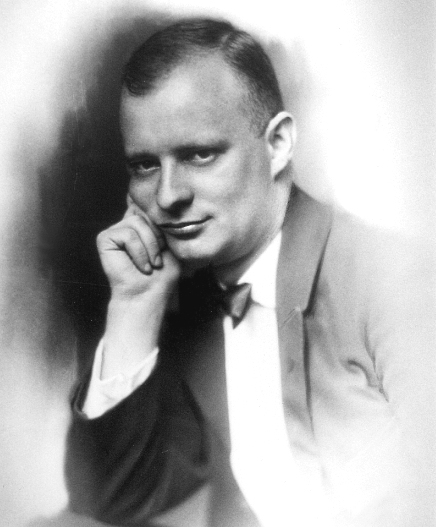
PHOTOS (from left): Hindemith in 1923; Wittgenstein; Gould; Fleisher with yours truly
I always suspected there was more to Paul Hindemith than meets the ear. No question, he was one of the 20th century’s most influential composers, especially in the United States, where he offered a respectable alternative for young composers to the Schoenberg school of twelve-tone composition. But he sure could blanch the color out of tonality. You can have your tonal music, but don’t let it get too voluptuous!
Of course, it wasn’t always that way. There was an iconoclastic edge to a lot of his earlier works. At least they made one sit up and take notice – including the Nazis, who booted him out of Germany. Occasionally, he’d come up with something like “Mathis der Maler,” which manages to be both sober and spiritual. But seldom does he rollick, as he does in his popular “Symphonic Metamorphosis of Themes by Carl Maria von Weber.” I suppose letting down your hair doesn’t necessarily come naturally to one who doesn’t have any.
Blame it on Hindemith’s philosophical adherence to “gebrauchsmusik” – in English, “utility music” – functional music written on demand, whether the Muse happens to be “in” or not. Hindemith penned reams of it. But it’s not all like being trapped in the back seat of your parents’ car on a long trip with nothing but a gray crayon.
Clearly the man did have a sense of humor, and liked to share inside jokes with his wife, Gertrud, whom he married in 1924. There is, for example, the Concerto for Woodwinds, Harp and Orchestra, with its third-movement allusions to Mendelssohn’s “Wedding March.” The work was premiered on May 15, 1949 – the couple’s silver wedding anniversary.
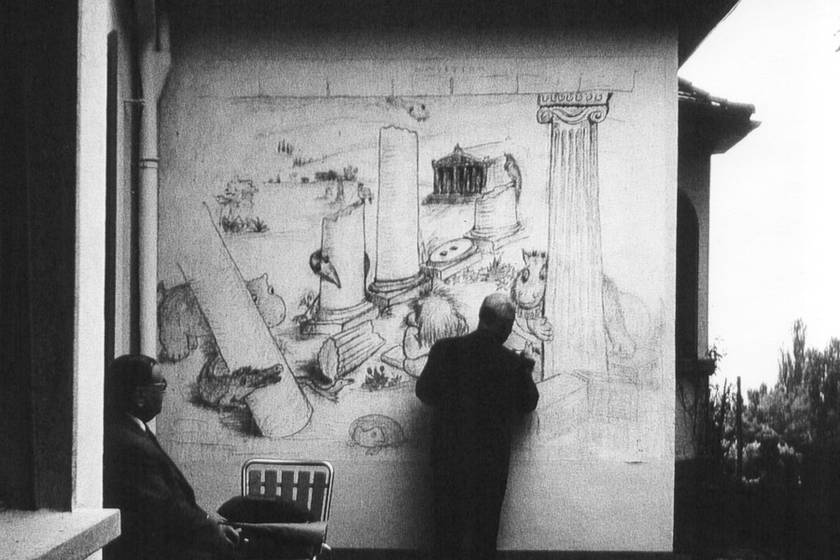
Hindemith was also a talented draughtsman, whether doodling in his manuscripts or sketching a mural on an outside wall of their Swiss villa. He was especially fond of designing his own Christmas cards. Sometimes the drawings were Thurberesque, with perhaps just a touch of Gerard Hoffnung’s whimsy when approaching musical subjects. Sometimes they were executed with a little more care.
He frequently included lions in his drawings. This was not a reference to St. Jerome, but rather to Hindemith’s wife, who happened to be a Leo. I find that touching, and rather human. A good deal more so than some of his music.
Concerto for Woodwinds, Harp and Orchestra (with Mendelssohn allusions beginning around 10:49)
Classic recording of “Mathis der Maler” Symphony, conducted by William Steinberg
Hindemith in a rare swashbuckling mood, from the “Symphonic Metamorphosis”
Hindemith the iconoclast (punctuated by a siren)
One of my most hated Hindemith works – get out the gray crayons!
And one of the most touching, written in a mere six hours the day after the death of King George V, as a last-minute replacement for Hindemith’s viola concerto “Der Schwanendreher,” and played by the composer himself on a live radio broadcast over the BBC not long after completing it at 5 p.m.
Who says Paul Hindemith didn’t have a sense of humor? Sure, his music could be as dry as dust, and he wrote too much of it, but the fact that he was so prolific practically guaranteed a trove of masterpieces amongst the stodgers.
This one’s no masterpiece, maybe, but it is marked by a certain amount of wit and therefore refreshingly engaging. The full title is “Overture to the Flying Dutchman as Sight-read by a Bad Spa Orchestra at 7 in the Morning by the Well” (1925). Less well-known than Mozart’s “A Musical Joke,” it hits many of the same marks. It’s the kind of painful Hindemith I can get behind.
Hindemith was kind of like a 20th century Telemann, spewing well-crafted music by the yard. But the price of such extraordinary productivity is that he often ran the risk of teetering into prolixity, and what we sometimes wind up with is an awful lot of spaetzle. Hindemith could be a real noodler. This one might be my most-hated Hindemith piece, “Gebrauchsmusik” at its worst:
But when he was on, he was on, and some of the orchestral pieces, especially, can be glorious, thrilling, and even transcendent in their luminosity.
My personal breakthrough with this composer came with an album released in the late 1980s, on London Records, with Herbert Blomstedt and the San Francisco Symphony. Not only does it contain the most exciting recording of Hindemith’s “Symphonic Metamorphosis of Themes by Carl Maria Weber” I have ever heard – and that’s saying something, since it must be his most-recorded work – but it also introduced me to an unexpectedly moving piece called “Trauermusik” (“Mourning Music,” or “Funeral Music”).
Hindemith, also a violist, was in London to give the UK premiere of his new concerto, “Der Schwanendreher,” scheduled for January 22, 1936. The timing was lousy. King George V died a few minutes before midnight on January 20. Not surprisingly, the concert was cancelled, but the BBC and conductor Sir Adrian Boult wanted to make use of Hindemith in whatever it was they decided to do in its place. The next morning, they set Hindemith up in a quiet office, with plenty of pencils and a stack of blank staff paper, and six hours later he emerged with a new concert piece, which he played the same night as part of a special memorial broadcast. That’s the kind of a composer Hindemith was.
Toward the end of the work Hindemith quotes a chorale by Johann Sebastian Bach, “Fur deinen Thron tret ich hiermet” (“Here I stand before Thy throne”). It was the composer’s great good fortune that the melody turned out to have added resonance, as it is widely recognized in England as “the Old 100th.” What could easily have been a mere occasional work, destined for a single performance and then lost to oblivion, actually turned out to be one of his most moving pieces.
Here is Hindemith that actually touches the heart. The violist is Geraldine Walther, then principal violist of the SFS.
Okay, Hindemith, so you have a soul. You’ve touched me with your humanity. Happy birthday.
Here’s another worthwhile Hindemith piece I discovered as part of an extensive set of his orchestral works recorded by Werner Andreas Albert – a Concerto for Woodwinds, Harp and Orchestra (1949). Note the quotation from Mendelssohn’s “Wedding March” in the last movement, a surprise for the composer’s wife. The premiere took place on their silver wedding anniversary.
Bernstein conducts the “Mathis der Maler” Symphony (1934) on TV in 1964
Happy birthday to the man some historians describe as the most arcane of the movie Stooges. Somewhere between Joe Besser and Curly Joe DeRita, Paul Hindemith enjoyed a brief stint as Curly Joe Gebrauchsmusik. In this capacity, his most riotous gag was laying a flugelhorn down on Moe’s jelly sandwich. Musicians loved him, but audiences tended to find him tedious.
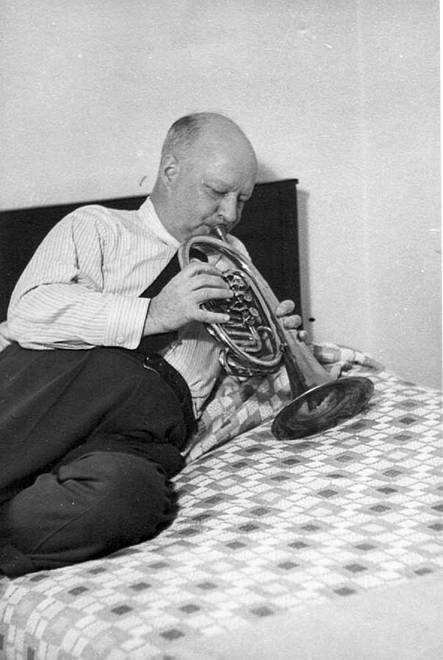
Here’s Curly Joe Gebrauchsmusik playing his flugelhorn in bed. Because that’s just the kind of guy he was. Writing music even when most people would be sleeping. When asked why it was he didn’t just sleep like everyone else, he replied, “There will be plenty of time for that when I’m in the audience.”