Perhaps the weather in the Philadelphia-Princeton area has been more conducive to film noir, but this week on “Picture Perfect,” I’ll be giving you the chance to dream about the great outdoors. Sundrenched plains and horses, that is.
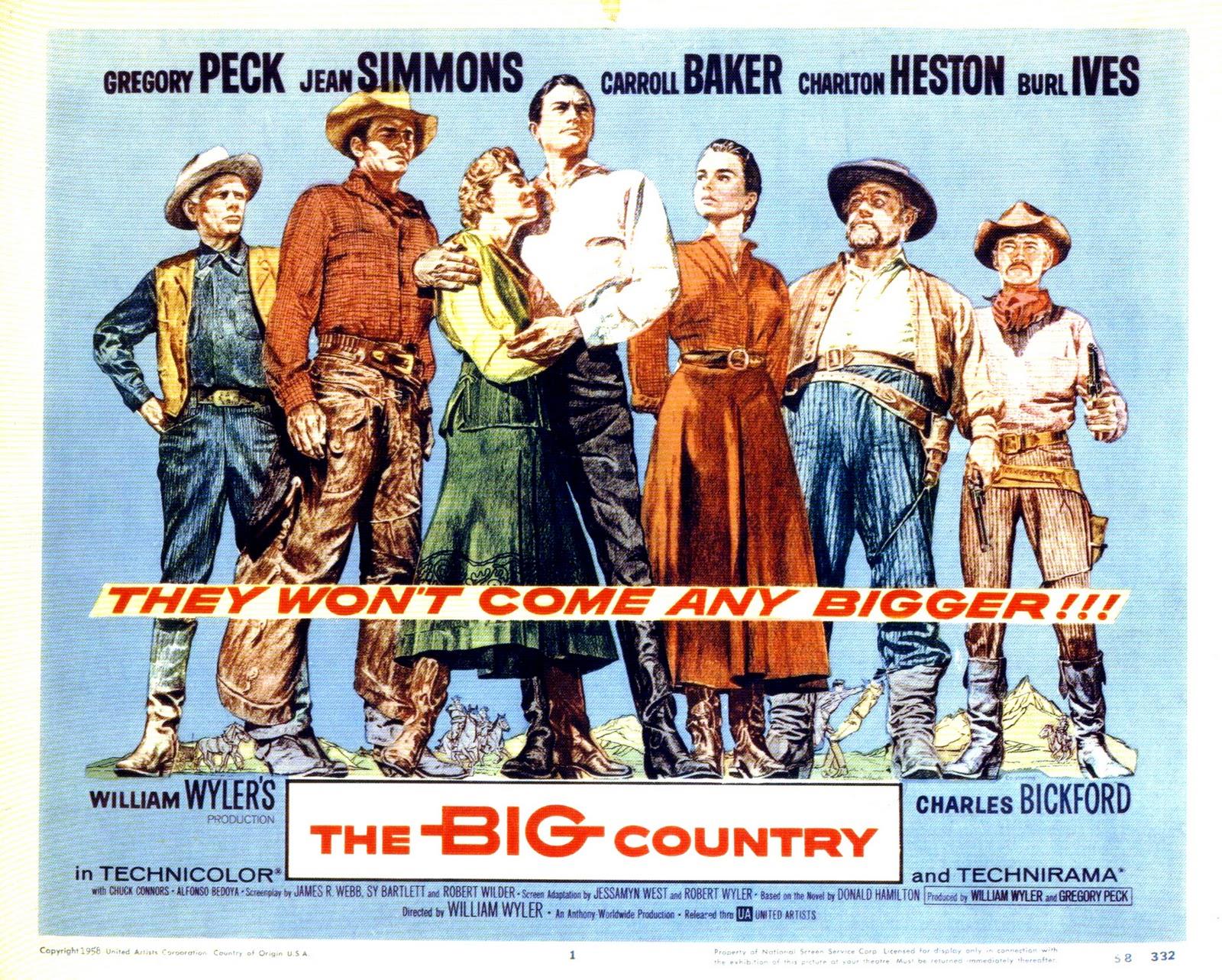
We’ll combat the effects of light deprivation with an hour of music from some big movie westerns – including “The Big Country” (1958, with music by Jerome Moross), “The Big Sky” (1952, by Dimitri Tiomkin), “Big Jake” (1971, by Elmer Bernstein) and “Silverado” (1985, by Bruce Broughton).
It’s all BIG this week, under the bright, open skies of the American west, on “Picture Perfect,” music for the movies, this Friday evening at 6 EDT, with a repeat Saturday morning 6; or you can listen to it later as a webcast at wwfm.org.
April fools! No, not the holiday (such that it is); I’m talking about the performers.
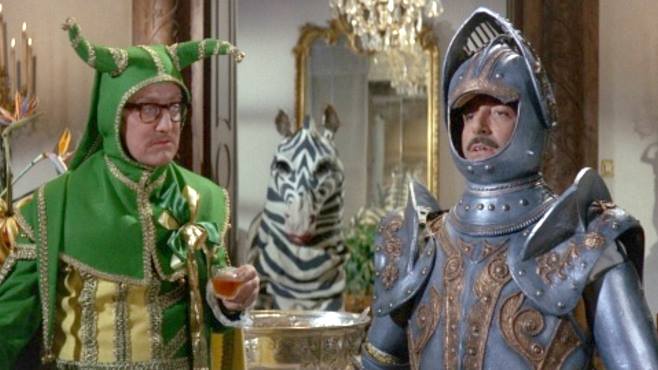
This week on “Picture Perfect,” we’ll have musical selections from big screen comedies. For whatever reason, it’s seldom that we get a chance to sample from comedy scores. The emphasis is usually on drama or action. The more I think about it, it seems very few scores for comedies tend to achieve classic status – proportionately speaking, of course.
Henry Mancini never seemed to have a problem with that, thanks in no small part to his long association with director Blake Edwards. We’ll hear music from my three favorite installments in “The Pink Panther” series – the original (1963), “A Shot in the Dark” (1964), and “The Pink Panther Strikes Again” (1976). That’s right, the one where Chief Inspector Dreyfus goes stark raving mad and determines to destroy the world with a doomsday ray, as the franchise hilariously jumps the shark.
Imagine how difficult it must be to write music for comedy, without it coming across as sounding like cartoon music. Which isn’t always necessarily a bad thing. With Pee-Wee Herman back on Netflix, we’ll hear some of Danny Elfman’s music for “Pee-Wee’s Big Adventure” (1985). The film marked the feature debut of director Tim Burton. It was Burton’s first teaming with composer Danny Elfman, who would become a regular collaborator. Elfman is obviously a big fan of Nino Rota.
If you ever wanted to see Alastair Sim in drag, then I’ve got the film for you. Sim, you’ll recall, played Ebenezer Scrooge in the classic 1951 film version of “A Christmas Carol.” A few years later, he appeared in “The Belles of St. Trinian’s” (1954) in two roles – as the headmistress of a girl’s school and her criminal brother. None other than Malcolm Arnold provided the music hall-style score.
“It’s a Mad Mad Mad Mad World” (1963) is a relic from the “more is more” school of comedy, with Milton Berle, Sid Caesar, Ethel Merman, Mickey Rooney, Phil Silvers, Terry-Thomas, Jonathan Winters, Jimmy Durante, and a tired Spencer Tracy. Ernest Gold’s approach to the music is defined by a manic waltz.
Before John Williams became a household name, with music for blockbusters like “Jaws” and “Star Wars,” he was known as Johnny Williams, when writing for television shows like “Lost and Space” and “Gilligan’s Island,” and for a string of mostly forgettable movie comedies.
“A Guide for the Married Man” (1967) starred Walter Matthau and Robert Morse. Interestingly, the film was directed by Gene Kelly, and a number of cast members from “It’s a Mad Mad Mad Mad World” have cameos. (It seems you couldn’t make a film of this kind without Terry-Thomas.) Looking back on the score is fascinating, in that there are already hints of the Williams we know in the thick of very period-specific music.
Elmer Bernstein, who wrote music for such classics as “The Ten Commandments,” “The Magnificent Seven” and “To Kill a Mockingbird,” received a second wind in the late ‘70s, when he was offered the chance to score “National Lampoon’s Animal House,” produced by Ivan Reitman and directed by John Landis. This led to opportunities to work on “The Blues Brothers” and “Ghostbusters,” among others. We’ll wrap things up with some of Bernstein’s music for the Reitman service comedy, “Stripes,” which teamed Bill Murray and Harold Ramis. The key to Bernstein’s big success as a comedy composer during the era is that, musically, he mostly played it straight.
I hope you’ll join me tonight at 6 EDT, with a repeat tomorrow morning at 6, as we unscrew the tops on the salt shakers and swap out the hard-boiled eggs, on “Picture Perfect: Music for the Movies.” Or that you’ll listen to it later, from a safe distance, as a webcast, at wwfm.org.
Every once in a while, when faced with the challenge of programming film music for Easter, I try to shake it up a bit, so that I’m not playing Biblical epics every year. With this in mind, the focus on this week’s “Picture Perfect” will be on four scores from films about nuns and missionaries.
“Black Robe” (1991), directed by Bruce Beresford, is based on a novel by the Irish Canadian writer Brian Moore. The film tells the tale of a Jesuit priest who treks through 1500 miles of Canadian wilderness on a mission to convert the native tribes of the Huron and the Algonquin. The evocative score is by Georges Delerue.
The Powell-Pressburger classic, “Black Narcissus” (1947), is one of those amazing films that just sort of sneaks up on you. Psychological and emotional tensions abound in a tale of repressed nuns struggling to maintain their composure in a voluptuous Himalayan valley. Somehow it manages to inspire a kind of awe in the viewer, as the wheels begin to spin off the tracks.
The stunning cinematography is by Jack Cardiff. Incredibly, the entire film was shot in England, mostly on soundstages, at Pinewood Studios. Brian Easdale (of “The Red Shoes” fame) wrote the music.
Audrey Hepburn gave one of her most impressive performances in Fred Zinnemann’s “The Nun’s Story” (1959). A young woman enters a convent of nursing sisters and undergoes many trials in the hopes of becoming a missionary in the Belgian Congo. The film also features Peter Finch, Edith Evans, Peggy Ashcroft, and, in a memorable early role, Colleen Dewhurst. The music was by Franz Waxman.
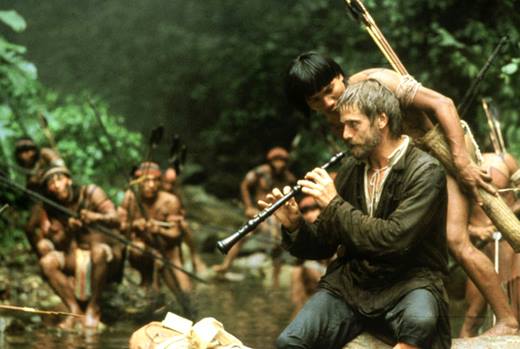
We’ll conclude with selections from one of Ennio Morricone’s best-loved scores, that for “The Mission” (1986). Jeremy Irons plays a Jesuit priest, who penetrates the South American jungle to convert the native Guarani to Christianity. Robert DeNiro plays a reformed slave hunter. The moving score has received a great deal of exposure over the years through its use in television commercials and by figure skaters, who have made “Gabriel’s Oboe” a recognizable hit.
I hope you’ll join me for music from films about nuns and missionaries this week on “Picture Perfect,” this Friday evening at 6, with a repeat Saturday morning at 6; or that you’ll listen to it later as a webcast at wwfm.org.
This week on “Picture Perfect,” the focus is on airports and airplanes. Believe it or not, I actually had the idea before I learned of the death of George Kennedy on Sunday at the age of 91. Kennedy appeared in all four of the “Airport” films – “Airport,” “Airport 1975,” “Airport ’77,” and “The Concord: Airport ‘79” – as cigar-chomping airline troubleshooter Joe Patroni. Only Patroni could fire a flare out the window of the Concorde and not have his arm ripped off.
In the original “Airport” (1970), producer Irwin Allen established the pattern for disaster movies of all stripes by placing an aging all-star cast in spectacular peril. Burt Lancaster! Dean Martin! Jean Seberg! Jacqueline Bisset! Helen Hayes! The list goes on and on, longer than the longest runway. The bongo-laden theme was by veteran composer Alfred Newman, from the last of his over 200 film scores.
Another movie with something of the same feel is “The V.I.P.s” (1963), allegedly inspired by a real-life love triangle made up of Vivien Leigh, Laurence Olivier and Peter Finch. The story is set at London Heathrow Airport, where flights are delayed because of a dense fog. The film was written by Terrence Rattigan, and sports a laundry list of stars, including Elizabeth Taylor, Richard Burton, Louis Jourdan, Maggie Smith, Rod Taylor and Orson Welles, with Margaret Rutherford in an Academy Award-winning performance. The music was by Miklós Rózsa.
By contrast, Steven Spielberg’s “The Terminal” (2004) is an (intentionally) comic take on the predicament of an Eastern European who finds himself in a kind limbo, trapped in an international arrivals airport terminal in New York after his country erupts into civil war and his passport and other documentation are no longer valid. His plight mirrors that of real-life Mehran Karimi Nasseri, an Iranian who lived 17 years in a terminal at Charles de Gaulle Airport.
Tom Hanks plays the unfortunate traveler, who makes the terminal his home, and Catherine Zeta-Jones the airline attendant with whom he strikes up a relationship. The music was by regular Spielberg collaborator John Williams, and I think you’ll find it quite different from the Williams known for his work on “Star Wars” and “Indiana Jones.”
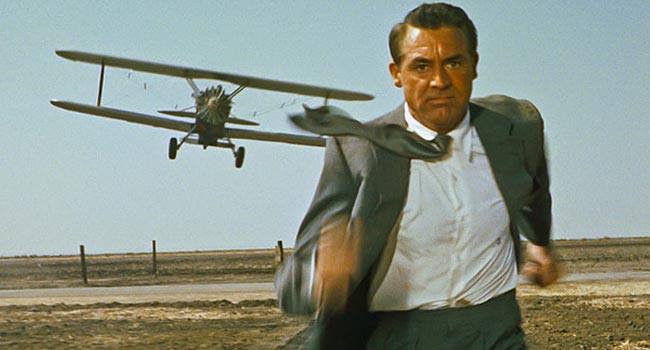
Finally, we turn to the Alfred Hitchcock thriller, “North by Northwest” (1959), a film which had Cary Grant encountering love and danger in, on, and from a variety of planes, trains and automobiles. Planes are particularly significant. Over the course of the film, we find out the title is a play on a Northwest Airlines flight; Eva Marie Saint learns she must do all she can to avoid getting on another; and of course the film’s most iconic image is that of Grant fleeing a strafing crop duster. Bernard Herrmann’s opening fandango propels us into the adventure.
I hope you’ll join me for an hour of music from films featuring airports and airplanes this week on “Picture Perfect,” tonight at 6:00 ET, with a repeat tomorrow morning at 6; or that you’ll listen to it later as a webcast at wwfm.org.
For anyone interested in previewing this year’s nominees for Best Original Score, last week’s “Picture Perfect” has been posted as a webcast, as has this week’s “Oscar Party” of classic film themes. It’s a great way to kill two hours as you anticipate the Academy Awards.