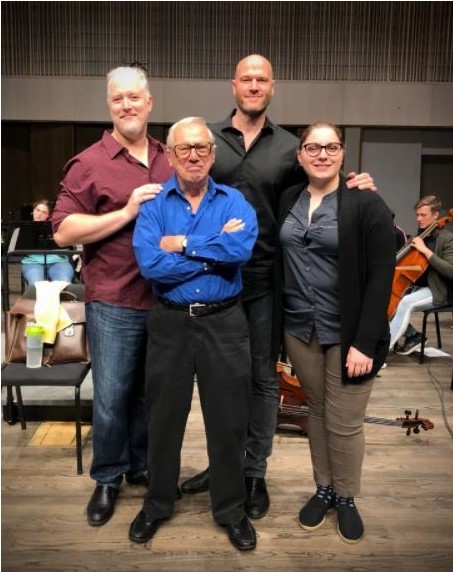
Robert Moran has made “Composers Datebook”… again! The program is being aired today, on classical music stations all across the country (including WWFM – The Classical Network and wwfm.org, at 5:01 p.m. EST). If you can’t find it, or you just can’t wait, it’s also been posted here:
https://www.yourclassical.org/programs/composers-datebook/episodes/2021/01/08
While you’re at it, be sure to follow the link to Moran’s “Lunchbag Opera.”
This seems like a good time to mention that Bob has not one, but TWO new albums out on Neuma Records.
“Points of Departure” (1993), the title track of the first, may just be the composer’s most frequently performed orchestral work. With its origins in the dance, the piece grooves to a post-minimalist pulse. I would think it would be a welcome addition to any afternoon drive-time playlist. It’s been recorded before, most notably by the Baltimore Symphony Orchestra conducted by David Zinman.
The program also includes two works that are new to me. “Angels of Silence” (1973) stands apart from the composer’s freewheeling “city pieces” of the same era by conjuring a more interior world of spare melodies, long-held lines, and static chords. At 22 minutes in this performance, with viola soloist Maria Rusu, it is the polar opposite of drive-time. Put it on when you’re in a meditative mood. “Star Charts and Travel Plans I” (2016-17) is also dreamy and beautiful, with evocative colors, and at 4 minutes in length, it leaves you wanting more.
But my personal favorites are the works with voice, which are also the most ardent. “Frammenti di un’opera barocca perduta” (2017) – “Fragments of a Lost Baroque Opera” – is marked by the kind of tender luminosity that first attracted me to Bob’s music, close to 25 years ago, when I encountered the suite from his opera “Desert of Roses.” Yet at its center is an aria that kicks even higher than “Points of Departure.” Daniel Bubeck is the versatile countertenor. The inclusion of a harpsichord is a nice touch. Even so, in spite of its title and its texts – three meditations on love, previously employed by various Baroque masters – this is no mere pastiche.
Finally, “Yahrzeit” (2002/2018), formerly for chorus and piano, is heard in a new arrangement. This moving memorial to Michael Neal Sitzner, on a text by James Skofield, his partner, benefits from its orchestration – the added warmth deepening the emotion of an already poignant work – and the contribution of bass-baritone Zachary James.
In all selections, the University of Delaware Symphony Orchestra is conducted by devoted Moran champion James Allen Anderson.
The second album offers something completely different. “Buddha Goes to Bayreuth” (2011-14) is an ambitious canvas spanning some 66 minutes. Scored for two choirs and two string ensembles, the work takes its inspiration from the fact that Wagner once toyed with the idea of composing a music drama on the life of Buddha. Moran lifts his chords from “Parsifal,” then filters them through the chance-operations of the “I Ching.” Add in the reverberant acoustic of Salzburg Cathedral (in its definitive, two-movement form, the work was given its premiere at the Salzburg Festival in 2014), and the result is haunting, contemplative, at times even ecstatic. The texts, though indecipherable, are fragments of ancient Tibetan mantras. Countertenor Stefan Görgner joins the KammerChor KlangsCala Salzburg and Stuttgarter Kammerorchester, conducted by Rupert Huber, for this antiphonal, transcendent wallow.
Thanks, Bob, for the embarrassment of riches. Happy birthday!
PHOTO: A blue-shirted Moran, flanked by (clockwise from left) James Allen Anderson, Daniel Bubeck, and Maria Rusu