Tag: Richard Goode

  • Rachmaninoff Busoni and Marlboro’s Serkin & Goode

    Rachmaninoff Busoni and Marlboro’s Serkin & Goode

    Today is one of those remarkable days, on which two masters of the same instrument happened to be born. (Another is February 2, which gave us both violinists Fritz Kreisler and Jascha Heifetz.) In addition to it being the anniversary of the birth of pianist-composer Sergei Rachmaninoff (in 1873), it is also the birthday of Ferruccio Dante Michelangelo Benvenuto Busoni (in 1866). Clearly, Ferruccio Busoni’s parents had great expectations for their boy!

    “Music from Marlboro” is on hiatus from WWFM – The Classical Network for the duration of the COVID-19 lockdown. However, it’s still possible to enjoy great Marlboro performances on recordings. Here’s a jawdropping performance of Busoni’s “Fantasia contrappuntistica,” a vertiginous knucklebuster played with elan by 16 year-old Peter Serkin and 20 year-old Richard Goode.

    Marlboro School of Music and Festival: Official Page

  • Classical Music Highlights Today on The Classical Network

    Classical Music Highlights Today on The Classical Network

    Ever wonder where I got the signature tune for “Picture Perfect?” Tune in to The Classical Network this afternoon to enjoy “Theater Set” by Elie Siegmeister, on his birthday. Siegmeister arranged music from his only film score, for the Gary Cooper-Rita Hayworth film “They Came to Cordura” (1959) into this concert suite, performed by Howard Hanson and the Eastman-Rochester Orchestra.

    We’ll also celebrate composer Aaron Jay Kernis, born in Philadelphia sixty years ago today. And to fill in around the edges, we’ll hear works by honorary Philadelphians Jennifer Higdon and Robert Moran.

    Two notable pianists were also born on this date. Ruth Slenczynksa will perform music by Robert Schumann, and Malcolm Frager will be the soloist in Richard Strauss’ “Burleske.”

    At 6:00, it’s another “Music from Marlboro.” The focus this week with be on former co-director of the Marlboro Music School and Festival, Richard Goode. Goode will participate in chamber music by Ferruccio Busoni and Johannes Brahms.

    You might say a Goode time is guaranteed, when you tune in today, between 4 and 7 p.m. EST, on WWFM – The Classical Network and wwfm.org.

  • Richard Goode: Marlboro Music Spotlight

    Richard Goode: Marlboro Music Spotlight

    If it’s Goode, you know it’s got to be great.

    On this week’s “Music from Marlboro,” we’ll celebrate pianist Richard Goode. Goode served as co-artistic director (with Mitsuko Uchida) of the Marlboro Music School and Festival, from 1999 to 2013. On and off, he’s been part of the fabric of Marlboro since he was 14 years-old.

    We’ll sample his artistry in outstanding performances of music by Ferruccio Busoni and Johannes Brahms.

    Inspired in part by Bach’s “Art of the Fugue,” Busoni composed his “Fantasia contrappuntistica” for solo piano in a flurry of inspiration in 1910. His arrangement for two pianos followed. I think you’ll agree, there’s no substitute for its thrilling antiphonal effects.

    The work is built into one continuous span, but subdivided into twelve parts – a prelude and variations on the Bach chorale “Ehre sei Gott in der Höhe” (“Glory to God in the Highest”) – capped by a quadruple fugue. The laws of counterpoint are rigorously applied, in a manner that would have made even Max Reger smile.

    The work was composed during a whirlwind tour of the United States. Busoni was especially proud of his ability to make every note of the fugue “sound.”

    We’ll hear it performed on a Marlboro spin-off recording from 1964, with Richard Goode and Peter Serkin, making musical mincemeat of this vertiginous knuckle-buster. Goode was only 20 years-old at the time – and Serkin was 16!

    Bach was also an important source of inspiration for Johannes Brahms. Following the death of his mother, the composer was discovered by one of his friends, weeping over the keyboard as he played through works by the Baroque master.

    Also stemming from his loss was Brahms’ Horn Trio in E flat major, Op. 40. The horn, which takes the place of the cello in the traditional configuration of the piano trio, was a highly unusual choice for chamber music, but one which must have recalled for Brahms the lessons he had taken as a child.

    Fortuitously, the instrument also has rustic associations. It was during a walk in the Black Forest that the composer first “heard” the trio’s opening theme. While the work is a celebration of nature, and in the last movement, perhaps even the hunt, the tempo marking of the third movement adagio is characterized as “slow and sad.” Brahms uncovers a well of emotion in the quotation of a German funeral melody, “Wer nur den lieben Gott läßt walten” (“If thou but suffer God to guide thee”).

    Demonstrating the kind of continuity that makes Marlboro shine among summer music festivals, we’ll again hear Richard Goode, this time in middle age, joining hornist Marie-Luise Neunecker and violinist Mark Steinberg, in 1989.

    We’ve never had it so Goode, on the next “Music from Marlboro,” this Wednesday evening at 6:00 EST, on WWFM – The Classical Network and wwfm.org.

    Marlboro School of Music and Festival: Official Page


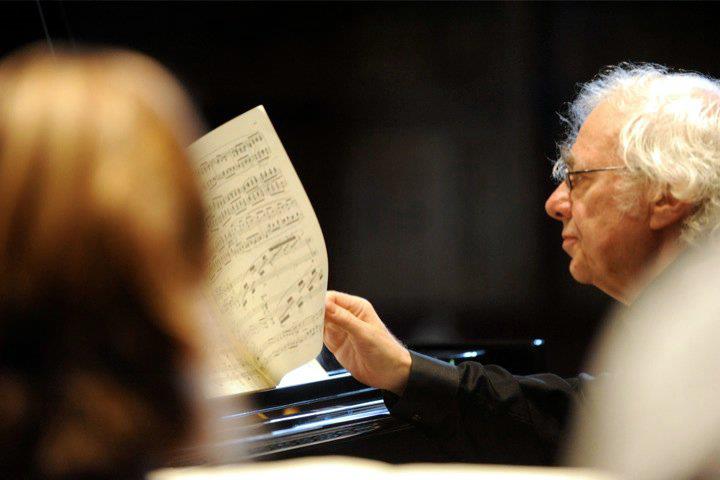
    FOR THE GREATER GOODE: Richard Goode at Marlboro in 2011

  • Brahms: Beyond the Bearded Bear

    Brahms: Beyond the Bearded Bear

    It’s amusing that the most enduring image of Johannes Brahms is that of a gruff and portly, bearded old bear, incongruously disposed to writing lullabies.

    Lest we forget, Brahms was once a slender young man with piercing blue eyes, who wore his hair long and caused Clara Schumann, 17 years his senior, to confide to her diary, “He is so masterful that it seems God sent him into the world complete.”

    Also, he liked his coffee strong.

    Don’t expect anything too grandfatherly on this week’s “Music from Marlboro,” when the focus will be on Brahms’ unusually intense Piano Quintet in F minor.

    This is not music of wistful recollection. The quintet is often tempestuous and even tragic, fueled by all the passion and earnestness of an excitable young man. Brahms began his quintet in 1862, when he was 29 years-old.

    That’s not to say the composer ever teeters over into sentiment or excess of a kind common to his fin-de-siècle successors. Even in his 20s, Brahms was too much himself ever to allow that to happen.

    Instead he takes the prototype of the piano quintet – established by his friend and mentor, Robert Schumann – and fashions it into something unsettled and at times downright sublime. We are in the presence of something great, but also perhaps a little terrifying.

    This masterpiece of Brahms’ early maturity began life as a string quintet, written under the spell of Schubert’s famous Quintet in C. Brahms showed the work in this form to Clara Schumann and his friend, the violinist Joseph Joachim. Both were full of praise, at least at first, but gradually the compliments gave way to suggestions. Joachim, in particular, admired the work’s power, but confessed he found little in it to charm.

    Undaunted, Brahms took the piece and arranged it for two pianos in 1863-64, consigning the original version, for strings alone, to flames of woe. This two-piano reworking was politely rather than enthusiastically received, and Clara, thinking now it sounded more like a transcription than an original composition, begged him to recast it once more.

    The third time proved to be a charm. The resulting quintet, which achieved its final state in the summer of 1864, was met with resounding acclaim. At last, the piece had arrived at a perfect marriage of expression and form.

    While Brahms retains the classical poise for which he is so well known, he stiffens the sinews and conjures the blood, so to speak. In fact, there are times when he ratchets up the tension so effectively it seems the music might just fly off the rails.

    We’ll hear an exciting performance from the 2007 Marlboro Music Festival, featuring pianist Richard Goode, violinists Augustin Hadelich and Benjamin Beilman, violist Samuel Rhodes, and cellist Amir Eldan.

    In tandem with the whole “bearded bear” thing, Brahms is generally pigeonholed as the Classicist among Romantics. With this in mind, I’ll open the hour with a work by Walter Piston, the great American classicist, a two-time Pulitzer Prize winner, who gained esteem as one of our worthiest symphonists. These days, his symphonies are hardly ever played (more’s the pity), but we sure do hear his ballet “The Incredible Flutist” – probably his least characteristic composition.

    Piston’s 1946 “Divertimento for Nine Instruments” was performed at the Marlboro Music Festival in 1977, by violinists Young Uck Kim and Mitchell Stern, violist Karen Dreyfus, cellist Jerry Grossman, double bassist Julius Levine, flutist Julia Bogorad, oboist Roger Cole, clarinetist Stewart Newbold, and bassoonist Sol Schoenbach.

    It is, after all, called “classical music.” Tune in for worthwhile works by a pair of classicists, on the next “Music from Marlboro,” this Wednesday evening at 6:00 EDT, on WWFM – The Classical Network and wwfm.org.

    Marlboro School of Music and Festival: Official Page


    PHOTOS: Boy, Brahms… you really let yourself go!

  • Brahms’ Intense Piano Quintet at Marlboro Music

    Brahms’ Intense Piano Quintet at Marlboro Music

    Don’t expect anything too drowsy on this week’s “Music from Marlboro,” when the focus will be on Johannes Brahms’ unusually intense Piano Quintet in F minor.

    This is not music of wistful reflection. The quintet is often tempestuous and even tragic, fueled by all the passion and earnestness of an excitable young man. Brahms began his quintet in 1862. He was 29 years-old.

    That’s not to say the composer ever teeters over into sentiment or excess of a kind common to his fin-de-siècle successors. Even in his 20s, Brahms was too much himself ever to allow that to happen.

    Instead he takes the prototype of the piano quintet – established by his friend and mentor, Robert Schumann – and fashions it into something unsettled and at times downright sublime. We are in the presence of something great, but also perhaps a little terrifying.

    This masterpiece of Brahms’ early maturity began life as a string quintet, written under the spell of Schubert’s famous Quintet in C. Brahms showed the work in this form to Clara Schumann and his friend, the violinist Joseph Joachim. Both were full of praise, at least at first, but gradually their compliments became outpaced by their suggestions. Joachim, in particular, admired the work’s power, but confessed he found little in it to charm.

    Undaunted, Brahms took the piece and arranged it for two pianos in 1863-64, consigning the original version, for strings alone, to flames of woe. This two-piano reworking was more politely than enthusiastically received, and Clara, thinking it sounded more like a transcription now than an original composition, begged him to recast it once more.

    The third time proved to be a charm. The resulting quintet, which achieved its final state in the summer of 1864, was met with resounding acclaim. At last, the piece had arrived at a perfect marriage of expression and form.

    While Brahms retains the classical poise for which is so well known, he stiffens the sinews and conjures the blood, so to speak. In fact, there are times when he ratchets up the tension so effectively it seems the music might just fly off the rails.

    We’ll hear an exciting performance from the 2007 Marlboro Music Festival, featuring pianist Richard Goode, violinists Augustin Hadelich and Benjamin Beilman, violist Samuel Rhodes, and cellist Amir Eldan.

    Proceed at your own risk. Safety gear will not be provided, on this week’s “Music from Marlboro,” this Wednesday evening at 6:00 EDT, on WWFM – The Classical Network and wwfm.org.

    Marlboro School of Music and Festival: Official Page

Tag Cloud

Aaron Copland (92) Beethoven (95) Composer (114) Film Music (123) Film Score (143) Film Scores (255) Halloween (94) John Williams (187) KWAX (229) Leonard Bernstein (101) Marlboro Music Festival (125) Movie Music (138) Opera (202) Philadelphia Orchestra (89) Picture Perfect (174) Princeton Symphony Orchestra (106) Radio (87) Ralph Vaughan Williams (85) Ross Amico (244) Roy's Tie-Dye Sci-Fi Corner (290) The Classical Network (101) The Lost Chord (268) Vaughan Williams (103) WPRB (396) WWFM (881)

DON’T MISS A BEAT

Receive a weekly digest every Sunday at noon by signing up here


RECENT POSTS