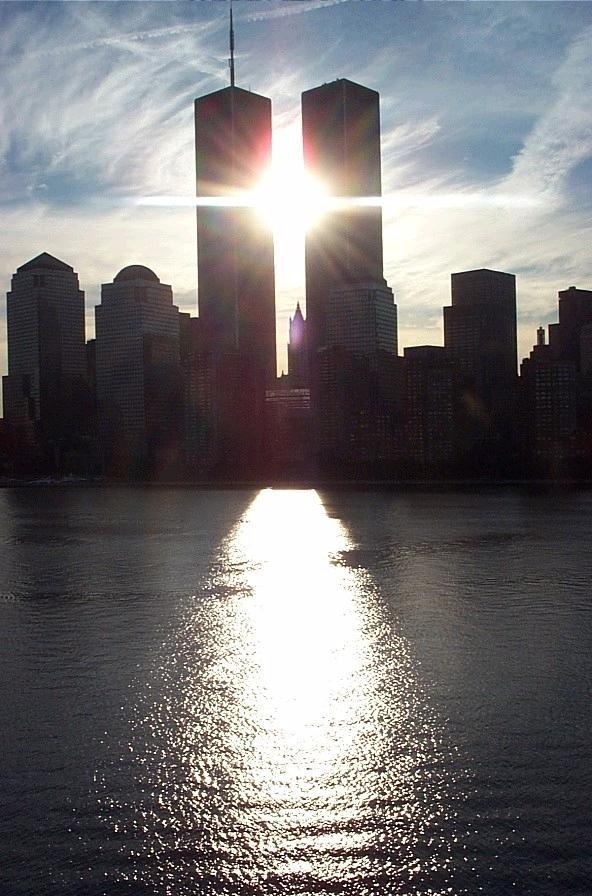
The day after 9/11, I’m sure we’re all ready to put it behind us. But 25 years is a landmark, and I didn’t have a show yesterday on which I could share some appropriate music. There’s only so much one can do with a film music program!
The anniversary is especially sobering this year, as I realize that we are now as far away from the World Trade Center attacks as my birth was from Pearl Harbor. That’s the perspective from which younger generations now perceive 9/11. It’s something that happened a long time ago.
While I understood that abstractly, it only really registered a year or two ago, when I noticed all these irreverent 9/11 posts on social media. Now, I can be as irreverent as the next guy, but these are obviously people who were not old enough to remember 9/11. There are still plenty of folks out there, who aren’t all that old, who experienced the terror first hand or continue to suffer loss, debilitating illness, or even lasting trauma just from having witnessed it on TV. All of us are living now with the legacy of 9/11. The world was forever changed that day, and not for the better. September 11, 2001 was the dawn of a new century of anxiety and dark uncertainty. We are living in unkinder times.
There’s really very little I can add to the countless memorials and reflections surrounding the surreal, unforgettable events of that September morning – a morning that, for those of us old enough to have lived through it, still feels like yesterday. But I’m a radio host, and I have a platform, and I would like to use it to try to encourage some reflection and maybe even offer a little solace. To this end, this Saturday on “The Lost Chord,” I will be presenting an hour of music of remembrance and consolation.
Pulitzer Prize winner Kevin Puts addresses the horrendous imprint of the attacks in his Symphony No. 2, which in a single movement traces an emotional arc from comparative innocence of an almost cinematic benignity, shocked by a sudden, violent upheaval, from which emerges a more reflective epilogue of uncertainty and fluctuating hope. It certainly does not leave one feeling uncompromisingly desolate in the manner of Ralph Vaughan Williams’ Symphony No. 6, the last movement of which some have compared to a world laid waste by atomic warfare.
Philadelphia composer Robert Moran wrote his “Trinity Requiem” to mark the tenth anniversary of the attacks. Moran rises to the occasion to provide an ethereal masterpiece, a 30-minute journey into paradise worthy to stand alongside the transcendent Requiem of Gabriel Fauré.
“Trinity Requiem” received its first performance in 2011 at Trinity Wall Street, the so-called “Ground Zero church” in Lower Manhattan. Miraculously, a hundred-year-old sycamore tree preserved the church’s St. Paul Chapel, constructed in 1766, from destruction by debris from the World Trade Center, including what would have been a direct hit from a falling I-beam. A recording of Moran’s work was released on the Innova label, featuring the Trinity Youth Chorus and members of the Trinity Wall Street Choir under the direction of Robert Ridgell.
“Trinity Requiem” is scored for treble voices, four cellos, organ, and harp. Handbells are employed in the “Pie Jesu.” And, following in the steps of Fauré, Moran includes a setting of “In Paradisum,” emphasizing a desire to attain peace at last.
Listen for a remarkable moment that occurs in the “Offertory” – the fourth movement (built on a bass line employed by Johann Pachelbel in his famous Canon) – when a siren appears. It was not written into the score, but rather actual street noise that bled into the recording session – an eerie bit of serendipity, unavoidably conjuring memories of the horror that unfolded outside the venue a decade before. But it is horror recollected in tranquility.
I hope you’ll join me for “The Persistence of Memory,” music of remembrance and consolation to mark the 25th anniversary of 9/11, on “The Lost Chord,” now in syndication on KWAX Classical Oregon.
———-
Clip and save the start times for all three of my recorded shows:
PICTURE PERFECT, the movie music show – Friday at 8:00 PM EDT/5:00 PM PDT
SWEETNESS AND LIGHT, the light music program – Saturday at 11:00 AM EDT/8:00 AM PDT
THE LOST CHORD, unusual and neglected rep – Saturday at 7:00 PM EDT/4:00 PM PDT
Stream them, wherever you are, at the link!
https://kwax.uoregon.edu/
Tag: Robert Moran
-
Music of Remembrance and Consolation for the 25th Anniversary of 9/11 on “The Lost Chord”
-
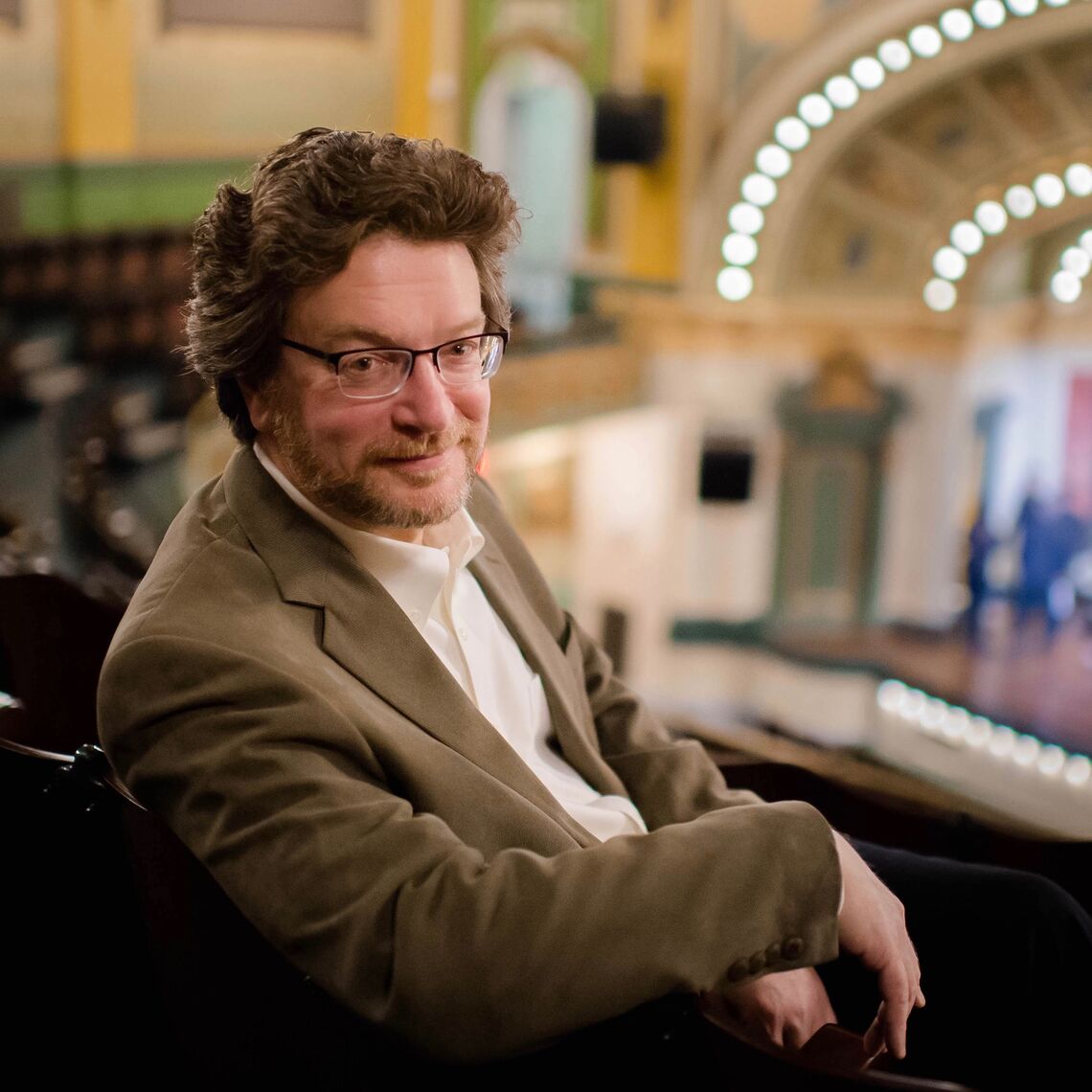
Kile Smith, Renaissance Man
I believe I first met Kile Smith when I invited him onto my radio show, “The Lost Chord,” in 2009. The idea was to bring Kile, at the time host of WRTI’s “Discoveries from the Fleisher Collection,” and Marvin Rosen, host of WPRB’s “Classical Discoveries,” together, so that we could jawbone about forgotten, new, and neglected composers, and also share some unusual music.
While each of our shows had their own distinctive character, there was an undeniable kinship in their questing spirits, and anyway I always admired both men for their programming and their passion. All-encompassing enthusiasm for what one does is invariably compelling. Also, Kile always expresses himself so well, and he’s got a winning presence. Anytime he filled in for another announcer on WRTI, as a listener I felt I’d hit the jackpot.
For this particular program, I handed hosting duties over to composer Robert Moran – the only guest host “The Lost Chord” has ever had – so that I could take my seat at the round table. Well, we had a blast, I think, and afterward we retired to Triumph Brewery. Interestingly, I later wound up working with both Kile and Marvin, thanks in no small part to their advocacy, at WRTI and WPRB.
My friendship with Kile has endured, and although we don’t see one another very often, there is social media and email to offer the illusion of connection, and every time we do meet, at a concert or for a coffee, I think we both walk away feeling enriched. I know Kile elevates me. He is generous, insightful, clever, funny, and real. And I don’t mind saying, I love listening to his voice.
I can’t believe it was on that visit in 2009 – which now seems so long ago – that Kile handed me a recording of his brand-new “Vespers,” featuring the acclaimed choral group The Crossing and the equally esteemed early music ensemble Piffaro, The Renaissance Band. The work is a modern masterpiece and deserves to be performed everywhere. I am honored to have been able to use my position as a radio host to broadcast it a number of times. More often, I’ve played this movement, a real standout, which Kile introduced on my show: his setting of Psalm 113. It’s just so… timeless.
As a composer, a writer, a broadcaster, a photographer, and probably a whole lot of other things I don’t even know about, Kile radiates talent. But he’s also a hell of a nice guy.
Today is his birthday, so send him some love!
You’ll find lots of good things on his website, kilesmith.com. -

Musical Wonder Cabinets on “The Lost Chord”
Cabinets of curiosities, also sometimes referred to as “wonder rooms,” were small collections of extraordinary objects, strange and often fanciful precursors of today’s museums, which attempted to categorize and explain oddities of the natural world. This week on “The Lost Chord,” we’ll have three musical equivalents.
Princeton University professor Dmitri Tymoczko’s “Typecase Treasury” recalls a small table his parents acquired, made from a typecase subdivided into a hundred little compartments. “Each had been filled with a tiny mineralogical curiosity,” he writes, “a strange crystal, a piece of iron pyrite, a shark’s tooth, or a fossilized tribolyte.” He found it a useful metaphor for a multi-movement collection of short pieces, in which he attempts to produce “a sense of form through juxtaposition.”
Grammy Award-winner Michael Colina is perhaps best known for his jazz and Latin projects. However, Colina was classically trained, having studied at the North Carolina School of the Arts, and then abroad, at the Chigiana Academy, in Sienna, Italy. We’ll hear his Violin Concerto, subtitled “Three Cabinets of Wonder,” a work inspired by Fanny Mendelssohn, the Buddha, and an Amazonian nature spirit.
Finally, we’ll sample just a bit from “Cabinet of Curiosities” by Philadelphia-based composer Robert Moran, who’s something of a wonder himself. “The Hapsburg Kunstkammer” employs graphic notation and is scored for marimba, hairbrush, aluminum foil, bells played with fingers, finger cymbals, telephone bell, vibraphone, rubber ball, celesta and harpsichord.
I hope you’ll join me for “Curiouser and Curiouser,” a tour of musical wonder cabinets, on “The Lost Chord,” now in syndication on KWAX Classical Oregon!
https://en.wikipedia.org/wiki/Cabinet_of_curiosities——–
Clip and save the start times for all three of my recorded shows:
PICTURE PERFECT, the movie music show – Friday at 8:00 PM EST/5:00 PM PST
SWEETNESS AND LIGHT, the light music program – Saturday at 11:00 AM EST/8:00 AM PST
THE LOST CHORD, unusual and neglected rep – Saturday at 7:00 PM EST/4:00 PM PST
Stream them, wherever you are, at the link!
-

Chameleonic Robert Moran Is 89
A work for amplified Volkswagen, played with flashlights. An opera for eleven dogs. A piano piece in which the performer crawls inside the lid and lets the piano play him.
Move over, Till Eulenspiegel. Today is the birthday of Robert Moran.
Moran, who’s made his home in Philadelphia for more than 40 years, is contemporary music’s merry prankster.
Following studies in Vienna with Hans Erich Apostel, with whom he “learned to count to twelve” (as in twelve-tone music), Moran attended Mills College, where his teachers were Darius Milhaud and Luciano Berio. His classmates at Mills included Steve Reich, Phil Lesh, and Tom Constanten. Lesh and Constanten went on to play for The Grateful Dead. I wonder what ever happened to Reich?
While there, Moran became involved with the whole San Francisco scene. He gained notoriety in the late 1960s and early ‘70s through a series of performance pieces incorporating entire cities, including San Francisco, Bethlehem, PA, and Graz, Austria. These involved tens of thousands of performers.
His many stage works include “Desert of Roses” (after Beauty and the Beast), written for Houston Grand Opera, and “Alice” (after “Alice’s Adventures in Wonderland”), composed for the Scottish Ballet. Maurice Sendak introduced him to the Grimm fairy tale “The Juniper Tree,” which became an operatic collaboration with Philip Glass.
For the occasion of the tenth anniversary of the terrorist attacks on the World Trade Center, Moran was commissioned to write a work for the youth chorus of Trinity Wall Street, the so-called “Ground Zero” church in Lower Manhattan. “Trinity Requiem,” scored for children’s chorus, four cellos, harp and organ, offers a similar brand of solace to that conjured in the 19th century masterwork by Gabriel Fauré.
With Moran, you never know what you’re going to get. In his more puckish moments, he might write for harpsichord and electric frying pan. But then there are times when his natural gift for lyricism will melt your heart. Whether he’s writing for Houston Grand Opera, 39 autos, giant puppets, or electric popcorn popper, his music is always vital and worth getting to know.
Happy birthday, Bob!
———
An aria from “Desert of Roses”
“Trinity Requiem” (its movements posted into a continuous YouTube playlist)
Flying high over Albania
“Obrigado” for Iowa Percussion
“Bank of America Chandelier”
Experimenting with spatial effects in “Solenga”
“Alice” for Scottish Ballet
Looking groovy and introducing his “Lunchbag Opera” for the BBC“Buddha Goes to Bayreuth”
“Modern Love Waltz” by Philip Glass, arranged by Robert Moran for accordion and cello
“Waltz. In Memoriam Maurice Ravel”
-
Happy Birthday Robert Moran Composer & Friend
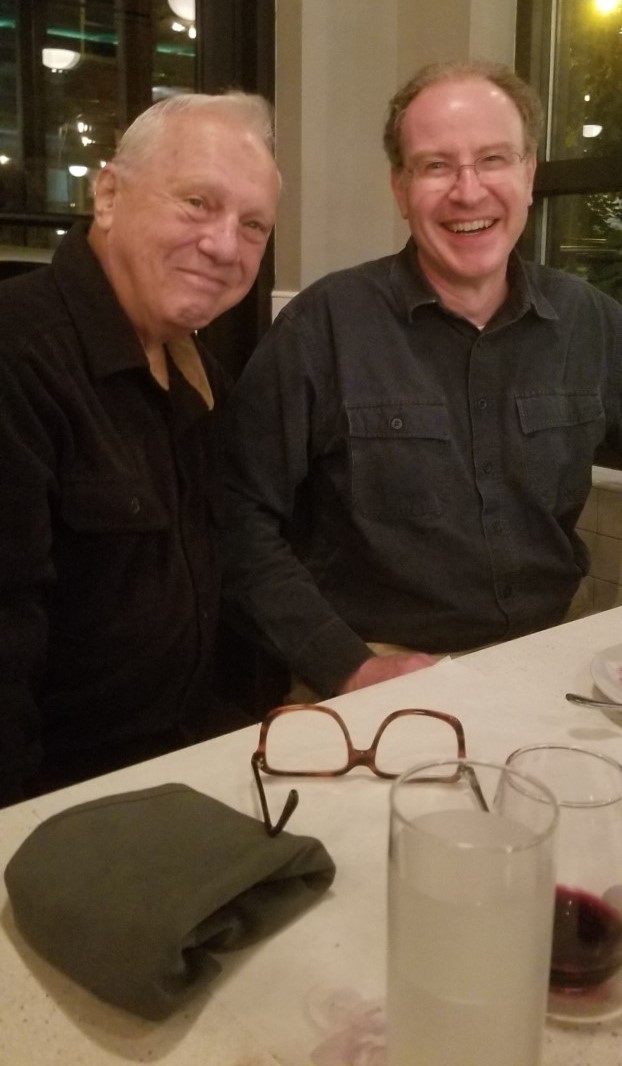
Today is the birthday of my good friend and steadfast companion for Mahler concerts at the Philadelphia Orchestra, composer Robert Moran. A pupil of Darius Milhaud, Luciano Berio, and Hans Erich Apostel, Bob’s experimented with all kinds music, from city-encompassing performance art “happenings,” to collaborations with Philip Glass, to commissions from Houston Grand Opera, Scottish Ballet, and Trinity Wall Street. Throughout his career, he’s often been fascinated by spatial effects in music. This is one of his more recent works, “Solenga,” from 2023:
Bob, if you see this, I’ve been trying to contact you. My computer died the other week and my email account is now over the storage limit, so I can’t write. I’ve been trying to phone, but of course you don’t have voice mail. (Come to think of it, neither do I!) But you can call me, text, or private message me on Facebook, if you are so moved. There’s a dinner invitation in it for you. Happy birthday!
An aria from Bob’s Beauty and the Beast opera, “Desert of Roses”
Selections from “Trinity Requiem,” for the tenth anniversary of 9/11
Flying high over Albania
“Alice” for Scottish Ballet
Looking groovy and introducing his “Lunchbag Opera” for the BBC
“Buddha Goes to Bayreuth,” Part 1
“Buddha Goes to Bayreuth,” Part 2
“Modern Love Waltz” by Philip Glass, arranged by Robert Moran for accordion and cello
“Waltz. In Memoriam Maurice Ravel”
Tag Cloud
Aaron Copland (94) Beethoven (95) Composer (114) Film Music (151) Film Score (143) Film Scores (255) Halloween (103) John Williams (198) KWAX (233) Leonard Bernstein (105) Marlboro Music Festival (125) Movie Music (166) Mozart (91) Opera (217) Philadelphia Orchestra (91) Picture Perfect (174) Princeton Symphony Orchestra (110) Radio (90) Ross Amico (244) Roy's Tie-Dye Sci-Fi Corner (290) The Classical Network (101) The Lost Chord (269) Vaughan Williams (107) WPRB (397) WWFM (881)