Philadelphia composer Romeo Cascarino (1922-2002), who served in the U.S. Army during World War II, composed a plaintive elegy, “Blades of Grass,” in 1945. He expressed a preference, on several occasions, that Carl Sandburg’s poem, “Grass,” be read before performances of the work. Sandburg’s poem was written in 1918, in response to “The Great War.”
Alas, how little the world changed in 27 years. Alas, how little it has changed today.
On Memorial Day, let us honor those who made the ultimate sacrifice by committing to being more conscious of living with compassion, regarding others with respect, striving for peaceful resolutions, and when conflict is unavoidable, acquitting ourselves with honor, humility, and mercy.
These are ideals we may not always live up to, but who are we, if we don’t try to be better?
Pile the bodies high at Austerlitz and Waterloo.
Shovel them under and let me work—
I am the grass; I cover all.
And pile them high at Gettysburg
And pile them high at Ypres and Verdun.
Shovel them under and let me work.
Two years, ten years, and passengers ask the conductor:
What place is this?
Where are we now?
Is it possible that for the first public performance of his Clarinet Concerto, Aaron Copland received a little help from a friend?
While he was still in his teens, in 1940 or ’41, Philadelphia composer Romeo Cascarino was handed a letter from the “Dean of American Composers.” Romeo’s father had sent Copland some of his compositions, and Copland responded with an impressively favorable evaluation. Included in the correspondence was an invitation for Romeo to visit Copland at Tanglewood, home of the Berkshire Music Center, an emerging musicians’ academy located in the Berkshire Hills of Western Massachusetts.
Understandably, the young man was full of anticipation. Tanglewood, also the summer home of the Boston Symphony Orchestra, was a magnet for some of the finest composers, conductors, and musicians of the time.
Following his arrival, Romeo received a further surprise when, upon a second examination of the scores, Copland told him he couldn’t suggest any improvements and that they should remain just as they were. He was especially taken with how naturally Romeo was able to move from key to key. Romeo responded that he never thought compositionally in terms of keys, but simply tried to write the music he was hearing and wished to express.
Copland remembered the young man when, in 1948, an interesting problem arose. He had written his Clarinet Concerto on a commission from Benny Goodman. In the agreement, Goodman was to have two years exclusivity in playing the work. However, Goodman had apparently gotten cold feet. He may have been “The King of Swing,” but tackling a concerto by America’s most revered composer was another kettle of fish entirely.
Copland became uneasy with Goodman’s hesitancy, and as the premiere of the concerto kept getting pushed back, a second performance was arranged with the Philadelphia Orchestra and clarinetist Ralph McLane. Perhaps this was the spur that Goodman required. The concerto was performed at last, just before Goodman’s exclusivity ran out. The premiere performance was given as a broadcast, over the radio, with the NBC Symphony Orchestra and Copland conducting.
HOWEVER, there are those who prefer to credit the second performance as the true premiere, as it was the first time it was ever heard before a live audience, at Carnegie Hall no less.
Here’s where it really gets interesting. For whatever reason, McLane didn’t want to play the cadenza as Copland had written it for Goodman. So he requested another.
This placed Copland, at the peak of his fame, in a bit of a quandary, since it was short notice and he was extraordinarily busy. Under the circumstance, he arrived at a practical solution. With McLane’s knowledge, he would delegate the task of writing a new cadenza, with the proviso that the substitute would be destroyed after the Philadelphia Orchestra performance.
For this delicate operation, which had to be undertaken in comparative secrecy, Copland turned not to any of his gifted proteges – including Leonard Bernstein, Lukas Foss, Irving Fine, etc. – but to the young Philadelphian he recollected from Tanglewood. Such was the regard in which Copland held the younger composer.
The performance, with the cadenza as “ghosted” by Cascarino, enjoyed great success. Cascarino was to remain uncredited and, characteristically, sought none. For subsequent performances, the concerto would be played with Copland’s original cadenza, as written for Goodman.
Goodman and Copland recorded the work twice. Copland regarded the stereo version, with the Columbia Symphony Orchestra, as far and away his personal favorite among the recordings he conducted.
This anecdote is a piece of Cascarino family lore, but I see no reason to disbelieve it. I heard it from the composer’s widow, and she heard it directly from the composer’s lips. Romeo’s reticence on the matter would be entirely characteristic. Consistent with the young man who would have been too shy to reach out to Copland in the first place, in his maturity Romeo remained modest to a fault. Throughout his life, even as he would brook no compromise when it came to the composition and performance of his own music, so he would not engage in self-promotion.
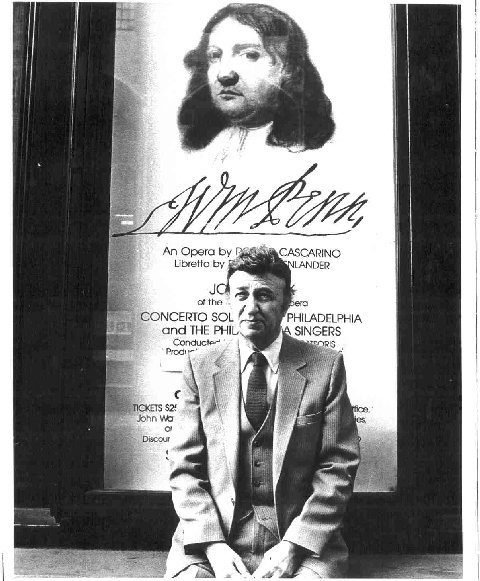
It was only through the intervention of his friend, arts writer Tom Di Nardo, that his opera “William Penn” finally received a series of performances at the Academy of Music in Philadelphia in 1982. Later, Tom pulled some strings to have the orchestral works recorded and released on Naxos.
None of the participants in the musical sleight-of-hand surrounding the Copland concerto are still living, but it’s possible that the proof is still out there, either by way of a scrap of score or surviving testimony. Would that there were, at least for curiosity’s sake, a recording of the McLane performance. Perhaps in the archives of Carnegie or Philadelphia?
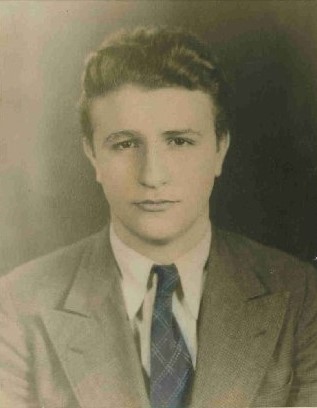
“Meditation,” inspired by Edgar Allan Poe’s “Annabel Lee,” composed in 1935, when Cascarino was 13 years-old, as he is in the photo, left.
In case you missed it, my radio documentary on Romeo Cascarino has been posted as a webcast, just in time for the composer’s centenary.
The show includes commentary by soprano Dolores Ferraro, the composer’s wife for over 40 years, and arts writer and longtime champion Tom Di Nardo; also rare recordings from the family archive, music from a Naxos release of Cascarino’s orchestral music with JoAnn Falletta conducting, and a selection from the composer’s magnum opus, the opera “William Penn.”
On the 100th anniversary of his birth, @[100063618910416:2048:WRTI] celebrates Philadelphia composer Romeo Cascarino. Tune in throughout the day, at approximately 8:25am, 11:00am, and 4:15pm, to enjoy recordings of Romeo’s music. Listen locally at 90.1 FM or anywhere online at wrti.org.
EDIT: Having just read the complete article, thank you, WRTI and Bruce Hodges, for the shout-outs. And for linking my show!
O Romeo, Romeo, wherefore art thou Romeo? Why does no one play your music?
It is well-crafted. It has heart. It is full of beauty. All it lacks is exposure.
This Sunday night on “The Lost Chord,” we salute Romeo Cascarino, in anticipation of the 100th anniversary of his birth on September 28, 1922.
Cascarino grew up in an unforgiving neighborhood in South Philadelphia. With a name like Romeo, he had to learn how to use his fists! While navigating the School of Hard Knocks, he taught himself privately, gleaning the mechanics of music theory from books checked out of the Free Library of Philadelphia. He was discovered by composer Paul Nordoff, who recognized his genius, and the two formed a bond that was more like a friendship than master-disciple.
For many years, Cascarino was a professor of composition at Combs College of Music. The recipient of two Guggenheim Fellowships, he labored at his magnum opus, the opera “William Penn,” for the better part of three decades. The work received its premiere at Philadelphia’s Academy of Music in 1982 to mark the 300th anniversary of the founding of the city.
Metropolitan Opera singer bass-baritone John Cheek sang the title role, Cascarino’s wife, soprano Dolores Ferraro, created the part of Gulielma, Penn’s wife, and Christofer Macatsoris conducted the Philadelphia Singers and the Concerto Soloists of Philadelphia.
Ferraro and arts writer Tom Di Nardo will join me to share their reminiscences and insights into Cascarino, the man and the composer, who died in 2002. I’ve assembled some of their remarks and punctuated the conversation with rare audio from the family archives, as well as studio recordings made by JoAnn Falletta and Sol Schoenbach, former principal bassoonist of the Philadelphia Orchestra.
A seductive, twilit beauty informs much of Cascarino’s output. If only he had completed “William Penn” 30 years earlier, it would now be regarded one of the great American operas of mid-century, spoken of in the same breath as Carlisle Floyd’s “Susanna” and Robert Ward’s “The Crucible.”
I hope you’ll join us in “Remembering Romeo,” this Sunday night at 10:00 EDT, on WWFM – The Classical Network and wwfm.org