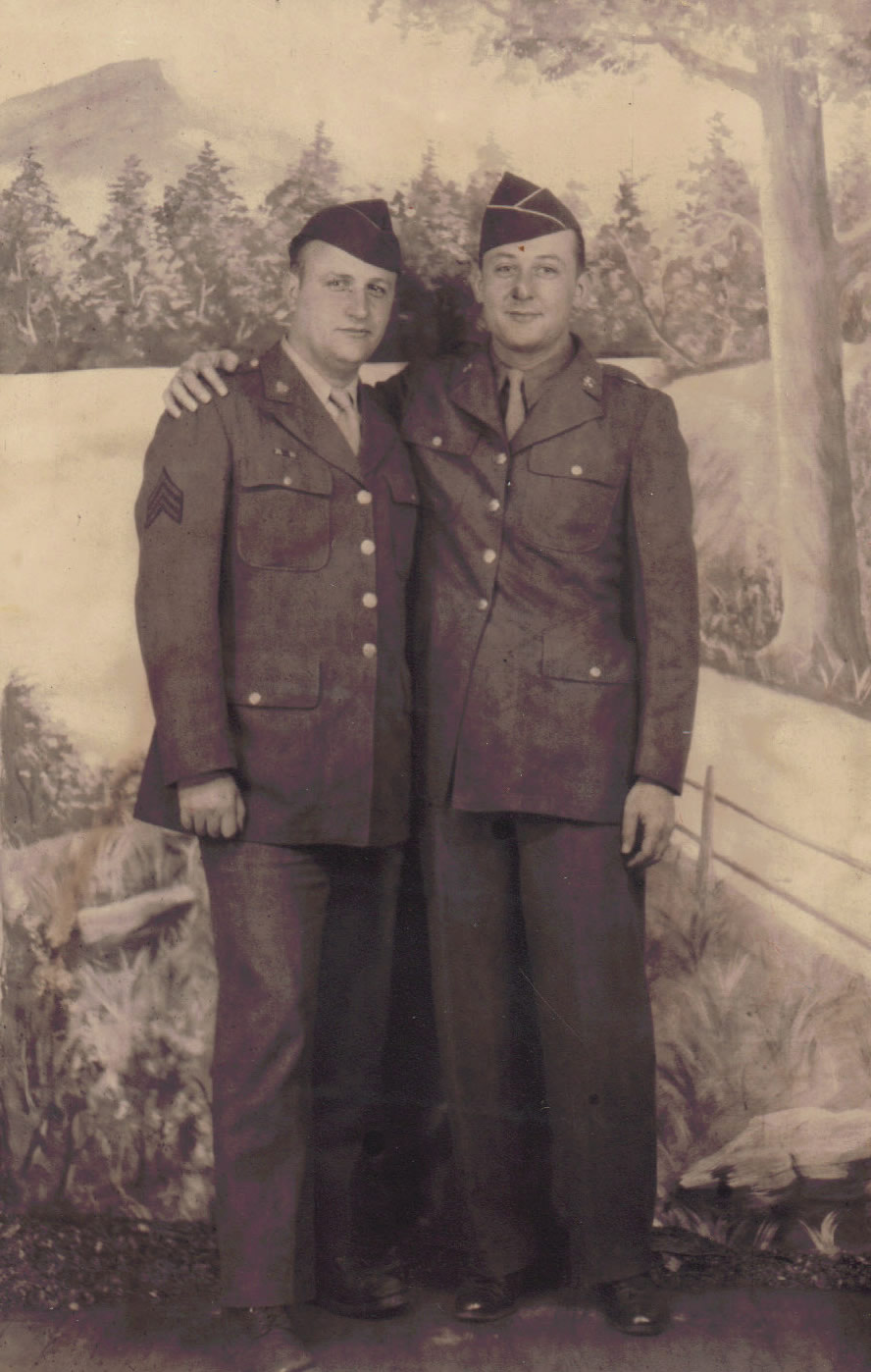
This morning on “Sweetness and Light,” I’ll be hoisting an Irish coffee for St. Patrick’s Day.
Join me for a stirabout of Celtic-inflected works by Henry Cowell, Ina Boyle, Ludwig van Beethoven, Peter Hope, Ignaz Moscheles, A.J. Potter, and Romeo Cascarino. I know, not all of these composers are Irish, but isn’t everyone Irish on St. Patrick’s Day?
Philadelphia composer Romeo Cascarino will be represented by a luscious arrangement of “Danny Boy,” recently released as a digital download, alongside his transporting song cycle “Pathways of Love.”
Your pot of gold is but a click away, on “Sweetness and Light,” this Saturday morning at 11:00 EDT/8:00 PDT on KWAX, the radio station of the University of Oregon!
As a belated Valentine’s treat, a new album has dropped featuring the love songs of Philadelphia composer Romeo Cascarino.
“Pathways of Love” is collection of eight songs on texts by Sara Teasdale, Eugene Field, Robert Frost, and others. Incredibly, Cascarino, who lived from 1922 to 2002, composed all but one of the songs at the age of 16, adding “Little Blue Pigeon,” during his courtship of soprano Dolores Ferraro. Like a latter-day Mendelssohn, he manages to replicate in the newer material the tone of his more precocious utterances.
The couple recorded the songs in their original versions for voice and piano on an Orion LP. The songs were then orchestrated as a set under their unifying title.
Rounding out the new release is Cascarino’s string arrangement of “Danny Boy,” undertaken as a birthday gift for Ferraro, by then long his wife.
The soprano on the new recording is Jessica Beebe, certainly no stranger to Princeton or Philadelphia audiences – although her career has taken her all over the United States, as a soloist, recitalist, and chorister. Aside from her work in opera and oratorio, she’s a member of the Grammy-winning ensemble The Crossing, the Grammy-nominated Clarion Society, and the Grammy-nominated Seraphic Fire.
The conductor is Timothy McDonnell, a Cascarino student.
The recording will be made available on Spotify, Amazon Music, Apple Music, etc. For now, enjoy it on YouTube.
If you like what you hear, don’t forget this lovely album of Cascarino’s orchestral works, conducted by JoAnn Falletta.
I wanted to post this yesterday for Romeo Cascarino’s birthday, but then life got in the way. It’s a computer realization of a rediscovered work by this sadly underperformed Philadelphia composer.
“Epitaph for a Soldier” was written in 1942/43, when Cascarino was around 20-years-old and serving in the U.S. Army.
According to his widow, soprano Dolores Ferraro, “It’s never been performed, just was among the scores in the basement. Romeo never talked much about the war and I was remiss in [not] asking him more about this piece, though I have my ideas. …[I]t’s stunning; dark with angst, thunder and lightning; yet lyrical and hopeful, too.
“We all know a work of Romeo’s would be beautiful, masterfully written and orchestrated, and it is, but different. Of course, the subject matter calls for this. It’s upsetting, moving and exciting! …What a thrill it gave me to hear what a 20-year-old Romeo composed! How painful to think of what he was feeling during that time….”
Its reemergence is like manna from heaven for admirers of the composer, most of whose orchestral output was issued on a Naxos compact disc conducted by JoAnn Falletta.
There’s a biographical profile of the composer beneath the audio file at the link. The realization is by Cascarino pupil Joe Nocella.
Cascarino’s “Blades of Grass,” for English horn and string orchestra, seems to have become his most-frequently encountered work, after perhaps the Bassoon Sonata and maybe some of the songs. The piece, which has been recorded twice, has, in addition to its other qualities, brevity on its side (at approximately nine minutes), so it gets the most radio air play. The work was inspired by a well-known poem of Carl Sandburg, “Grass,” a somber reflection on the nature of conflict and the futility of war, which makes it a good fit for any Memorial Day concert or radio show. Last year, it came to the notice of the U.S. Marine Band. Perhaps they might also be interested in this recent rediscovery?
Cascarino attained the rank of sergeant. His Bassoon Sonata, which I broadcast yesterday on “Sweetness and Light,” was written for his Army buddy, Sol Schoenbach, who went on to become principal bassoonist of the Philadelphia Orchestra.
“Epitaph for a Soldier” is a valuable addition to the composer’s catalogue and another piece wholly suitable for Memorial Day performance. Is there anyone out there in a position to give it its world premiere?
BTW – There are other works by the composer that have either been similarly realized through electronic means or played only by student performers or by the composer himself in private recordings. These include movements for string quartet, piano works, and even a sextet for winds.
If you are interested in taking a look at any of these, send me a note and I’ll put you in touch with Dolores.
Here’s one of my many posts about the composer from last year.
I was really scratching my head on this one. How to construct a unified light music program with such seemingly disparate pieces?
This morning on “Sweetness and Light,” marvel at how gracefully I meet the challenge of marking the birthday anniversaries of composers Romeo Cascarino and Florent Schmitt and also including music from a too-long-deferred pleasure: a recent release of “Latin American Piano Gems” (Centaur 4083) performed by pianist Gila Goldstein.
The unifying theme is sonatinas, or “little” sonatas.
Philadelphia composer Romeo Cascarino’s Bassoon Sonata was written after World War II for his Army buddy Sol Schoenbach, who would go on to become principal bassoonist of the Philadelphia Orchestra. “Sonatina” may not be in the title, but the character is light, and the sonata is only seven minutes long!
Florent Schmitt’s “Sonatine en Trio” is a very happy discovery indeed. There’s a certain neoclassic quality to the music, which we’ll hear in a version for flute, cello and piano, by a French composer whose orchestral works can be quite opulent. The title itself seems to harken back to an earlier time. In fact, the keyboard part was originally conceived for harpsichord. It’s cheering music, and I think you’ll agree, a great start to the day!
“Latin American Piano Gems” is a transporting collection of works by Ernesto Lecuona, Astor Piazzolla, Manuel Ponce, and Heitor Villa-Lobos. We’ll enjoy a piece by Argentine composer Carlos Guastavino, who is largely remembered for his songs. Guastavino wrote his Sonatina while visiting Manuel de Falla, who spent his final years in self-imposed exile in Cordoba, Argentina, following the Spanish Civil War. All in all, a very enjoyable album. We’ll be dipping into it again soon!
This morning’s program will also include delights by Federico Moreno Torroba, Eugène Bozza, Erik Satie, and Ludwig van Beethoven.
I hope you’ll join me for “Small Pleasures” – an hour of sonatinas for varied instruments and instrumental combinations – on “Sweetness and Light,” this Saturday morning at 11:00 EDT/8:00 PDT, exclusively on KWAX, the radio station of the University of Oregon!
I can’t say it’s what the composer intended, but there’s no such thing as bad publicity. Here’s the slow movement of Romeo Cascarino’s Bassoon Sonata – played on theremin and toy piano!
Cascarino, who was born on this date 101 years ago, grew up in an unforgiving neighborhood in South Philadelphia. With a name like Romeo, he had to learn how to use his fists! While navigating the School of Hard Knocks, he taught himself privately, gleaning the mechanics of music theory from books checked out of the Free Library. He was discovered by composer Paul Nordoff, who recognized his genius, and the two formed a bond that was more like a friendship than teacher-student.
While still in his teens, Cascarino was handed a letter from Aaron Copland, inviting him to Tanglewood. Romeo’s father had secretly sent the “Dean of American Composers” some of Romeo’s compositions, and Copland responded with an impressively favorable evaluation. At Tanglewood, upon further examination, Copland said he couldn’t suggest any improvements and that Romeo’s works should remain just as they were.
If you’re interested to know more, I wrote about Cascarino and Copland in further detail last year:
Later, Cascarino served as a professor of composition at Philadelphia’s Combs College of Music. The recipient of two Guggenheim Fellowships, he labored at his magnum opus, the opera “William Penn,” for the better part of three decades. The work received its premiere at Philadelphia’s Academy of Music in 1982 to mark the 300th anniversary of the founding of the city. Metropolitan Opera singer bass-baritone John Cheek sang the title role.
“William Penn” is one of American opera’s best-kept secrets. I’m convinced, if only it had been completed 30 years earlier, it would now be spoken of in the same breath with Carlisle Floyd’s “Susannah” and Robert Ward’s “The Crucible.”
In 2006, a number of Cascarino’s orchestral works were recorded by JoAnn Falletta for the Naxos label. These too are informed by a seductive, twilit beauty.
The Bassoon Sonata was written at the request of Cascarino’s army buddy, Sol Schoenbach, in 1942. The composer made some sketches, but completed the work only after he was discharged. Schoenbach later became principal bassoonist of the Philadelphia Orchestra and recorded the piece for Columbia Records’ “Modern American Music Series.”
This was the not only music to came out of the war. Cascarino composed his plaintive elegy, “Blades of Grass,” in 1945. The title refers to Carl Sandburg’s poem “Grass,” written in 1918, in response to the “Great War.” It seems the work was played by the U.S. Marine Band as recently as last month!
Here it is, performed by English hornist Dorothy Freeman and Philadelphia’s Orchestra 2001.
Happy birthday, Romeo Cascarino, wherever you are. Your music endures, even if we have to thank the Marines, and not the Army, for playing it!
Clockwise from left: Cascarino outside the Academy of Music, before a poster of “William Penn;” at Tanglewood with Aaron Copland (Copland standing, arms crossed, center, with Cascarino the big guy holding the cigarette on the right); and Sgt. Cascarino conducting a U.S. Army band