Tag: Rudolf Serkin

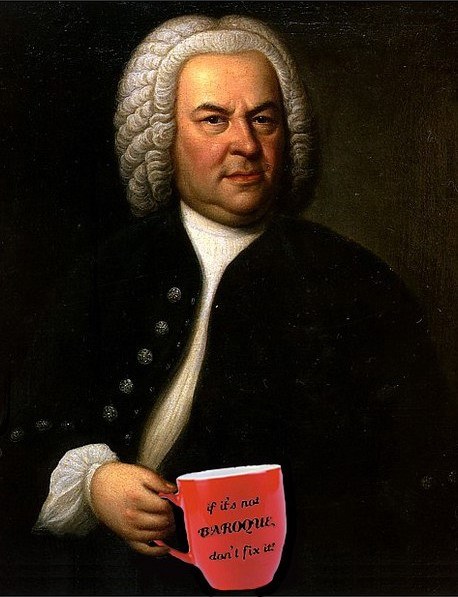
  • Bach at Marlboro: Casals, Serkin & More

    Bach at Marlboro: Casals, Serkin & More

    If, like me, you’re in the Northeast, hopefully you’re enjoying winter’s last gasp (on the second day of spring!) from someplace warm and comfortable, preferably with a mug of tomato soup and a toasted cheese sandwich at your side, and plenty of great music at the touch of a button or the click of a mouse.

    Although The Classical Network’s daylong celebration of Bach’s birthday has been postponed due to the inclement weather, nothing, not even Mother Nature, can impede an all-Bach “Music from Marlboro.” Join me for sublime music-making by the likes of Marlboro legends Pablo Casals, Felix Galimir, Mieczyslaw Horszowski, and Rudolf Serkin. Even the personnel of the Marlboro Festival Orchestra is stuffed with already-legendary and soon-to-be-legendary performers. It doesn’t get any better than this.

    Unfortunately, my original cut for the 58:30 show was an hour and four minutes! There was so much wonderful material, I couldn’t bring myself to delete any of the music, but I had to cut my text to the bone. So here is some of the background material that was left on the cutting room floor.

    About Pablo Casals: The legendary cellist was affiliated with the Marlboro Music Festival for the last 13 years of his life, from 1960 to 1973. It was Casals who, at the age of 13, rediscovered Bach’s cello suites in a thrift shop in Barcelona. His 1939 recordings established the works as cornerstones of the modern repertoire. Casals’ loving, humanistic interpretations of Bach’s orchestral works (as well as those of Mozart, Beethoven, Schubert, Mendelssohn, and Schumann) at Marlboro form a remarkable capstone to an enviable career. We’ll hear Casals in 1965, conducting Marlboro musicians, including trumpeter Robert Nagel, flutist Ornulf Gulbransen, oboist John Mack, and violinist Alexander Schneider, in Bach’s Brandenburg Concerto No. 2.

    About Mieczyslaw Horszowski: The great pianist died in 1993, just shy of his 101st birthday. He had one of the longest careers of any performing artist. Horszowski was a pupil of Theodor Leschetizky, who was a pupil of Carl Czerny, who in turn was a pupil of Beethoven. Horszowski played Beethoven’s Piano Concerto No. 1 in public for the first time in 1901! He joined the faculty of the Curtis Institute of Music in 1942. He remained there for over 50 years, giving his last lesson a week before his death. We’ll hear Horszowski in 1982, performing Bach’s Keyboard Concerto No. 7 in G minor, BWV 1058.

    About Felix Galimir: This marvelous musician had an amazing career. He was a violinist with the Vienna Philharmonic and the NBC Symphony (under Toscanini), formed the Galimir Quartet, and was in residence at Marlboro from 1954 until his death in 1999. Galimir will be on the podium, accompanying the venerable Horszowski in the aforementioned Bach concerto.

    About Rudolf Serkin: The visionary Serkin co-founded the Marlboro Music Festival in 1951, with Adolf and Herman Busch, and Marcel, Blanche, and Louis Moyse. In addition to being one of the most revered pianists of his generation, he managed to direct the festival for 40 years, until his death in 1991. We’ll listen to Serkin’s probing and intimate account, from 1976, of Bach’s 14 Canons, BWV 1087, on the first eight notes of the aria ground from the “Goldberg Variations.”

    Along the way, we’ll also hear a Trio Sonata in G major, BWV 1038, performed in 1974 by flutist Michel Debost, violinist Pina Carmirelli, cellist Ronald Leonard, and harpsichordist Mark Kroll!

    Not much talk from me, but lots of great music, as we celebrate Bach on “Music from Marlboro,” this Wednesday evening at 6:00 EST, on WWFM – The Classical Network. Please support us in advance of our belated Bach birthday celebration (which will take place tomorrow, hopefully, if we’re not under ten feet of snow) at wwfm.org. Thank you for your support, and Happy Birthday, Bach!

    Marlboro School of Music and Festival: Official Page
  • Schubert’s Light & Shadow From Marlboro

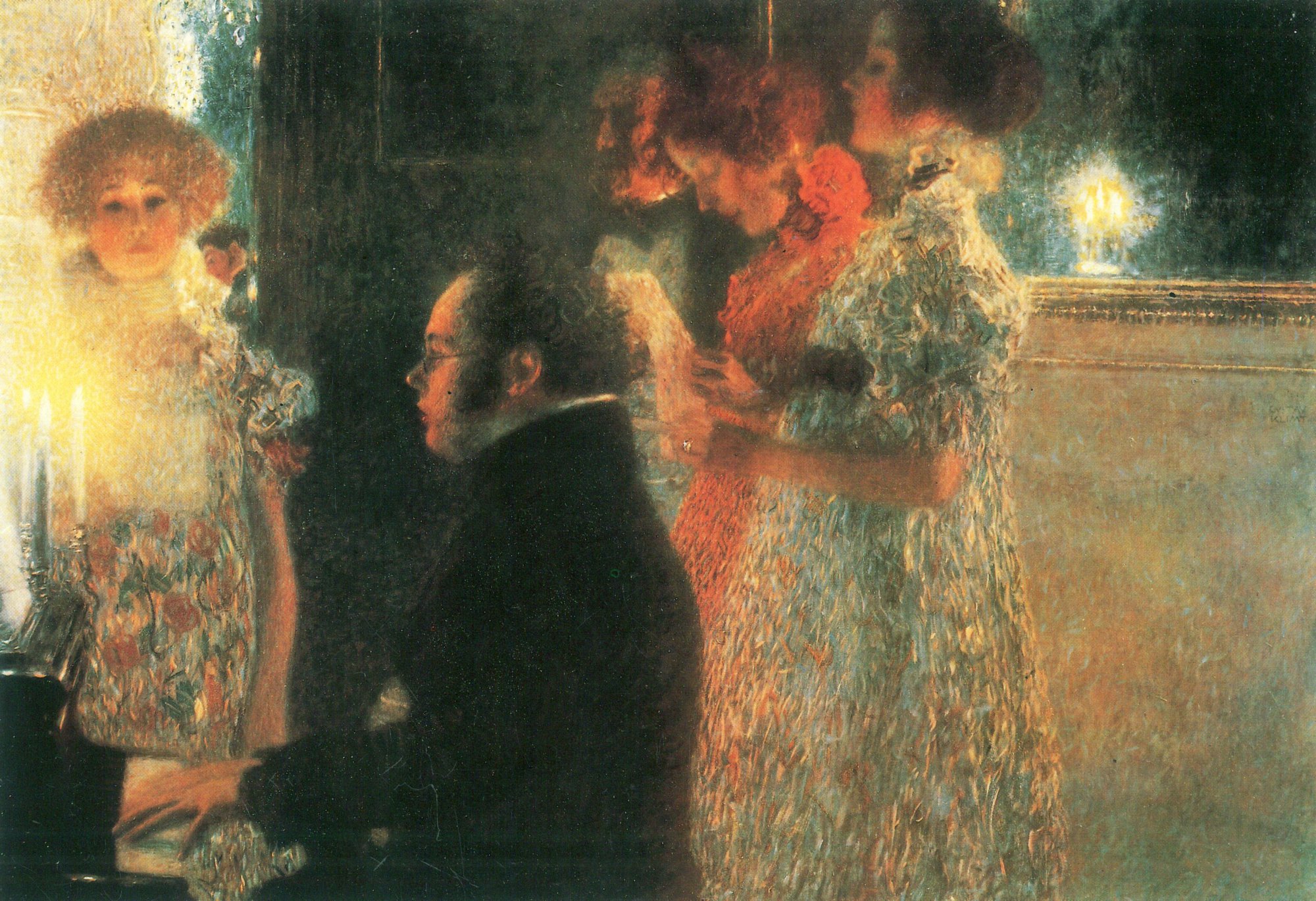
    Schubert’s Light & Shadow From Marlboro

    When we think of the music of Schubert’s final year, what comes across most strikingly, perhaps, is the complexity of feeling. Sensitively modulated light and shadow – the unpredictable contrasts of major and minor, agitation and calm, ecstasy and depression – create a sensation not unlike that experienced when wisps of cloud sweep across the sun on a mild autumn day. We find it in the late piano sonatas; we find it in the transcendent String Quintet in C major. It’s a beauty so intense that it actually kind of hurts.

    Every rule has its exception, of course, and on this week’s “Music from Marlboro,” we catch Schubert in a comparatively light-hearted mood – which I think appropriate on the occasion of his birthday – with his Piano Trio No. 1 in B-flat major, D. 898. While the trio does venture into remote keys and has its share of turbulence, the overarching spirit is very, very far from the eerie resignation of “The Hurdy-Gurdy Man.” In fact, it’s a pretty happy piece. We’ll hear it performed at the 2008 Marlboro Music Festival by pianist Jonathan Biss, violinist David Bowlin, and cellist Marcy Rosen.

    Then we’ll round out the hour with what might possibly have been the final music Schubert ever wrote. “The Shepherd on the Rock,” D. 965, on a text by Wilhelm Müller and Karl August Varnhagen von Ense, was composed barely a month before the composer’s death at the age of 31. The multi-sectional “lied” traverses a wide range of moods, as a shepherd listens to echoes from the valley below, grapples with his feeling of loneliness, and finds hope in the prospect of Spring and rebirth.

    Marlboro veterans, soprano Benita Valente, clarinetist Harold Wright, and pianist Rudolf Serkin, set down a classic – indeed legendary – recording of the work in 1960. This live performance was captured at Marlboro nine years later. In the words of Rudolf Serkin, “An artistic achievement cannot and should not be repeated. Isn’t it a miracle that a performance never is the same?”

    Get ready to share his wonder. It’s an all-Schubert hour, on this week’s “Music from Marlboro,” this Wednesday evening at 6:00 EST, on WWFM – The Classical Network and wwfm.org.

    Marlboro School of Music and Festival: Official Page

  • Saint-Saëns Mozart & Marlboro

    Saint-Saëns Mozart & Marlboro

    On this All Saints’ Day, we’ll have music by Saint-Saëns, to open this week’s “Music from Marlboro.” In fact, works by two former prodigies will frame tonight’s program.

    Saint-Saëns demonstrated perfect pitch at the age of two and gave his first public concert at the age of five. He was 72, at the other end of a very long career, when he composed his Fantaisie, Op. 124. We’ll hear it performed by violinist Thomas Zehetmair and harpist Alice Giles, from the 1982 Marlboro Music Festival.

    Mozart, of course, was composing from the age of five; he wrote his first symphony at the age of eight. He lived less than half as long at Saint-Saëns (who died at 86), but in his comparatively brief span managed to hit greater heights. We’ll conclude with Mozart’s Piano Trio in B-flat major, K. 502, written in 1786, when he was about 30 years-old and at the peak of his powers. We’ll hear a recording made at Marlboro in 1968, with pianist (and Marlboro co-founder) Rudolf Serkin, violinist Jaime Laredo, and cellist Madeline Foley.

    In between, we’ll have “Ainsi la nuit” (Thus the Night) by Henri Dutilleux. The seven-movement string quartet was meticulously crafted by the composer between 1973 and 1976, after intensive study of the works of Beethoven, Bartok, and Webern, and a series of preliminary sketches he called “Nights.” Nevermind the prodigy status; Dutilleux was about 60 at the time he completed the piece. All the hard work certainly paid off – the quartet was embraced as a modern masterpiece. We’ll hear it performed at Marlboro in 2001 by violinists Joseph Lin and Harumi Rhodes, violist Richard O’Neill, and cellist Marcy Rosen.

    I hope you’ll join me for music by Saint-Saëns, Dutilleux, and Mozart, on the next “Music from Marlboro,” this Wednesday evening at 6 EDT, on WWFM – The Classical Network and wwfm.org.

    Marlboro School of Music and Festival: Official Page

    Caricature of Saint-Saëns playing the harp, by his pupil, Gabriel Fauré

  • Marlboro Music Greats on the Radio

    Marlboro Music Greats on the Radio

    We’ll have performances by artistic directors current and founding this week on “Music from Marlboro.”

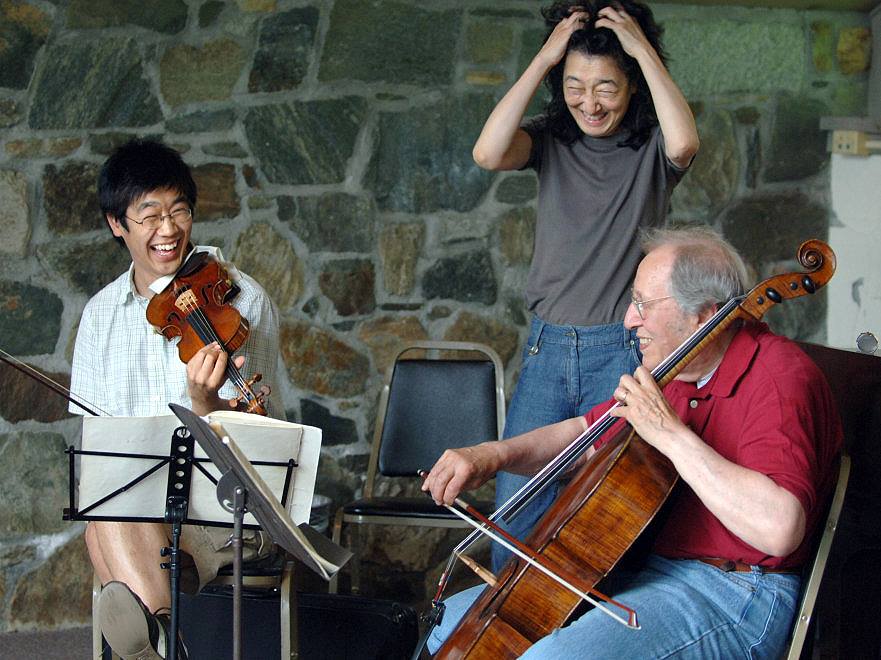
    Mitsuko Uchida, who has led the Marlboro Music School and Festival since 2013, will join violinist Soovin Kim and cellist David Soyer (of the legendary Guarneri Quartet) for Beethoven’s “Archduke” Trio.

    The Philadelphia-born Soyer, who taught at Marlboro for over 35 years, could be notoriously ornery. In particular, he was known for snapping at pianists for playing too loudly.

    According to Uchida, “I avoided him for years because he was known to be nasty to pianists and because for him every pianist was too loud. We joked about it, but one day, I thought, listen, it’s about time that I risked being shouted at by David – ‘you are too loud!’ So I plucked up my courage and we did the ‘Archduke’ together with this wonderful violinist Soovin Kim. I think David tolerated me for the first week because of his love for Soovin Kim. He told me all the time, ‘oh you are too loud, too loud.’ But then there was a moment when he realized that actually I was not too loud. From then on it was smooth sailing. I learned so much from David, from the way he played, from the way he could make the cello sound with such unbelievable accuracy, simplicity and honesty, and, of course, he played louder than anyone else. In the ‘Archduke,’ but also in the slow movement of the Schubert E-flat Trio, I think nobody ever played like that, apart from Pablo Casals. There was a quality of his that was so moving, every time, in rehearsal.”

    We’ll hear Uchida, Kim and Soyer in the “Archduke,” in a performance captured in 2006.

    Then founding director Rudolf Serkin will join Philadelphia-based soprano Benita Valente and hornist Myron Bloom for Franz Schubert’s “Auf dem Strom” (“On the River”), a work composed in tribute to Beethoven. The text, by Ludwig Rellstab, was originally intended for the older master. The song was first performed on the only concert devoted exclusively to Schubert’s music during Schubert’s lifetime, which took place on the first anniversary of Beethoven’s death, March 26, 1828. Schubert himself would die only eight months later. The Marlboro performance dates from 1960.

    I hope you’ll join me for music of Beethoven and Schubert played by Marlboro artistic directors, this Wednesday evening at 6:00 EDT, on WWFM – The Classical Network and wwfm.org.

    Marlboro School of Music and Festival: Official Page
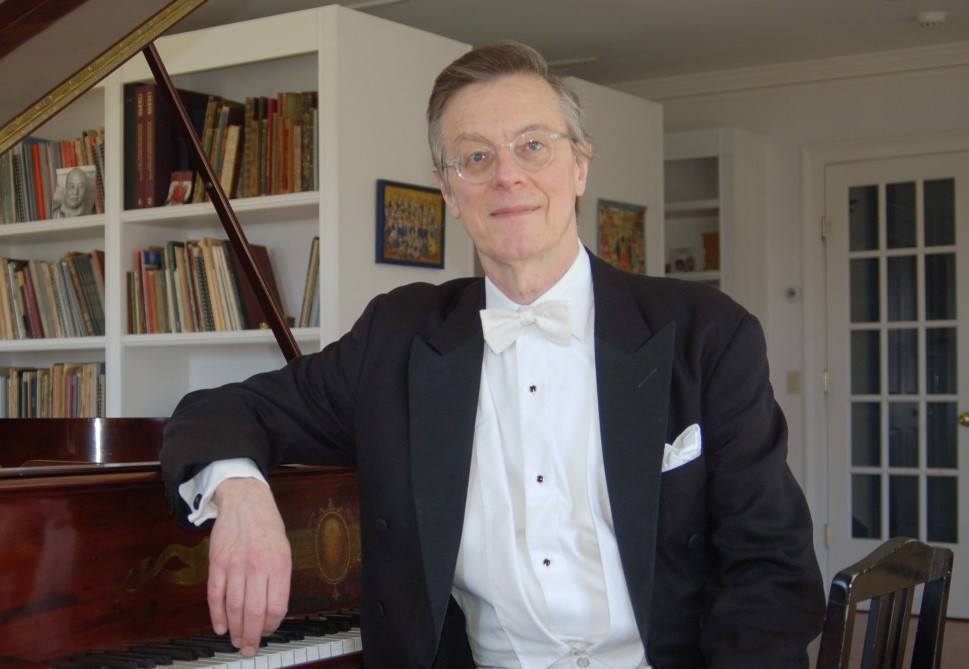

    PHOTO: A lighter moment (not too loud) with Soovin Kim, Mitsuko Uchida and David Soyer

  • Peter Serkin at 70 A Piano Maverick

    Peter Serkin at 70 A Piano Maverick

    For some reason, I always equate Peter Serkin in my mind with Peter Fonda. Perhaps it’s because he’s like the Easy Rider of pianists. At one point, he even totally dropped out, moving to Mexico and not playing for a couple of years. When he returned, as often as not, he was a kind of countercultural champion of modernist works (he was one of the founders of the new music ensemble Tashi); but he is, after all, his father’s son (he was sired by legendary pianist Rudolf Serkin), so Bach and Beethoven have been just as important to him as an artist and as a person.

    Hard to believe that Peter Serkin is 70 years-old today. We’ll honor him with several of his recordings, alongside those of the late violinist Ruggiero Ricci and composers Adolphe Adam, Ernest Bloch, Robert Farnon, and Leo Arnaud (he of Olympic fanfare fame).

    I’ll be bearing the torch for great music and music-making, from 4 to 7 p.m. EDT, on WWFM – The Classical Network and wwfm.org.

Tag Cloud

Aaron Copland (92) Beethoven (95) Composer (114) Film Music (120) Film Score (143) Film Scores (255) Halloween (94) John Williams (185) KWAX (229) Leonard Bernstein (100) Marlboro Music Festival (125) Movie Music (135) Opera (198) Philadelphia Orchestra (88) Picture Perfect (174) Princeton Symphony Orchestra (106) Radio (87) Ralph Vaughan Williams (85) Ross Amico (244) Roy's Tie-Dye Sci-Fi Corner (290) The Classical Network (101) The Lost Chord (268) Vaughan Williams (103) WPRB (396) WWFM (881)

DON’T MISS A BEAT

Receive a weekly digest every Sunday at noon by signing up here


RECENT POSTS