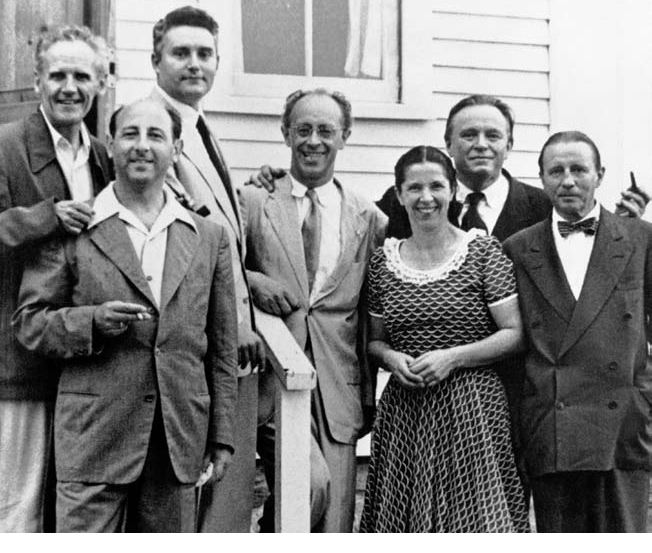
During the final hour of my shift this evening on WWFM, I’ll be previewing a special series that will commence next Wednesday, featuring chamber music performances from Marlboro Music.
Marlboro Music is the noted Vermont retreat, where the world’s most acclaimed and most promising artists come together for inspired music-making. The festival can be enjoyed over five weekends, from mid-July to mid-August. This year’s festival will be held from July 15 to August 13, on the campus of Marlboro College. You can find out more about Marlboro Music at marlboromusic.org.
This week, we’ll hear commercially issued recordings of performances from Marlboro, including Samuel Barber’s “Summer Music,” with Marlboro wind players, captured in 1981, and Franz Schubert’s Piano Trio No. 2 in E-flat major, Op. 100, D. 929, featuring Marlboro co-founders Adolf Busch, Herman Busch and Rudolf Serkin, recorded in 1951.
Future weeks will bring privileged access to the Marlboro archives, which include many, many performances never before heard beyond the confines of the festival, all of them featuring chamber music luminaries and stars of tomorrow.
Join me for “Music from Marlboro” beginning next Wednesday, July 12, at 6 p.m. EDT. The preview will air this evening at 6, on WWFM – The Classical Network and wwfm.org.
PHOTO: Marlboro founders Marcel Moyse, Louis Moyse, Rudolf Serkin, Blanche Moyse, Adolf Busch, Herman Busch (with cellist Nathan Chaikin second from left)
Like just about everyone else, I have missed doing something special for the centennial of Max Reger’s death. Not that I didn’t see it coming. I just plum forgot.
Reger died on this date in 1916. Perhaps the craziest exemplar of crazy German contrapuntalism, Reger could write music of such density that the individual voices could get lost in a tangle, deep inside a knot, somewhere in an impenetrable thicket.
He was mostly a composer of “abstract” music – mainly a lot of fugues and sets of variations – seeing himself as the heir of Beethoven and Brahms. But it is the Baroque masters Reger most closely resembles, in his own gargantuan, overcooked way, especially in his organ works, of which he composed many.
Aside from his sporadically delightful (though occasionally borderline) “Variations and Fugue on a Theme by Mozart” and a handful of organ works, most of his prolific output is known mainly by specialists. For some reason or another, Rudolf Serkin remained a high profile torchbearer. Serkin recorded Reger’s Piano Concerto with the Philadelphia Orchestra and, later in life, the “Variations and Fugue on a Theme of Bach.”
To me, Reger comes closest to being palatable – and even charming – when restricted to a single, non-keyboard instrument, as in his sonatas for solo violin and suites for solo cello.
Also, it sounds like he may have actually had some fun composing his “Four Tone Poems after Arnold Böcklin.” Böcklin, you may recall, was the Swiss artist who painted “The Isle of the Dead,” which inspired the third of these. Surprisingly, the tone poems are late works. Did anyone see them coming? I guess after a lifetime of getting all tangled up, Reger just wanted to walk around with loose shoelaces for a change.
Despite the fact that in most of his photos he looks like he’s got a mouth full of sauerkraut, Reger actually proved himself to have a sharp sense of humor. His most famous retort to a critic came in the form of a letter written in 1906. It reads: “I am sitting in the smallest room of my house. I have your review in front of me. Soon it will be behind me.”
Reger, you rascal. Why couldn’t you get more of that into your music?
Actually, somebody didn’t forget: Michael Kownacky will be celebrating Reger tonight on “A Little Night Music,” at 10 EDT on wwfm.org.
“Variations and Fugue on a Theme by Mozart”:
“Fantasy and Fugue on B-A-C-H”:
Rudolf Serkin plays the “Variations and Fugue on a Theme by Bach”: