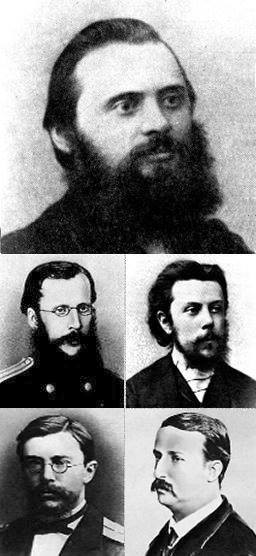
Balakirev, of course, was the founder of the “Mighty Handful,” or “The Russian Five,” that collective of Russian nationalist composers that also included Nikolai Rimsky-Korsakov, Modest Mussorgsky, Alexander Borodin, and Cesar Cui.
He had very strong ideas about what Russian music should be, and he was not at all bashful about telling other composers what to do. He essentially micromanaged the early careers of his acolytes, which included not only “The Five,” but on several occasions Peter Ilych Tchaikovsky.
In his later years, though Balakirev’s influence was on the wane, he made two final, important contributions. He was responsible for introducing the prodigy Alexander Glazunov to Rimsky-Korsakov, and he was blessed with one last, very talented disciple, Sergei Lyapunov.
This Sunday night on “The Lost Chord,” we’ll hear music by this last of the Russian nationalists, who was as much influenced by the keyboard prowess of Liszt as he was the patriotic zeal of his mentor. He also happens to be the composer of “The Lost Chord” signature music.
I hope you’ll join me for “One Past Five” – music of Sergei Lyapunov – this Sunday night at 10:00 EDT, on WWFM – The Classical Network and wwfm.org.
WHEN BEARDS WERE IN: Top left, Mily Balakirev; bottom left (clockwise), Cesar Cui, Modest Mussorgsky, Alexander Borodin, Nikolai Rimsky-Korsakov; right, Sergei Lyapunov
The connection between music and science has been much remarked upon.
In the case of Alexander Borodin, he was a doctor and chemist. Borodin was born on this date in 1833. As a boy he had had piano lessons, but he received his formal education at the Medical-Surgical Academy in St. Petersburg. He then served as a surgeon in a military hospital before undertaking three years of advanced scientific study in Western Europe.
In 1862, he returned to his alma mater to teach. There, he managed to establish courses for women. In 1872, he founded a school of medicine for women. He devoted the remainder of his scientific career to research. He is co-credited with the discovery of the aldol reaction, a means of forming carbon-carbon bonds in organic chemistry.
Around the time of his return to the Academy, he met Mily Balakirev, the persuasive advocate of Russian nationalism in music, who took the chemist under his wing and supervised the composition of his Symphony No. 1. Borodin began work on his Symphony No. 2 in 1869. Since regarded as a particularly successful blend of Slavic drama and lyricism with European classical form, it was not a particular success at its premiere in 1877.
Borodin became sidetracked while working on the piece by his absorption in an opera on the subject of Prince Igor. This was to become his most significant musical contribution and one of the most important Russian historical operas. Because of his other commitments and repeated distractions, the work was left unfinished at the time of his death. It was completed by his friends and colleagues, Nikolai Rimsky-Korsakov and Alexander Glazunov.
The big show-stopper, of course, is his “Polovtsian Dances,” which has been used to sell everything from records to cleanser.
Borodin was yet another beneficiary of the exceeding generosity of Franz Liszt, whose contributions in this regard are not widely enough acknowledged. It was Liszt’s advocacy as a conductor that brought Borodin to the attention of European audiences. In gratitude, the composer dedicated “In the Steppes of Central Asia” to Liszt in 1880.
Borodin was also embraced by the French Impressionists, who admired his unusual harmonies. Of course, he achieved even greater renown when melodies from his works became the basis for the musical “Kismet” in 1953. In 1954, he was honored with a posthumous Tony Award!
Since for Borodin music was basically an avocation, something to which he devoted himself mostly during holidays or when he was otherwise unable to report to work, it became a running gag among his friends that they’d wish him poor health.
“In winter I can only compose when I am too unwell to give my lectures,” he wrote. “So my friends, reversing the usual custom, never say to me, ‘I hope you are well’ but ‘I do hope you are ill.’”
He had plenty of experience with illness. The composer survived cholera and suffered several heart attacks. He finally dropped dead during a ball at the Academy in 1887.