Tag: Samuel Coleridge-Taylor

  • Black Composers Reissue: Still, Kay & More

    Black Composers Reissue: Still, Kay & More

    As someone with an insatiable appetite for American symphonies composed during the first half of the 20th century, I try not to miss a performance, or even a radio broadcast, of music by Roy Harris, William Schuman, or Aaron Copland. But for as much as I adore those composers, the American symphonies that delight me the most, off the top of my head, are Charles Ives’ 2nd, Howard Hanson’s 2nd (the “Romantic”), and William Grant Still’s 1st (the “Afro-American”).

    Still’s symphony, the first by a Black American to be performed by a major orchestra, serves as a kind of capstone to my four-part survey of Columbia Records’ landmark Black Composer Series. This was put together for “The Lost Chord” and originally broadcast on WWFM The Classical Network to mark the belated reissue of the series – after 40 years! – as a 10-CD boxed set by Sony Classical.

    The “Afro-American Symphony” is one of the few pieces in this set, which originally appeared on vinyl between 1974 and 1978, that is heard with any frequency. It serves as a portrait of the artist as a young man, drawing on spirituals, blues, and banjo riffs redolent of the composer’s boyhood in Little Rock, Arkansas. (He was born in Woodville, Mississippi.) More enterprising music directors should give it a shot. It’s the kind of work that goes straight to the heart and gets lodged in the head. Audiences will love it.

    Hear it on the final program in my survey, which also includes “Markings,” by Ulysses Kay. Kay composed his piece in 1966 to the memory of Dag Hammerskjöld, secretary general of the United Nations. Called “the greatest statesman of our century” by John F. Kennedy, Hammarskjöld was awarded a posthumous Nobel Peace Prize, after he was killed in a plane crash en route to ceasefire negotiations during the Congo Crisis of 1961.

    The series concludes on an “up” note, with a lively “Danse Nègre,” from the “African Suite” of 1898, by Afro-English composer Samuel Coleridge-Taylor.

    Enjoy the fourth and final installment of “Black to the Future” – celebrating the reissue of Columbia Records’ forward-looking Black Composers Series – by following the link and clicking on “listen”:

    https://www.wwfm.org/post/lost-chord-february-24-black-future-part-iv

    In case you missed it, here’s Part One, with music by Chevalier de Saint-Georges, Olly Wilson, and Fela Sowande:

    https://www.wwfm.org/post/lost-chord-february-3-black-future

    Part Two, with works by George Walker and José Maurício Nunes Garcia:

    https://www.wwfm.org/post/lost-chord-black-future-part-ii

    And Part Three, with works by José Silvestre de los Dolores White y Lafitte (José White), David Baker, and Roque Cordero:

    https://www.wwfm.org/post/lost-chord-february-17-black-future-part-iii

    On a related note, Michael Kownacky will introduce Still’s “Troubled Island,” the first opera by an African-American composer to be staged by a major company – the New York City Opera, in 1949 – on a double-bill with Paul Moravec’s “Sanctuary Road,” this week on the Sunday Opera at 3:00 EST, on WWFM – The Classical Network and wwfm.org.


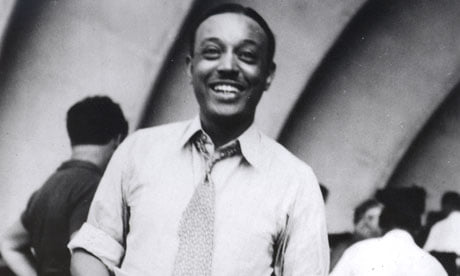
    PHOTO: William Grant Still at the Hollywood Bowl
  • Black Composers Series on WWFM

    Black Composers Series on WWFM

    It’s music by the so-called “Dean of Afro-American composers” tonight on “The Lost Chord.”

    William Grant Still’s “Afro-American Symphony” (1930) will be heard alongside Ulysses Kay’s “Markings” (1966), an elegy for secretary general of the United Nations Dag Hammerskjöld, and Samuel Coleridge-Taylor’s lively “Danse Nègre” from the “African Suite” (1898).

    I hope you’ll join me for the grand conclusion of my month-long survey of highlights from the landmark Black Composers Series of 1974-1978, newly reissued in a handsome 10-CD boxed set, thanks to Sony Classical, on “Black to the Future, Part IV,” this Sunday night at 10:00 EST, on WWFM – The Classical Network.

    But if you find the siren song of Oscar is simply too strong to resist, you can always catch the show later in the week as a webcast, along with previous installments from the series, at wwfm.org.


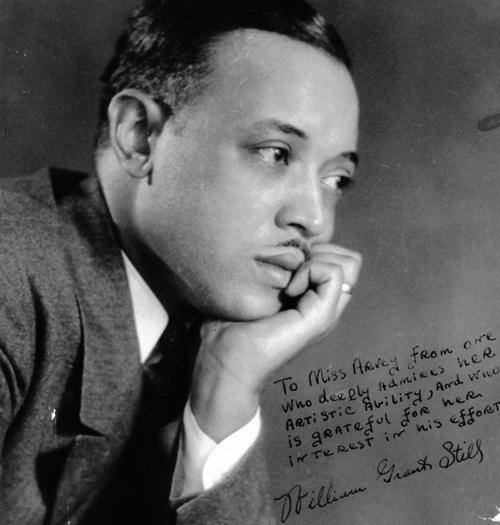
    PHOTOS (clockwise from left): William Grant Still, Ulysses Kay, and Samuel Coleridge-Taylor

  • Classical Music Today on The Classical Network

    Classical Music Today on The Classical Network

    Afro-British composer Samuel Coleridge-Taylor (1875-1912) scored his biggest hit with “Hiawatha’s Wedding Feast.” The cantata became something of a cultural phenomenon between the wars. Sir Malcolm Sargent led performances of the piece annually, from 1928 to 1939, in a costumed, semi-ballet version, featuring close to a thousand performers. Unfortunately, the composer did not live to enjoy his success, nor did his heirs receive any royalties, as he had sold the music outright (for 15 guineas – about $2160 US).

    We’ll get a taste of “Hiawatha” at 2:00 this afternoon on The Classical Network. “Hiawatha’s Wedding Feast” is the first part of a larger oratorio, “The Song of Hiawatha.” A complete recording, released on the Argo label back in 1992, features a rising star by the name of Bryn Terfel – but it is Arthur Davies who sings the work’s hit tune, “Onaway! Awake, Beloved!”

    Antonin Dvořák was also very much enamored with Longfellow’s most famous poem. It’s said that he jotted the theme for the slow movement to his Sonatina for Violin and Piano, Op. 100, onto his starched cuff during a visit to Minnehaha Falls. The melody became popularized as “Indian Lament.” Dvořák wrote the Sonatina with his children in mind. We’ll hear it performed by brother and sister Gil and Orli Shaham.

    Then stay tuned at 3:00 for William Levi Dawson’s epic “Negro Folk Symphony.” The work was introduced by Leopold Stokowski and the Philadelphia Orchestra in 1934. Dawson revamped the piece in 1952, following a trip to West Africa. It was Stokowski who made the world premiere recording of the symphony, in its revised and expanded form. We’ll hear it played in a fine modern recording by the Detroit Symphony Orchestra conducted by Neeme Järvi.

    If you happened to miss David Baker’s Cello Sonata this past Sunday night on “The Lost Chord,” tune in today for his “Jazz Suite for Clarinet and Symphony Orchestra: Three Ethnic Dances.” Clarinetist Alan Balter will perform with the Akron Symphony Orchestra.

    The afternoon will commence with today’s Noontime Concert, featuring members of the Dolce Suono Ensemble. The group’s flagship trio will present a mix of classics and commissions. The “classics” are by Mendelssohn and Martinu, and the “commissions” were fulfilled by Jeremy Gill and Zhou Tian. The broadcast will conclude with an arrangement of Leonard Bernstein’s “Candide Overture.” Flutist and founding artistic director Mimi Stillman will be joined by cellist Nathan Vickery and pianist Charles Abramovic. The concert took place on October 14 at Trinity Center for Urban Life, 22nd and Spruce Streets, in Philadelphia.

    Dolce Suono’s next concert, “Rediscoveries,” will take place tomorrow night at 7:00, again at Trinity Center for Urban Life. That program will include works by three American masters who were revered at mid-century, but whose music in recent decades has fallen into comparative neglect – Irving Fine, William Schuman, and Norman Dello Joio. Also on the program will be works by Elliot Carter, Leonard Bernstein, Shulamit Ran, and the late Katherine Hoover. For more information, look online at dolcesuono.org.

    If you’ve a tooth for “sweet sound” (or “dolce suono”), satisfy the craving from 12 to 4 p.m. EST, on WWFM – The Classical Network and wwfm.org.


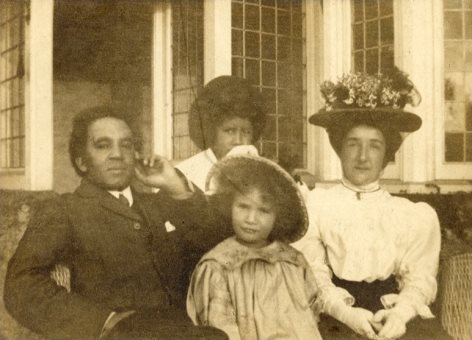
    PHOTO: Coleridge-Taylor and his family, wife Jessie and children Gwendolyn and Hiawatha (rear)

  • Samuel Coleridge-Taylor’s Lost Chord

    Samuel Coleridge-Taylor’s Lost Chord

    Afro-British composer Samuel Coleridge-Taylor (1875-1912) achieved much in his comparatively short life, attracting the attention and advocacy of Sir Charles Villiers Stanford, Sir Edward Elgar, and Sir Malcolm Sargent.

    His cantata “Hiawatha’s Wedding Feast” became a cultural phenomenon between the wars. Sargent led performances of the piece annually, from 1928 to 1939, in a costumed, semi-ballet version, featuring close to a thousand performers. Unfortunately, this was among the works the composer had sold outright, his heirs thereby missing out on the royalties. By the time of Sargent’s advocacy, the short-lived Coleridge-Taylor had already been dead for 16 years.

    This Sunday night on “The Lost Chord,” we’ll hear selections from a complete recording of “Scenes from ‘The Song of Hiawatha,’” one of the earliest to feature rising star Bryn Terfel, released on the Argo label back in 1991. We’ll also hear Sargent’s 1932 recording of Coleridge-Taylor’s “Othello Suite.” The hour will conclude with one of the composer’s musical explorations of his African heritage, the “Symphonic Variations on an African Air,” in a performance conducted by Grant Llewellyn, released on Argo in 1993.

    That’s “Taylor-Made” – music of Samuel Coleridge-Taylor – this Sunday night at 10:00 EST, on WWFM – The Classical Network and wwfm.org.

  • Dvořák’s Hiawatha Melodrama Premiere

    Dvořák’s Hiawatha Melodrama Premiere

    If, like me, you’re of the opinion that Dvořák never wrote a bad note, or if you are a particular fan of the “New World” Symphony, you might be interested to tune in tonight to hear the “Hiawatha Melodrama.”

    Dvořák composed what is now commonly numbered his Symphony No. 9 (for decades it was known as the Symphony No. 5) in 1893, while he was director of the National Conservatory of Music in New York City. The work was influenced by Native American music and African American spirituals. The composer intimated that certain sections were inspired by his reading of “The Song of Hiawatha.” In fact, he intended the famous Largo as a sketch for a later opera or cantata on the theme, and the third movement scherzo was suggested by a dance at Hiawatha’s wedding feast.

    Beginning in the early 1990s, cultural historian Joseph Horowitz and Dvořák scholar Michael Beckerman began experimenting with presentations involving portions of Longfellow’s text with music from Dvořák’s symphony. These developed into a 35-minute work, which achieved its final form in 2013. (In musical terms, a melodrama is the marriage of music with spoken word.) The arrangers also lifted passages from Native American-influenced music from Dvořák’s Sonatina, Op. 100 (the composer sketched the theme for the Larghetto on his starched cuff during a visit to Minnehaha Falls in Minnesota), and his “American Suite.”

    We’ll hear the world premiere recording, on the Naxos label, featuring as the narrator bass-baritone Kevin Deas.

    To round out the hour, I’ve programmed selections from “Hiawatha’s Wedding Feast,” one of three cantatas that comprise “Scenes from the Song of Hiawatha,” by the English composer of African descent, Samuel Coleridge-Taylor. Coleridge-Taylor composed the work five years after Dvořák completed his “New World” Symphony.

    “Hiawatha’s Wedding Feast,” became a cultural phenomenon. By the time it was taken up by Sir Malcolm Sargent, it was given annually, from 1928 to 1939, in a costumed, semi-ballet version, featuring close to a thousand performers. Unfortunately, this was among the works the composer had sold outright, his heirs thereby missing out on the royalties. By the time of Sargent’s advocacy, the short-lived Coleridge-Taylor had already been dead for 16 years.

    The recording, released on the Argo label back in 1991, is one of the earliest of rising star Bryn Terfel.

    I hope you’ll join me for “Indian Summer” – works inspired by Longfellow’s “The Song of Hiawatha” – this Sunday night at 10:00 EST, on WWFM – The Classical Network and at wwfm.org.


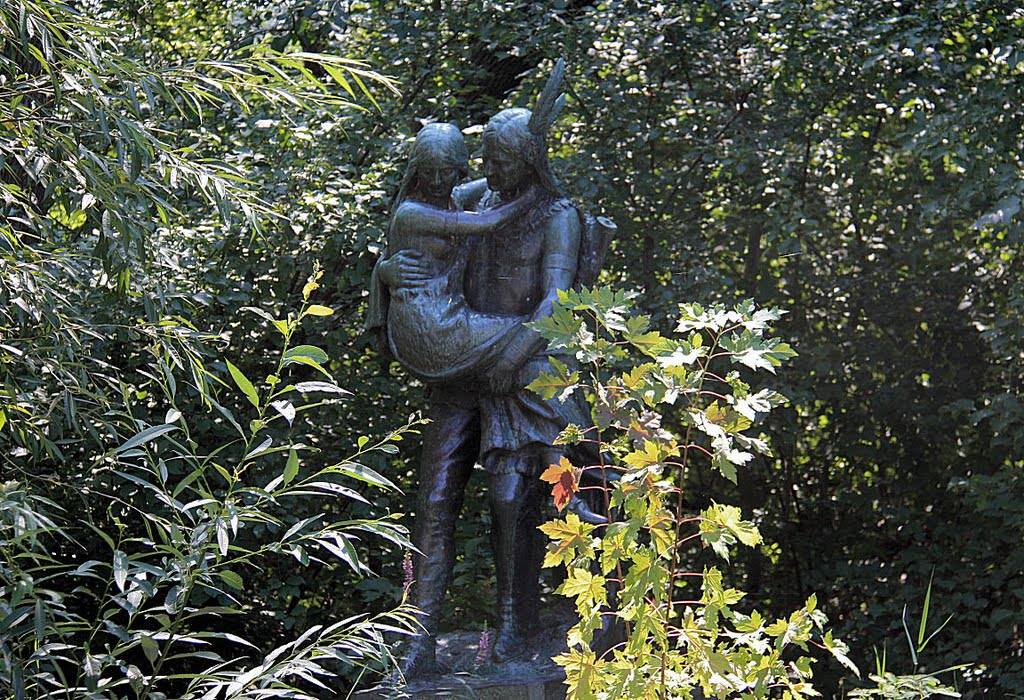
    PHOTO: “Hiawatha and Minnehaha” by Jacob Fjelde, Minnehaha Park, Minneapolis

    More about it here: http://www.mnopedia.org/thing/hiawatha-and-minnehaha-jacob-fjelde

Tag Cloud

Aaron Copland (92) Beethoven (95) Composer (114) Film Music (123) Film Score (143) Film Scores (255) Halloween (94) John Williams (187) KWAX (229) Leonard Bernstein (101) Marlboro Music Festival (125) Movie Music (138) Opera (202) Philadelphia Orchestra (89) Picture Perfect (174) Princeton Symphony Orchestra (106) Radio (87) Ralph Vaughan Williams (85) Ross Amico (244) Roy's Tie-Dye Sci-Fi Corner (290) The Classical Network (101) The Lost Chord (268) Vaughan Williams (103) WPRB (396) WWFM (881)

DON’T MISS A BEAT

Receive a weekly digest every Sunday at noon by signing up here


RECENT POSTS