Tag: Serge Koussevitzky

  • Koussevitzky Champion of American Music

    Koussevitzky Champion of American Music

    Friday was the 150th anniversary of Serge Koussevitzky’s birth, but I had just finished recording one of my radio shows, and I couldn’t muster the energy and focus to post about it. Even a photo with a link to one of his recordings would have been something, albeit inadequate in proportion to his significance as one of the great champions of modern music and, more specifically, American music.

    It’s been calculated that, between 1924 and 1944, Koussevitzky presented 162 American works, 66 of which were world premieres. On his Concerts Koussevitzky, conducted in Paris in the 1920s, he also introduced Ravel’s enduring orchestration of Mussorgsky’s “Pictures at an Exhibition” and Honegger’s “Pacific 231.” As music director of the Boston Symphony Orchestra, he gave first performances of Bartók’s Concerto for Orchestra and Copland’s “Appalachian Spring” suite.

    “Kouss” was in on the ground floor at Tanglewood. He mentored Leonard Bernstein and others. When his wife, Nadia, died, he set up the Koussevitzky Music Foundation in her memory, to support and promote living composers. Early Foundation commissions yielded Britten’s “Peter Grimes” and Messiaen’s “Turangalîla-Symphonie.”

    Kouss began his career as a double-bassist and blossomed into one of the most important conductors of the 20th century. I was remiss in not acknowledging him on his birthday anniversary. Mea culpa, and happy 150, Serge Koussevitzky!


    First recording of “Pictures at an Exhibition”

    Broadcast premiere of Bartók’s Concerto for Orchestra (with the original wet-noodle ending, soon to be revised by the composer)

    Live performance of Sibelius’ Symphony No. 7

    Roy Harris’ Symphony No. 3

    Tchaikovsky’s Symphony No. 5

    Rehearsing the BSO in Rimsky-Korsakov’s “Scheherazade”

    Filmed performance of Randall Thompson’s “The Last Words of David”

    Playing the slow movement of his Double-Bass Concerto, with piano

    10-minute documentary, “The Story of Tanglewood” (1949)


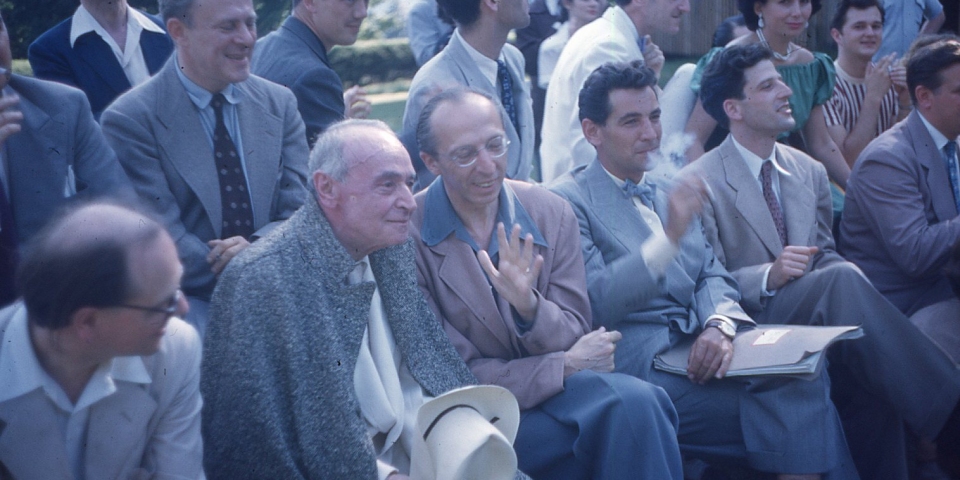
    Serge Koussevitzky, holding hat, with (left to right) Olivier Messiaen, Aaron Copland, Leonard Bernstein (lighting up), and Lukas Foss at Tanglewood in 1949 (photo by Ruth Orkin)
  • Stravinsky’s Wind Symphonies A Centennial

    Stravinsky’s Wind Symphonies A Centennial

    On this date, 100 years ago, Igor Stravinsky’s “Symphonies of Wind Instruments” was given its first performance at Queen’s Hall, London, on a concert conducted by Serge Koussevitzky. Written the previous year, and dedicated to the memory of Debussy, the chorale that concludes the piece was first published in the French magazine “La Revue musicale,” alongside memorial works by Ravel, Bartók, Falla, Dukas, Satie, and others. The issue was titled “Le Tombeau de Claude Debussy.”

    However, the opening night audience found Stravinsky’s music anything but grave. They chortled inappropriately, and Koussevitzky glanced over his shoulder to share a conspiratorial grin. Even so, at the end of the performance, any cheekiness was obliterated by applause, as Stravinsky rose to take a bow.

    The work is scored for 24 wind instruments. The term “symphonies” has nothing to do with symphonic form. Rather, Stravinsky employed the word for its broader, older connotation, from the Greek, of “sounding together.” He would reorchestrate the piece in 1947.

    Three days prior to the Queen’s Hall jeers, Stravinsky had given Londoners something to cry about, as he attended the UK premiere, in the same venue, of the concert version of his riot-inducing ballet “The Rite of the Spring.”

    It’s always refreshing to look back on a time when people were actually passionate about music.


    “Symphonies of Wind Instruments”

    Riot at “The Rite”


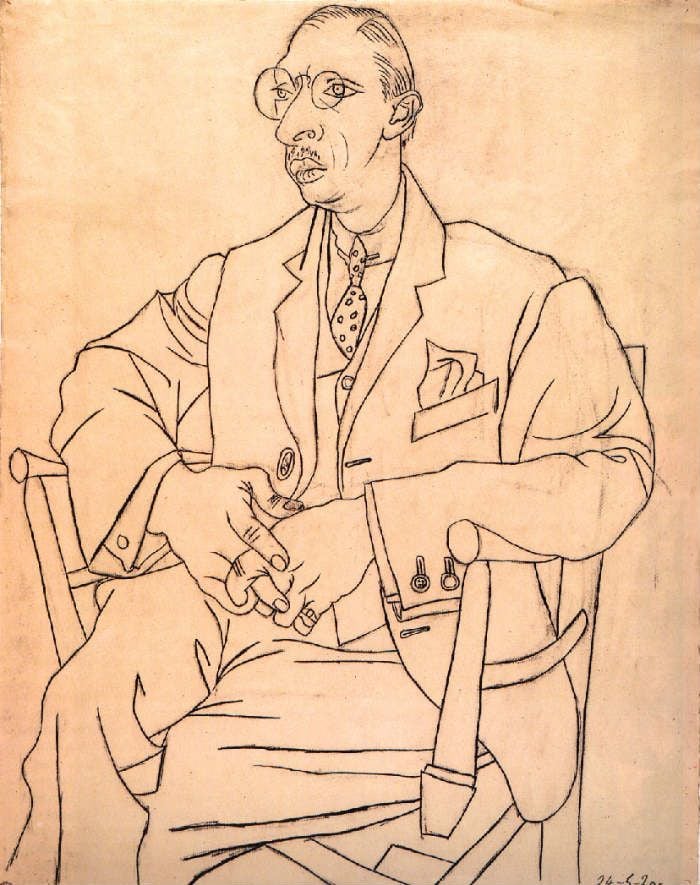
    Stravinsky as rendered by Picasso in 1920

  • Mario Lanza A Centennial Celebration

    Mario Lanza A Centennial Celebration

    Mario! Mario!

    Who would have dreamt that Alfredo Arnold Cocozza would grow up to become one of the biggest stars of the 1950s?

    Mario Lanza was born in South Philadelphia, in a row home on the 600 block of Christian Street, one hundred years ago today. It was the year the great Caruso died (on August 9th), and Lanza, famously, went on to play him in the movies. In fact, “The Great Caruso” became the highest-grossing M-G-M film of 1951.

    Legend states that Lanza was discovered by Serge Koussevitzky, traveling music director of the Boston Symphony Orchestra, after booking an adjacent hotel room so that he might be overheard practicing. Koussevitzky described Lanza as “Caruso redivivus” (Caruso reborn), and stated, “Yours is a voice such as is heard once in a hundred years.”

    Fresh-faced and forever young, Lanza is preserved in his everlasting vitality on records and celluloid. He died of an apparent pulmonary embolism in 1959 at the age of 38.

    Shortly before his own death in 1987, Enrico Caruso Jr. observed, “I can think of no other tenor, before or since Mario Lanza, who could have risen with comparable success to the challenge of playing Caruso in a screen biography… Lanza was born with one of the dozen or so great tenor voices of the century, with a natural voice placement, an unmistakable and very pleasing timbre, and a nearly infallible musical instinct.”

    On the one hundredth anniversary of his birth, celebrate Koussevitzky’s “voice of a hundred years.”

    Happy birthday, Mario Lanza.


    “Drink drink drink” from “The Student Prince”:

    At the time of his death, Lanza was preparing a return to the operatic stage as Canio in “Pagliacci” (seen here in “The Great Caruso”):

    “Parigi, o cara” from “La Traviata,” with Frances Yeend and Eugene Ormandy conducting, at the Hollywood Bowl in 1947. In the audience was Louis B. Mayer, who signed the 26 year-old tenor to a long-term movie contract.

    High-spirited tribute in Peter Jackson’s “Heavenly Creatures,” set to Rudolf Friml’s “The Donkey Serenade”:

    Lanza’s first gold record, “Be My Love”:

  • Jules Eskin Boston Symphony Cellist Dies at 85

    Jules Eskin Boston Symphony Cellist Dies at 85

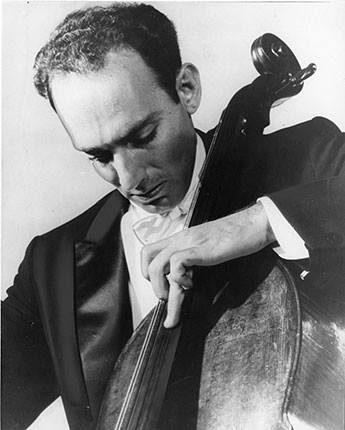
    The beloved cellist Jules Eskin has died. Eskin was principal cellist of the Boston Symphony Orchestra for 53 years. Eskin was living history. His association with the orchestra extended back to the days of Serge Koussevitzky.

    Born in Philadelphia in 1931, Eskin was picked up by the Dallas Symphony at the age of 16, where he performed under the direction of Antal Dorati. He studied with Janos Starker in Dallas, then with Gregor Piatigorsky and Leonard Rose at the Curtis Institute of Music. In 1948, he was a fellowship student at the Tanglewood Music Center, where he performed in the TMC Orchestra under Koussevitzky. He then spent three years as principal cello of the Cleveland Orchestra under George Szell and seven years with the New York City Opera. In addition, he participated in the Marlboro Music Festival and played in the Casals Festival Orchestra in Puerto Rico. He joined the BSO as principal cello in 1964, when Erich Leinsdorf was music director.

    Eskin died yesterday at his Brookline home. The cause of death was cancer. Earlier, he had withdrawn from the Boston Symphony for a season to undergo cancer treatments in 1981. He is survived by his wife, BSO violinist Aza Raykhtsaum. The couple celebrated their 30th wedding anniversary in January. Eskin announced his retirement from the orchestra only last month. He was 85 years-old.

    We’ll honor him with some of the recordings he made with the Boston Symphony Chamber Players, of which he was a founding member, this afternoon from 4 to 7:00 EST on WWFM – The Classical Network and at wwfm.org.

  • Roy Harris Neglected Genius of American Symphony

    Roy Harris Neglected Genius of American Symphony

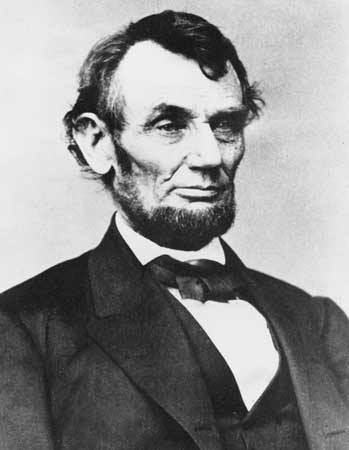
    Roy Harris was born on Lincoln’s birthday, in a log cabin in Lincoln County, Oklahoma. Did he let it go to his head? Maybe. He went on to become one of America’s greatest composers.

    He basically drove a milk truck while studying with “American Indianist” composer Arthur Farwell. Contacts in the East got him touch with Aaron Copland, who put in a good word with Nadia Boulanger. Harris was one of the legions of composers who studied with Boulanger in Paris.

    Back home, he attracted the attention of Serge Koussevitzky, then music director of the Boston Symphony Orchestra. It was Kouss who first performed Harris’ “Symphony 1933.” But the real pay dirt came with Harris’ Symphony No. 3, regarded then, as now, as one of the finest American symphonies. Its tightly-argued, single-movement structure manages to recall Renaissance polyphony, Jean Sibelius, and the American prairie. It was the perfect work for its time, with the world teetering at the brink of war and the country starting to emerge from the Great Depression.

    Yet, for some reason, the composer of this most-revered symphony is also one of our most neglected. In fact a number of his symphonies have yet to be recorded. Why?

    Tune in at 8:30 this morning to enjoy Harris’ Symphony No. 6, “Gettysburg,” which takes its impetus from the Gettysburg Address. It’s all music honoring the presidents, on this, Lincoln’s birthday, until 11:00 this morning on WPRB 103.3 FM and at wprb.com

Tag Cloud

Aaron Copland (92) Beethoven (95) Composer (114) Film Music (123) Film Score (143) Film Scores (255) Halloween (94) John Williams (187) KWAX (229) Leonard Bernstein (101) Marlboro Music Festival (125) Movie Music (138) Opera (202) Philadelphia Orchestra (89) Picture Perfect (174) Princeton Symphony Orchestra (106) Radio (87) Ralph Vaughan Williams (85) Ross Amico (244) Roy's Tie-Dye Sci-Fi Corner (290) The Classical Network (101) The Lost Chord (268) Vaughan Williams (103) WPRB (396) WWFM (881)

DON’T MISS A BEAT

Receive a weekly digest every Sunday at noon by signing up here


RECENT POSTS