Tag: Serialism

  • Milton Babbitt A Centennial Celebration

    Milton Babbitt A Centennial Celebration

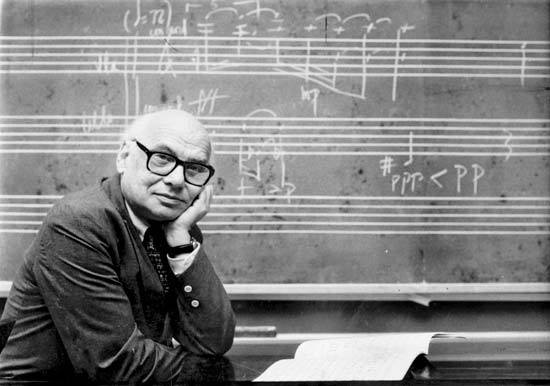
    Today is the 100th anniversary of the birth of Milton Babbitt. Babbitt, born in Philadelphia, was a staple at Princeton University for many years. It’s telling that he joined both the music and mathematics faculties there. Later, he was also on the faculty of the Juilliard School.

    Babbitt gained widespread notoriety for an essay he wrote, titled “Who Cares If You Listen?” It turns out the provocative stance was the result of an editorial decision, and that Babbitt’s original title had been “The Composer as Specialist” – not likely to generate nearly as much interest.

    While he frequently composed in a serial style, his music is usually pretty lucid, without undo congestion and with a minimum of soul-crushing dissonances. In fact, his language could often attain a paradoxical simplicity amidst the appearance of complexity.

    In the 1960s, Babbitt became interested in electronic music, apparently for its rhythmic precision, as opposed to any unusual timbral considerations. I find it endearing that he was also fond of jazz and musical theater. He himself was a saxophonist. In 1946, he penned a musical, “Fabulous Voyage,” a retelling of Homer’s “The Odyssey.”

    Babbitt was the recipient of an honorary Pulitzer Prize in 1982. He died in Princeton in 2011, at the age of 94.

    Listen here for “Penelope’s Night Song” from “Fabulous Voyage”:

    “Composition for Twelve Instruments” (1948):

    “Reflections” (1974) for piano and synthesized tape:

    Milton Babbitt on electronic music:

  • Boulez: A Corrective Force in Music

    Boulez: A Corrective Force in Music

    Think of Pierre Boulez as a corrective.

    Whether or not you are crazy about Boulez as a composer or a conductor, he certainly had a knack for casting music in a fresh light. No romantic indulgence or fuzzy thinking to be found in his interpretations of Debussy and Ravel. Instead, a kind of neoclassical elegance prevails.

    A similar sense of discipline informs his recordings of the Mahler symphonies (of all things). He transforms what under Leonard Bernstein, for instance, became the ne plus ultra of Romantic excess, into presentiments of the Modern Age – which to some extent actually makes sense. After all, didn’t Mahler himself once declare, “My time will come!”

    As concerns his own music, he actually thought Arnold Schoenberg didn’t take his 12-tone experiments far enough. Boulez was a radical who out-radicaled the radicals. He redrew the boundaries of integral serialism, controlled chance, and electronic music. An aggressive push to the avant garde earned him a reputation as an enfant terrible.

    Ironically, by the time Boulez died last week at the age of 90, his brand of dogma had long come to seem old-fashioned, as pluralism and a new acceptance of tonality have come to dominate the contemporary music scene.

    This Sunday night on “The Lost Chord,” we’ll remember Boulez with a recording of his keystone composition, “Le Marteau sans maître” (“The Hammer without a Master”), written between 1953 and 1957. The piece consists of three cycles, instrumental and vocal, after poems by René Char – one surreal and fantastical; another somber and existentialist; and a third romantic and utopian. The individual movements of the cycles are shuffled and integrated. The titles of the poems: “The Furious Craftsman,” “Stately Building and Presentiments,” and “Hangmen of Solitude.”

    There is a further fascination to be found in the work’s instrumentation, which includes a colorful assortment of percussion, and the use of the instruments, which suggests Southeast Asian and African influences.

    The piece was lauded by Igor Stravinsky as “the only significant work of this new age,” and by György Ligeti as “the chief work of the 1950s.” Furthermore, it is surprisingly listenable, with a kind of hypnotic allure.

    We’ll round out the hour with Maurice Ravel’s evocations of a distant land, his “Chansons madécasses” (“Madegascan Songs”), of 1925/1926, on texts of Evariste-Desiréa de Parny.

    Again, there are three of them: “Nahandove,” the name of the narrator’s beloved, the arrival of whom he anticipates on a sticky, languorous night; “Aoua!,” a violent outcry against white imperialism; and “Il est doux” (“How pleasant to lie”), a portrait of a lazy day, passed beneath a palm tree, waiting for the cool of night.

    I thought this an ideal complement to “Le Marteau sans maître,” with Boulez conducting, of course.

    If there’s one thing Boulez did well it was to force everyone to think – about music, about progress and about the reasons we value the things we hold sacred.

    He once proclaimed, “A civilization that conserves is one that will decay!” Even so, we are very lucky to have his recordings, and music is the healthier for his provocations.

    I hope you’ll join me for “Modern Romance” – Pierre Boulez in poetry and song – tonight at 10 ET, with a repeat Wednesday evening at 6; or that you’ll listen to it later as a webcast, at wwfm.org.

    PHOTO: The Hammer has found a Master
  • Irving Fine: Celebrating the Composer’s Centenary

    Irving Fine: Celebrating the Composer’s Centenary

    Irving Fine, you’re so fine. You’re so Fine, you blow my mind.

    This Sunday night on “The Lost Chord,” we’ll mark the centenary of the birth (on December 3, 1914) of this most appropriately named composer, with an hour of his well-crafted music. We’ll hear works for piano, mixed chorus, woodwind quintet, and string orchestra.

    For more on Fine, see my post of December 3.

    I’ve mentioned several times, between the show and my postings, Fine’s late flirtation with serialism. Since I don’t actually include any of the twelve-tone works on my playlist (too many other short, beautiful pieces to cover), I’ll include a link to his Symphony here.

    This is twelve-tone music for people who don’t like twelve-tone music.

    Fine conducted the work’s premiere with the Boston Symphony Orchestra in 1962. Less than two weeks later, he was dead of a massive coronary at the age of 47.

    I hope you’ll join me for “Everything’s Fine,” this Sunday night at 10 ET, with a repeat Wednesday evening at 6; or that you’ll listen to it later as a webcast at http://www.wwfm.org.

    PHOTO: (Left to right) The inseparable Lukas Foss, Irving Fine and Harold Shapero, composers of the “Boston Six,” doin’ nothin’

  • George Rochberg A Birthday Celebration

    George Rochberg A Birthday Celebration

    Today is the birthday of George Rochberg (born in Paterson, NJ, in 1918; died in Bryn Mawr, PA, in 2005), for decades a staple of the University of Pennsylvania music department, which he chaired until 1968. He continued to teach there until 1983.

    Rochberg’s music underwent a compelling transformation, when, following the death of his teenage son in 1964, he suddenly found the serial palette he had up until then employed inadequate to express his grief. By the 1970s, he had begun incorporating tonal passages into his music, much to the dismay of his peers. Little did anyone realize at the time that this was the most avant garde approach Rochberg could have taken. His music heralded a return to tonality and the embrace of a new romanticism that has since become the norm.

    Here’s a selection from his Symphony No. 2 (1955-1956), which is serial but, contrary to his later concerns, still emotionally expressive:

    https://www.youtube.com/watch?v=qHf9VueIzG8

    Then the Pachelbel variations from his String Quartet No. 6 (1978):

    And finally, the opening of his lovely “Transcendental Variations” (1971-1972, the third movement of his String Quartet No. 3, transcribed for string orchestra in 1975):

    Happy birthday, George Rochberg!

    PHOTOS: Rochberg (left) and a bust by his friend, the sculptor Christopher Cairns

Tag Cloud

Aaron Copland (92) Beethoven (95) Composer (114) Film Music (119) Film Score (143) Film Scores (255) Halloween (94) John Williams (185) KWAX (229) Leonard Bernstein (99) Marlboro Music Festival (125) Movie Music (134) Opera (198) Philadelphia Orchestra (87) Picture Perfect (174) Princeton Symphony Orchestra (106) Radio (87) Ralph Vaughan Williams (85) Ross Amico (244) Roy's Tie-Dye Sci-Fi Corner (290) The Classical Network (101) The Lost Chord (268) Vaughan Williams (102) WPRB (396) WWFM (881)

DON’T MISS A BEAT

Receive a weekly digest every Sunday at noon by signing up here


RECENT POSTS