We don’t know exactly when Shakespeare was born, but he was baptized on April 26, 1564 – so it could have been a few days before that. Since he died on April 23, 1616, and because human beings love symmetry, the Bard’s birthday is most commonly observed on the presumptively-shared anniversary of his death. His little life may have been rounded with a sleep, but posterity has fluffed the pillows in an impulse to keep things tidy.
Be that as it may, this time of year is an excellent excuse to make much ado about Patrick Doyle. This week on “Picture Perfect,” we’ll enjoy selections from Doyle’s scores composed for the films of Kenneth Branagh.
In 1987, Doyle joined Branagh’s Renaissance Theatre Company, for which he provided incidental music. Two years later, Branagh – and by extension, Doyle – made a leap to the big screen, where they achieved a remarkable feat, rethinking Shakespeare’s “Henry V.” Remember, this is the play that propelled Laurence Olivier to worldwide fame in 1944, both as a filmmaker and the Bard’s most celebrated interpreter, and William Walton’s score is regarded as one of the best of all time.
Branagh’s version is quite different. Though equally rousing, it doesn’t shy away from Henry’s more complicated nature and the grittier aspects of what it means to go to war. It was a bold gamble, but one that paid off. Not only did this revisionist “Henry” receive nearly universal acclaim, the film was a box office success, and Branagh would be nominated for two Academy Awards, like his predecessor, in the categories of Best Actor and Best Director. Certainly, the film’s score deserved to be recognized – but in the year of “The Little Mermaid,” it failed even to secure an Academy Award nomination.
An interesting footnote: Doyle himself is the baritone who introduces “Non nobis Domine,” a prayer of thanksgiving, following the Battle of Agincourt.
In 2006, Branagh directed an adaptation of “As You Like It.” As has become his custom, he took a celebrity approach to its casting, although perhaps not so wildly uneven as some of the cameos in his big screen “Hamlet.” Kevin Kline plays Jacques; Alfred Molina the fool, Touchstone; and Branagh regulars, Brian Blessed and Richard Briers appear, as well.
The most radical liberty taken with the play is that Branagh transplants the action to 19th century Japan. The language remains firmly rooted in Shakespeare’s text, although there are striking cross-cultural elements, including ample kimonos, kabuki theatre, ninjas, and a sumo wrestler. Still, it’s a long way off from the astounding bomb that was Branagh’s American Songbook-interpolated “Love’s Labour’s Lost.”
While Olivier’s “Hamlet” won four Academy Awards in 1948, including those for Best Picture and Best Actor, Branagh’s 1996 version is cinema’s first adaptation of the complete text. It is, unavoidably, an uneven interpretation, with some puzzling casting choices – including walk-ons by Jack Lemmon, Robin Williams, and Gerard Depardieu – but there are enough merits, certainly, to make the four-hour trek worthwhile.
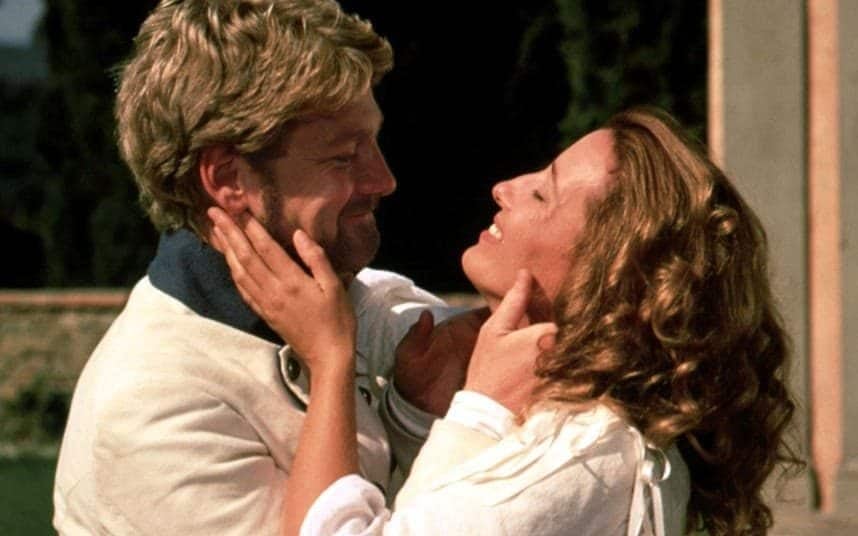
Finally, Branagh teamed with his then-wife, Emma Thompson, for a “merry war” of wits, as Benedick and Beatrice, in his 1993 adaptation of “Much Ado About Nothing.” Again, the film features an eclectic supporting cast of classically trained actors and pop Hollywood phenomena. Briers, Blessed, and Imelda Staunton share screen time with Denzel Washington, Michael Keaton, and Keanu Reeves. Yet, somehow, despite the different nationalities, ethnicities, and accents, the entire enterprise works. There is an exuberance to the over-the-top opening sequence which sets up a momentum that carries through the rest of the film.
Sigh no more! Join me for the Shakespeare scores of Patrick Doyle on “Picture Perfect,” music for the movies, now in syndication on KWAX Classical Oregon!
——–
Clip and save the start times for all three of my recorded shows:
PICTURE PERFECT, the movie music show – Friday at 8:00 PM EDT/5:00 PM PDT
SWEETNESS AND LIGHT, the light music program – Saturday at 11:00 AM EDT/8:00 AM PDT
THE LOST CHORD, unusual and neglected rep – Saturday at 7:00 PM EDT/4:00 PM PDT
Stream them, wherever you are, at the link!
https://kwax.uoregon.edu
Tag: Shakespeare
-
Strike Up, Pipers! Patrick Doyle Does Shakespeare on “Picture Perfect”
-
Weber Operas: 200 Years of “Oberon;” “Der Freischütz” in Concert
In this year of Carl Maria von Weber anniversaries – the influential German composer died 200 years ago (on June 25, 1826, to be exact) – it’s worthwhile to note the bicentennial of his final opera, actually a singspiel (an opera with spoken dialogue), “Oberon,” which was first performed on this date at Covent Garden, a little more than two months before his passing.
Oberon, of course, is king of the fairies, as we all know from “A Midsummer Night’s Dream.” Weber also imports Puck and Titania. But from there James Robinson Planché’s libretto (which George Grove, of Grove Dictionary fame, described as “unmitigated awfulness”) goes its own way. The story combines elements of Christoph Martin Wieland’s German poem “Oberon” and the 13th century French romance “Huon de Bordeaux.”
In Shakespeare, the fairy royals quarrel over the guardianship of an Indian prince (and accusations of infidelity). Here, Oberon refuses to reconcile with his queen until a faithful human couple is found. Puck directs his attention to Huon, a knight of Charlemagne, charged with assassinating the Caliph’s “right-hand man,” who is engaged to marry the Caliph’s daughter, Reiza. In the meantime, Huon and Reiza both have visions that draw them to one another. A number of trials ensue, including shipwreck, abduction by pirates, and enslavement. The plot thickens, though ultimately a happy ending is achieved, thanks to some blasts on Oberon’s magic horn.
Weber’s “Oberon” overture still appears regularly on orchestra programs and of course on classical radio. The delicacy of some of the music anticipates Mendelssohn’s more famous treatment of the fairies. Mendelssohn pays more overt tribute to his predecessor by actually quoting a theme from the Act II finale, “Hark, the mermaids,” in his own “A Midsummer Night’s Dream” overture.
Weber was not enthusiastic about the London production, but the opera was a great success. The first performance elicited many encores. Sadly, the composer died before he could set to work on a revision. Undoubtedly, he would have overseen the translation of text and dialogue to his native tongue (work which would be undertaken posthumously by other hands).
“Oberon” was first performed in the United States later that year – it would be performed at the Metropolitan Opera between 1918 and 1921 – but if it’s encountered at all now, it’s often as a concert performance, bypassing the requirements of elaborate staging or scenery.
Here’s a performance of the overture from an electric concert given in Tokyo by George Szell and the Cleveland Orchestra in 1970. Szell was fatally ill with cancer (it was his final concert), but you would never know it from what he was able to draw from his players. Their performance of Sibelius’ Symphony No. 2, on the same program, was especially stunning.
https://www.youtube.com/watch?v=PFE0tcRDtm8
Here it is, given the Franz Liszt treatment.
https://www.youtube.com/watch?v=OyWGTWuBZww
And as an arrangement for guitar quartet by Anthony Burgess (author of “A Clockwork Orange”), who was something of a composer himself.
https://www.youtube.com/watch?v=yYetHoiCv9M
Johann Nepomuk Hummel’s “Fantasy on Oberon’s Magic Horn”
https://www.youtube.com/watch?v=-aKwy4BLekwAct II Mermaids’ chorus, transcribed by Charles-Valentin Alkan
https://www.youtube.com/watch?v=HAbgs0osOac
A complete recording of the opera
https://www.youtube.com/watch?v=rht8LHy2C4Q
A staged production (which I have yet to watch)
https://www.youtube.com/watch?v=ImXedOZXqhw
Weber’s most influential opera, of course, was “Der Freischütz” (“The Free-Shooter”), of 1821. With its pact with the devil, magic bullets, and lurid Wolf’s Glen sequence, replete with thunder and lightning, withered trees, skulls, and apparitions, it set the prototype for a more extreme branch of German Romantic opera. The work was a great favorite of Hector Berlioz.
Interestingly, Berlioz’s sympathetic arrangement of “Der Freischütz,” undertaken to meet the requirements for Parisian performance – including adaptation of spoken dialogue to recitative and orchestration of Weber’s piano piece “Invitation to the Dance” for use as a ballet (de rigueur in Paris) – will be presented in concert at Carnegie Hall this Thursday by vocal soloists and the American Symphony Orchestra conducted by Leon Botstein. I’ve already got my ticket – and I didn’t have to barter my soul to Samiel!
https://americansymphony.org/2025-2026/der-freischutz/
More about Weber, at the very least on June 25, for the bicentennial of his passing…
——-
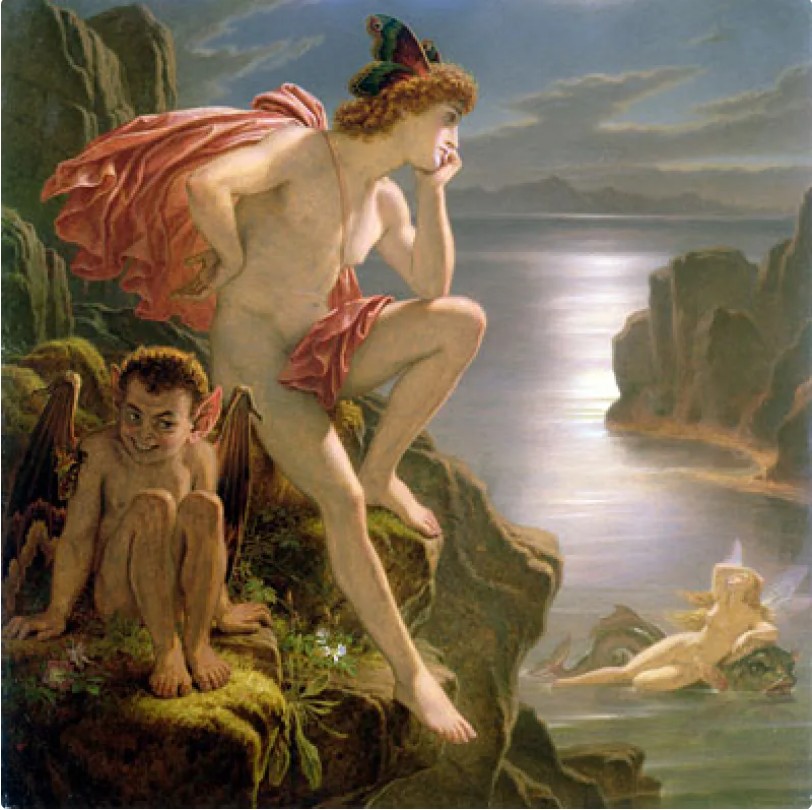
PAINTING: “Oberon and the Mermaid” (1883), by Sir Joseph Noel Paton -
Shakespeare’s Birthday Celebration on KWAX
Some are born great, some achieve greatness, and some have greatness thrust upon them.
We don’t know exactly when Shakespeare was born, but he was baptized on April 26, 1564 – which means it could have been a few days earlier. Since he died on April 23, 1616, and because everyone loves symmetry, his birthday is most commonly observed on the presumptively-shared anniversary of his death. His little life may have been rounded with a sleep, but posterity has fluffed the pillows in an impulse to keep things tidy.
At any rate, we hardly need an excuse to celebrate his plays, which have inspired lots of colorful music. This morning on “Sweetness Light,” we’ll quaff our fill of Shakespearean comedy, with selections by Otto Nicolai, Edward German, Felix Mendelssohn (as transcribed and performed by Sergei Rachmaninoff), and William Walton.
We’ll also hear a fragment of a projected opera by Pyotr Ilych Tchaikovsky on the subject of “Romeo and Juliet,” left incomplete at the time of the composer’s death. It was edited and orchestrated by his pupil, Sergei Taneyev. You may not know the fragment, but you will most definitely recognize the thematic material!
Partying is such sweet sorrow. We’ll celebrate the Bard on “Sweetness and Light,” this Saturday morning at 11:00 EDT/8:00 PDT, exclusively on KWAX, the radio station of the University of Oregon!
Stream it wherever you are at the link:
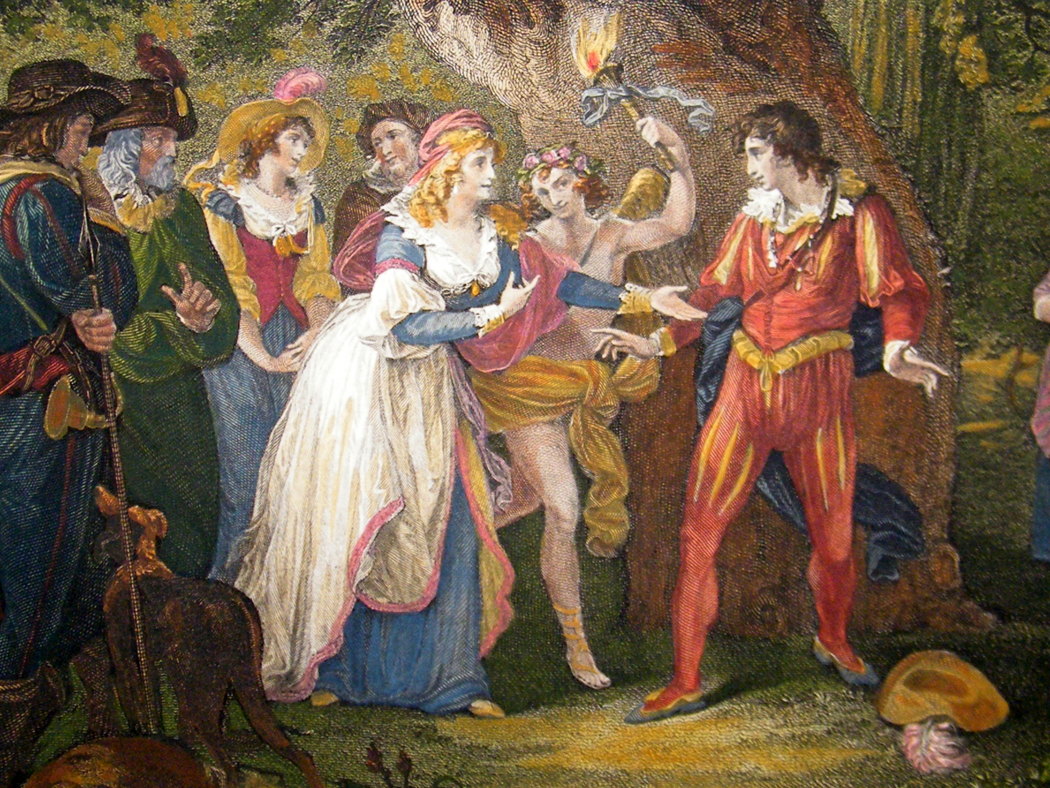
IMAGE: William Hamilton, “As You Like It” (1790)
-

Shakespeare Saint George and England’s April 23
April 23 – The feast day of Saint George, dragon-slayer and patron saint of England (and elsewhere). He’s famously invoked in Shakespeare’s “Henry V,” during the siege of Harfleur. It’s only appropriate that England’s most-celebrated playwright was born on this date in 1564. Or was he? We’re not sure, but we know he was baptized on April 26, and he died on April 23, 52 years later, so we’re inclined to make it fit! Methinks the Bard would appreciate the touch of poetic license.
Happy birthday, Shakespeare, and cry Harry, England and Saint Geooooooooorge!
Olivier, “Once more unto the breach, dear friends!”
Branagh, same
Bonus! Brian Blessed, who played Exeter in the Branagh version, at 84
Edward Elgar, “The Banner of Saint George,” conducted by the late Sir Andrew Davis
Some of the most impressive artistic renderings of St. George aren’t even English. And I kind of feel sorry for the dragon, to be honest.
Branagh as “Henry V” (left) and “Saint George Killing the Dragon” by Bernat Martorell
-

Shakespeare’s Birthday Celebration on KWAX Radio
‘Tis true, we knoweth not f’r c’rtain at which hour Mr. Wm. Shakespeare wast b’rn, but baptiz’d wast he on April 26, 1564. Beest t so symmetry ev’ryone loves, his birthday is commonly obs’rv’d on the anniv’rsary of his lamentable death, which did occur on April 23, 1616. The party dost start early this m’rning, on “Sweetness and Light.”
I desire you’ll joineth me f’r some lightheart’d Shakespearean inspirations by Johan Wagenaar, Sir Arthur Sullivan, Mario Castelnuovo-Tedesco, Felix Mendelssohn (transcrib’d by S’rgei Rachmaninoff), Sir Thomas M’rley, and Erich Wolfgang K’rngold.
Get thy day off to a valorous starteth, this Saturday m’rning at 11:00 EDT/8:00 PDT. Partying is such sweet s’rrow on “Sweetness and Light, ” now exclusively on KWAX, the radio station of the Univ’rsity of ‘regon.
Stream t, wh’rev’r thou art, at the link.
Tag Cloud
Aaron Copland (93) Beethoven (95) Composer (114) Film Music (144) Film Score (143) Film Scores (255) Halloween (94) John Williams (195) KWAX (229) Leonard Bernstein (104) Marlboro Music Festival (125) Movie Music (159) Mozart (90) Opera (212) Philadelphia Orchestra (89) Picture Perfect (174) Princeton Symphony Orchestra (109) Radio (88) Ross Amico (244) Roy's Tie-Dye Sci-Fi Corner (290) The Classical Network (101) The Lost Chord (269) Vaughan Williams (105) WPRB (397) WWFM (881)