Am I am such a tender ass, if my hair do but tickle me, I must scratch?
This week on “Picture Perfect,” we’ll celebrate William Shakespeare, just a few days shy of the anniversary of his birth, on April 23 (observed). Tune in for an hour of music from film adaptations of his comedies. We’ll enjoy selections from “As You Like It” (William Walton), “A Midsummer Night’s Dream” (Korngold), “The Taming of the Shrew” (Nino Rota), and “Much Ado About Nothing” (Patrick Doyle), even as we wryly acknowledge that the course of true love never did run smooth.
What fools these mortals be!
Verily, the wise ones know to stream it, wherever they are, at the link, this Friday evening at 8:00 EDT/5:00 PDT!
We don’t know exactly when Shakespeare was born. We do know that he was baptized on April 26, 1564. Scholars must have found the potential for symmetry irresistible: since he died on April 23, 1616, the Bard’s birthday has traditionally been observed on the same date as his death.
Of course, he’s one of the most influential artists who ever lived. Regardless of what anyone may argue to the contrary, his relevancy will never wane, for as long as humans continue to exist. Who knows, maybe longer. I’ll have to consult Sycorax.
In the meantime, I’ll be doing my small part, in anticipation of the Bard’s birthday anniversary, with three programs of music inspired by his works.
First, on “Picture Perfect” (tonight at 8:00 EDT/5:00 PDT), we’ll have an hour of selections from cinematic adaptations of the comedies, including “As You Like It” (William Walton), “A Midsummer Night’s Dream” (Erich Wolfgang Korngold), “The Taming of the Shrew” (Nino Rota), and “Much Ado About Nothing” (Patrick Doyle).
Then, on “Sweetness and Light” (Saturday morning at 11:00 EDT/8:00 PST), we’ll do our best to charm and to cheer with Shakespearean inspirations by Johan Wagenaar, Sir Arthur Sullivan, Mario Castelnuovo-Tedesco, Felix Mendelssohn (transcribed by Sergei Rachmaninoff), Sir Thomas Morley, and again, Erich Wolfgang Korngold (same composer, different work).
Finally, on “The Lost Chord,” power corrupts, as we juxtapose musical adaptations of “Macbeth,” by William Walton and Sir Arthur Sullivan, with works inspired by Eugene O’Neill’s “The Emperor Jones,” by Louis Gruenberg and Heitor Villa-Lobos, on a program titled “Power Plays” (Saturday at 7:00 p.m. EDT/4:00 p.m. PDT).
If music be the food of love, stream on, on KWAX, the radio station of the University of Oregon!
2023 marks the 400th anniversary of the so-called First Folio, a collection of Shakespeare’s plays, published seven years after the author’s death and considered to be one of the most influential books ever issued.
Although not quite on the same level of significance, this Sunday night on “The Lost Chord,” we’ll devote an hour to music inspired by the Bard – a topic which, of course, could fill many years of such programs – in observation of William Shakespeare’s birthday.
First, fairy high jinks are a metaphor for the mutability and volatility of the human heart in “A Midsummer Night’s Dream.” We’ll hear two works inspired by Shakespeare’s pixilated comedy.
English composer Walter Leigh (1905-1942) was killed in action during the Second World War, just shy of his 37th birthday. Like Paul Hindemith, who was his teacher for two years, Leigh thrived on writing music made to order for specific occasions. His incidental music for “A Midsummer Night’s Dream,” first played in open air in 1936, sounds like a throwback to the Restoration period.
Italian-born composer Mario Castelnuovo-Tedesco (1895-1968) fled fascism in Europe to settle in California. There, he wrote concertos for Jascha Heifetz, Gregor Piatigorsky and Andrés Segovia. He is particularly well-regarded for his guitar music, having composed nearly 100 works for the instrument. He also worked on about 200 film scores. As a teacher, his students included André Previn, Nelson Riddle, Herman Stein, Henry Mancini, Jerry Goldsmith, and John Williams.
Over the course of his career, Castelnuovo-Tedesco churned out an extraordinary amount of music inspired by the Bard. He composed an opera after “The Taming of the Shrew,” four dances for “Love’s Labour’s Lost,” 33 Shakespeare songs drawn from the plays, and settings of 35 of the sonnets.
Between 1930 and 1953, he wrote a number of overtures on Shakespearean themes – at least 11, enough to fill two compact discs, which have been issued on the Naxos label. His overture to “A Midsummer Night’s Dream” dates from 1940.
Czech composer Josef Bohuslav Foerster (1859-1951) lived a very long life, during which he witnessed, firsthand, many remarkable events in music history. Born in Prague, Foerster worked as a critic in Hamburg, then moved to Vienna, where he became closely acquainted with Gustav Mahler.
Although he occasionally employed in his works musical inflections of his native land, he wasn’t truly part of the Czech nationalist school embraced by Dvořák and others. Because his music is not as overtly Czech-sounding as some, and because he spent so much of his early career in Germany and Austria, Foerster’s output and reputation were embraced only gradually by his countrymen.
He returned to Prague in 1918, with the establishment of the Czechoslovak Republic, and found employment there at both the conservatory and university. Gradually, he attained the status of “grand old man” of Czech music.
He composed his symphonic suite “From Shakespeare” in 1909. Made up of four portraits of prominent female characters from Shakespeare plays, the work consists of a brief introduction, followed by musical meditations on Perdita (from “The Winter’s Tale”), Viola (from “Twelfth Night”), Lady Macbeth (from – well, you know), and finally, Katherina, Petruchio and Eros (from “The Taming of the Shrew”).
I’ll provide the whipped cream and maraschino cherries. Bring your own straws for “Great Shakes” – celebrating William Shakespeare and 400 years of the First Folio – this Sunday night at 10:00 EDT, on WWFM – The Classical Network and wwfm.org.
“Is it not strange that sheep’s guts should hale souls out of men’s bodies?”
This week on “Picture Perfect,” on the presumed birthday of William Shakespeare (April 23, 1564), we’ll make much ado about Patrick Doyle, with selections from his scores written for the films of Kenneth Branagh.
In 1987, Doyle joined Branagh’s Renaissance Theatre Company, for which he provided incidental music. Two years later, Branagh – and by extension, Doyle – made a leap to the big screen, where they achieved a remarkable feat, rethinking Shakespeare’s “Henry V.” Remember, this is the play that propelled Laurence Olivier to worldwide fame in 1944, both as a filmmaker and the Bard’s most celebrated interpreter, and William Walton’s score is regarded as one of the best of all time.
Branagh’s version is quite different. Though equally rousing, it doesn’t shy away from Henry’s more complicated nature and the grittier aspects of what it means to go to war. It was a bold gamble, but one that paid off. Not only did this revisionist “Henry” receive nearly universal acclaim, the film was a box office success, and Branagh would be nominated for two Academy Awards, like his predecessor, in the categories of Best Actor and Best Director. Certainly, the film’s score deserved to be recognized – but in the year of “The Little Mermaid,” it failed even to secure an Academy Award nomination.
An interesting footnote: Doyle himself is the baritone who introduces “Non nobis Domine,” a prayer of thanksgiving, following the Battle of Agincourt.
In 2006, Branagh directed an adaptation of “As You Like It.” As has become his custom, he took a celebrity approach to its casting, although perhaps not so widely uneven as some of the cameos in his big screen “Hamlet.” Kevin Kline plays Jacques; Alfred Molina the fool, Touchstone; and Branagh regulars, Brian Blessed and Richard Briers appear, as well.
The most radical liberty taken with the play is that Branagh transplants the action to 19th century Japan. The language remains firmly rooted in Shakespeare’s text, although there are striking cross-cultural elements, including ample kimonos, kabuki theatre, ninjas, and a sumo wrestler. Still, it’s a long way off from the astounding bomb that was Branagh’s American Songbook-interpolated “Love’s Labour’s Lost.”
While Olivier’s “Hamlet” won four Academy Awards in 1948, including those for Best Picture and Best Actor, Branagh’s 1996 version is cinema’s first adaptation of the complete text. It is, perhaps, an uneven interpretation, with some puzzling casting choices – including walk-ons by Jack Lemmon, Robin Williams, and Gerard Depardieu – but there are enough merits, certainly, to make the four-hour trek worthwhile.
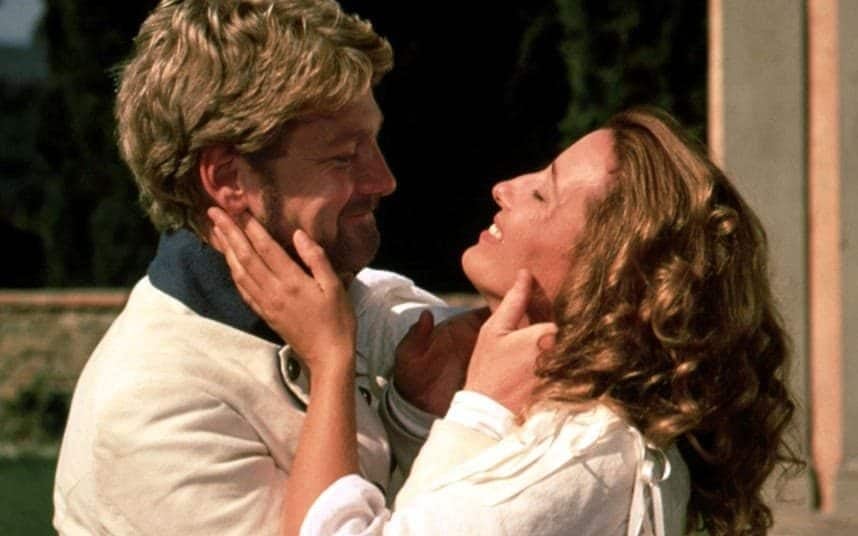
Finally, Branagh teamed with his then-wife, Emma Thompson, for a “merry war” of wits, as Benedick and Beatrice, in his 1993 adaptation of “Much Ado About Nothing.” Again, the film features an eclectic supporting cast of classically trained actors and pop Hollywood phenomena. Briers, Blessed, and Imelda Staunton share screen time with Denzel Washington, Michael Keaton, and Keanu Reeves. Yet, somehow, despite the different nationalities, ethnicities, and accents, the entire enterprise works. There is an exuberance to the over-the-top opening sequence which sets up a momentum that carries through the rest of the film.
Sigh no more, but join me for the Shakespeare scores of Patrick Doyle on “Picture Perfect,” music for the movies, this Saturday evening at 6:00 EDT, on WWFM – The Classical Network and wwfm.org.
How could you not love this opening?
Faith and sheep’s guts in “Much Ado About Nothing”