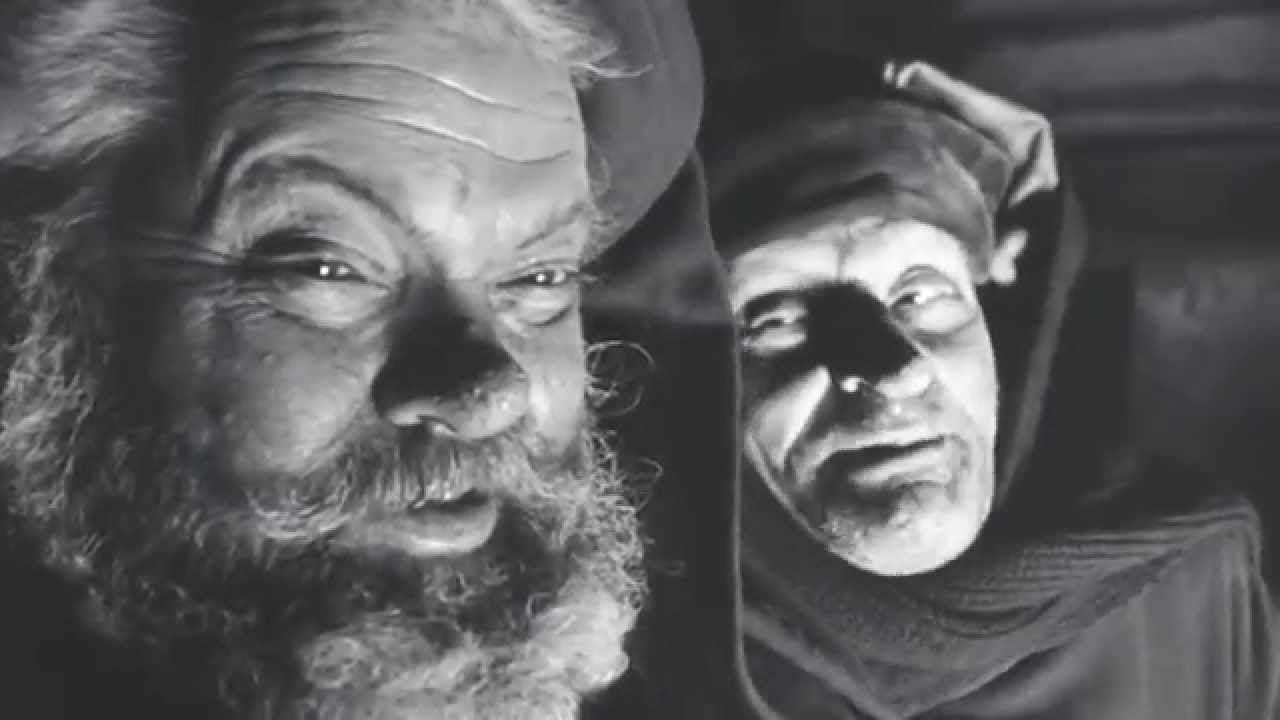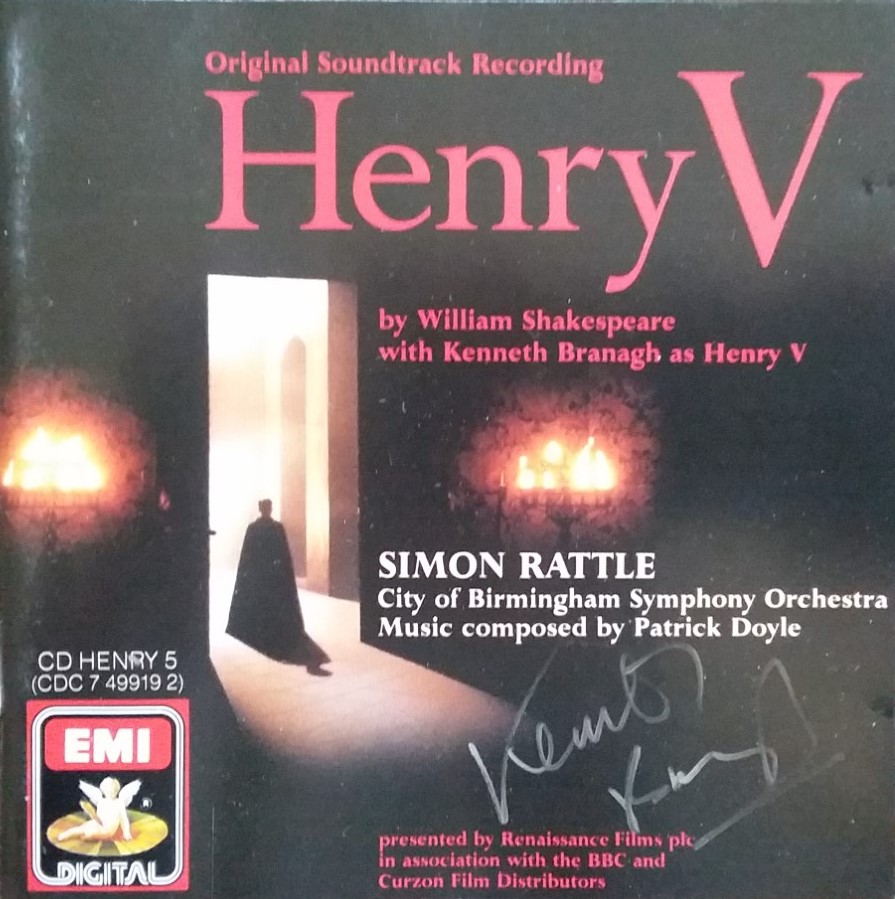
Here’s a glimpse of my soundtrack to Patrick Doyle’s “Henry V.” I had the booklet signed by Kenneth Branagh. At the time, Branagh had just been hired by Marvel to direct “Thor,” and I was hoping to talk him into casting Brian Blessed as Odin and Derek Jacobi as Loki. Alas, it was not to be… not that I ever thought it would be!
Enjoy selections from Branagh’s “Henry V,” alongside Doyle’s music for “As You Like It,” “Hamlet,” and “Much Ado About Nothing.”
Branagh meets the Bard on “Picture Perfect,” this Friday evening at 6:00 EDT, on WWFM – The Classical Network and wwfm.org.
This week on “Picture Perfect,” between the surmised date of Shakespeare’s birth (April 23, 1564) and his baptismal date (April 26), we’ll make much ado about Patrick Doyle, with selections from his scores written for the films of Kenneth Branagh.
In 1987, Doyle joined Branagh’s Renaissance Theatre Company, for which he provided incidental music. Two years later, Branagh – and by extension, Doyle – made a leap to the big screen, where they achieved a remarkable feat, rethinking Shakespeare’s “Henry V.” Remember, this is the play that propelled Laurence Olivier to worldwide fame in 1944, both as a filmmaker and the Bard’s most celebrated interpreter, and William Walton’s score is regarded as one of the best of all time.
Branagh’s version is quite different. Though equally rousing, it doesn’t shy away from Henry’s more complicated nature and the grittier aspects of what it means to go to war. It was a bold gamble, but one that paid off. Not only did this revisionist “Henry” receive nearly universal acclaim, the film was a box office success, and Branagh would be nominated for two Academy Awards, like his predecessor, in the categories of Best Actor and Best Director. Certainly the film’s score deserved to be recognized – but in the year of “The Little Mermaid,” it failed even to secure an Academy Award nomination.
An interesting footnote: Doyle himself is the baritone who introduces “Non nobis Domine,” a prayer of thanksgiving, following the Battle of Agincourt.
In 2006, Branagh directed an adaptation of “As You Like It.” As has become his custom, he took a celebrity approach to its casting, although perhaps not so widely uneven as some of the cameos in his big screen “Hamlet.” Kevin Kline appears as Jacques; Alfred Molina is the fool, Touchstone; and Branagh regulars, Brian Blessed and Richard Briers appear, as well.
The most radical liberty taken with the play is that Branagh transplants the action to 19th century Japan. The language remains firmly rooted in Shakespeare’s text, although there are striking cross-cultural elements, including ample kimonos, kabuki theatre, ninjas, and a sumo wrestler. Still, it’s a long way off from the astounding bomb that was Branagh’s American Songbook-interpolated “Love’s Labour’s Lost.”
While Olivier’s “Hamlet” won four Academy Awards in 1948, including those for Best Picture and Best Actor, Branagh’s 1996 version is cinema’s first adaptation of the complete text. It is, perhaps, an uneven interpretation, with some puzzling casting choices – including walk-ons by Jack Lemmon, Robin Williams and Gerard Depardieu – but there are enough merits, certainly, to make the four-hour trek worthwhile.
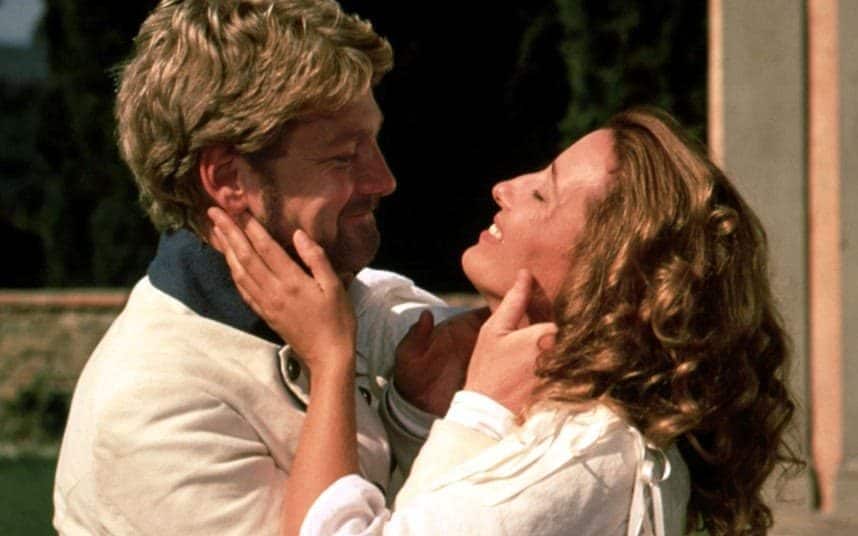
Finally, Branagh teamed with his then-wife, Emma Thompson, for a “merry war” of wits, as Benedick and Beatrice, in his 1993 adaptation of “Much Ado About Nothing.” Again, the film features an eclectic supporting cast of classically trained actors and pop Hollywood phenomena. Briers, Blessed, and Imelda Staunton share screen time with Denzel Washington, Michael Keaton and Keanu Reeves. Yet, somehow, despite the different nationalities, ethnicities, and accents, the entire enterprise works. There is an exuberance to the over-the-top opening sequence which sets up a momentum that carries through the rest of the film.
Sigh no more, but join me for the Shakespeare scores of Patrick Doyle on “Picture Perfect,” this Friday evening at 6:00 EDT, on WWFM – The Classical Network and wwfm.org.
We don’t really know when Shakespeare was born. (He was baptized on April 26, 1564.) Traditionally, his birthday is celebrated on April 23, since that also happens to be the anniversary of his death, in 1616. Man, by nature, is a compulsive creature, seeking order in all things.
For obvious reasons, I can’t be with you on the air waves today. But if you pardon, we will mend! Here’s a lovingly curated playlist of music inspired by the Bard.
I left off a lot of the better-known works, so feel free to supplement!
Franco Zeffirelli died on June 15 at the age of 96. The influential director favored big emotions and grandiose subjects, making his biggest mark in Shakespeare and opera. I’ll leave the opera to other hands. However, this week on “Picture Perfect,” I’ll do what I can to honor his artistry with music from a selection of his films.
“Romeo and Juliet” (1968) was probably the most culturally significant of these. Not only did it turn out to be a surprise hit, the film has been a staple of high school English curricula for decades. Zeffirelli’s vision proved especially appealing to teenaged audiences – in part because of the refreshing youth of its leads (Leonard Whiting and Olivia Hussey, 17 and 16 respectively).
“Romeo and Juliet” was nominated for several Academy Awards, including those for Best Picture and Best Director. Laurence Olivier spoke the film’s prologue and epilogue, and reportedly dubbed the voice of the Italian actor who played Lord Montague. Nino Rota wrote the music, and the love theme was popularized as “A Time for Us.”
Another enduring success for Zeffirelli, a devout Roman Catholic, was his television miniseries, “Jesus of Nazareth” (1977). This time Olivia Hussey plays Mary, mother of Jesus. The all-star cast includes eight Academy Award winners, past and future (Anne Bancroft, Ernest Borgnine, James Earl Jones, Laurence Olivier, Christopher Plummer, Anthony Quinn, Rod Steiger, and Peter Ustinov). It makes me happy to learn that the sets for the film were reused by Monty Python for “Life of Brian.”
The music was by Maurice Jarre, David Lean’s composer-of-choice. I realize we’ve been hearing a lot of late-period Jarre recently, when he was most under the spell of electronics. “Jesus of Nazareth” sports a good old-fashioned orchestral score, with obligatory Biblical chorus.
Zeffirelli proved again and again that he was especially adept at adapting Shakespeare for the big screen. With the unlikely casting of action hero Mel Gibson as the melancholy Dane, “Hamlet” (1990) was something of a gamble that paid off. Zeffirelli puzzlingly tampers with one of the all-time great openings in the history of drama, delaying the appearance of the ghost of Hamlet’s father in favor of some fabricated funeral that looks like a rejected scene from “Star Wars,” but Gibson brings to the title role a refreshing vitality. The reading is passionate and dangerous. The music was by Ennio Morricone.
Art imitates life in Zeffirelli’s first feature as director, “The Taming of the Shrew” (1967), a showcase for the famously tempestuous husband-and-wife Richard Burton and Elizabeth Taylor. In addition, “Shrew” and “Romeo” provided notable supporting roles for a young Michael York. Nino Rota supplies an alternately rollicking and melancholy score in a manner that seems characteristic of Italian composers – perhaps the influence of Italian opera?
Of course Zeffirelli made a magnificent imprint in the world of opera, with his opulent, eye-popping productions. For film, he directed adaptations of “La traviata” and “Otello,” with Placido Domingo.
Among his other films were “Brother Sun, Sister Moon,” “The Champ,” “Endless Love,” “Jane Eyre,” and “Tea with Mussolini.” But we’ll go with the spectacle – I think Franco would have wanted it that way – this Friday evening at 6:00 EDT, on WWFM – The Classical Network and wwfm.org.
Did I ever tell you about the time Captain Kirk saved a Canadian Shakespeare festival? No? Read on…
Immediately following today’s Noontime Concert with the Rolston String Quartet (even as I type, performing Beethoven’s Op. 132), our Shakespeare celebration will commence, in honor of the possible anniversary of the Bard’s birth. Shakespeare died on this date in 1616. We don’t know when he was born, really, but he was baptized on April 26,1564, and for many the potential symmetry is irresistible.
Also, April 23 happens to be St. George’s Day. As I say, irresistible.
Among my featured highlights this afternoon will be an extended suite of William Wallton’s music for the Laurence Olivier film of “Henry V.” The speaker will be Christopher Plummer.
Plummer played Henry at the Stratford Shakespeare Festival, of Stratford, Ontario, in 1956, when one night he was hospitalized with a kidney stone. His understudy for that particular production was none other than William Shatner, who had been cast in the role of Gloucester. You can read how it all panned out here: