Saturday is the big day. The 400th anniversary of the death of William Shakespeare. Also the anniversary of his birthday (52 years earlier), allegedly. Have you anything special planned? Back-to-back screenings of the Olivier and Branagh versions of “Henry V?” Falstaff beer pong? A “Hamlet” sleepover?
We’ll do our best to get your creative juices flowing this morning, as we set the scene with the third of four programs devoted to music inspired by the Bard’s plays. Be with me bright and early for Johan Svendsen’s “Romeo and Juliet,” Sir William Walton’s “As You Like It,” and Josef Bohuslav Foerster’s “From Shakespeare,” really musical portraits of four female characters from Shakespeare’s plays (Perdita from “The Winter’s Tale,” Viola from “Twelfth Night,” Lady Macbeth from, well, “Macbeth,” and Katherina from “The Taming of the Shrew”). And that’s just in the 6:00 hour!
Before too late, we’ll also have Erich Wolfgang Korngold’s “Much Ado About Nothing” and “Cymbeline” by his teacher, Alexander Zemlinsky. By then, you should be sufficiently caffeinated to compose sonnets with a quill.
I’ll be welcoming two guests this morning: Mariusz Smolij, music director of the Riverside Symphonia , who will tell us about his orchestra’s Friday night concert at St. Martin of Tours Church in New Hope – he’ll talk to us a little after 8 – and William Walker from The Princeton Singers will drop by a little after 9 to tell us about the choir’s Shakespeare-inspired concerts at Princeton University Art Museum on Saturday evening.
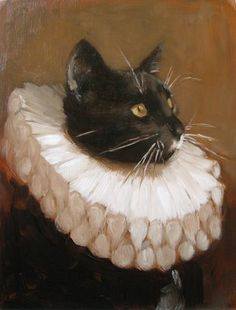
Music and sweet poetry agree this morning, from 6 to 11 EDT, on WPRB 103.3 FM and at wprb.com. We’re donning an Elizabethan collar, on Classic Ross Amico.
Right now, we’re listening to some of Erich Wolfgang Korngold’s music for “Much Ado About Nothing.” Though he wrote it in his early 20s, for a 1919 production of the play in Vienna, the “Korngold sound” is already very much in evidence. It would later serve him well during his time in Hollywood, where he would compose music for films like “The Adventures of Robin Hood.” Later on in the hour, we’ll hear music by Korngold’s teacher, Alexander Zemlinsky, written for a production of Shakespeare’s “Cymbeline.”
Around 9:00, we’ll be joined by William Walker of The Princeton Singers, who will tell us all about the choir’s Shakespeare-inspired concerts coming up this Saturday evening at Princeton University Art Museum.
Before the morning is out, we’ll hear Ralph Vaughan Williams’ “Serenade to Music” (on a text from “The Merchant of Venice”) and Paul Moravec’s 2004 Pulitzer Prize-winning composition, “Tempest Fantasy.” It’s all Shakespeare Thursday mornings until 11:00 EDT, as we commemorate the 400th anniversary of the Bard’s death (on April 23, 1616), on WPRB 103.3 FM and at wprb.com.
“Be not afeard. The isle is full of noises,
Sounds, and sweet airs that give delight and hurt not.
Sometimes a thousand twangling instruments
Will hum about mine ears, and sometime voices
That, if I then had waked after long sleep,
Will make me sleep again. And then, in dreaming,
The clouds methought would open and show riches
Ready to drop upon me, that when I waked
I cried to dream again.”
With two weeks left in our four-part celebration of William Shakespeare this month, we’ve still got a lot of ground to cover. In case you haven’t heard, April 23 marks the 400th anniversary of the Bard’s death. (It’s also traditionally held to be the date of his birth, 52 years earlier.) Every Thursday morning on WPRB, we’re listening to music inspired by Shakespeare’s plays and sonnets.
In the remaining hours, I am hoping to get to the following composers and works: Geoffrey Bush’s “Yorick,” Cecil Coles’ “Comedy of Errors Overture,” David Diamond’s “Music for Romeo and Juliet,” Gerald Finzi’s “Let Us Garlands Bring,” Josef Bohuslav Foerster’s “From Shakespeare,” Erich Wolfgang Korngold’s “Much Ado About Nothing,” Florent Schmitt’s “Antony and Cleopatra” (in a recent recording with the Buffalo Philharmonic Orchestra conducted by JoAnn Falletta), Jean Sibelius’ “The Tempest,” Bedrich Smetana’s “Richard III,” Ralph Vaughan Williams’ “Serenade to Music” (on a text from “The Merchant of Venice”), Sir William Walton’s “Macbeth,” and Alexander Zemlinsky’s “Cymbeline,” among others.
In this week of the Pulitzer Prizes, we’ll also hear Paul Moravec’s “Tempest Fantasy,” the 2004 winner of the Pulitzer Prize for Music.
With only ten hours to go, can I possibly program all of these, with additional surprises? Where there’s a Will, there’s a way! Maybe I’m a utopianist, but I sure will try. I have no idea if and when any of them will be played, so you will just have to tune in whenever you can, for as long as you can.
I’ll also welcome two guests tomorrow: Mariusz Smolij, music director of the Riverside Symphonia, will tell us about his orchestra’s Friday night concert at St. Martin of Tours Church in New Hope – he’ll talk to us a little after 8 a.m. – and William Walker from The Princeton Singers will drop by a little after 9 to tell us about their Shakespeare-inspired concerts at Princeton University Art Museum on Saturday evening.
We’re buried by the Bard, Thursday mornings in April, from 6 to 11 EDT, on WPRB 103.3 FM and at wprb.com. We’re all shook up for Shakespeare, on Classic Ross Amico.
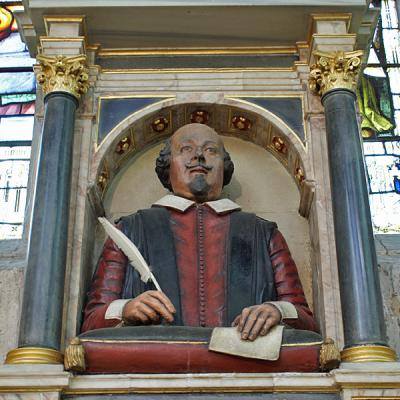
PHOTO: Funerary monument, carved by Gerard Johnson, a Shakespeare contemporary, which overlooks Shakespeare’s grave at Holy Trinity Church at Stratford-upon-Avon.
The epitaph on the grave itself (attributed to Shakespeare):
Good friend for Jesus sake forbeare,
To dig the dust enclosed here.
Blessed be the man that spares these stones,
And cursed be he that moves my bones.
If music be the food of love, play on.
Give me excess of it that, surfeiting,
The appetite may sicken, and so die.
Duke Orsino, “Twelfth Night,” Act I, scene 1
Are you played out on the Bard yet? April 23rd marks the 400th anniversary of the death of William Shakespeare, and area musicians prepare to strut and fret their hour upon the stage.
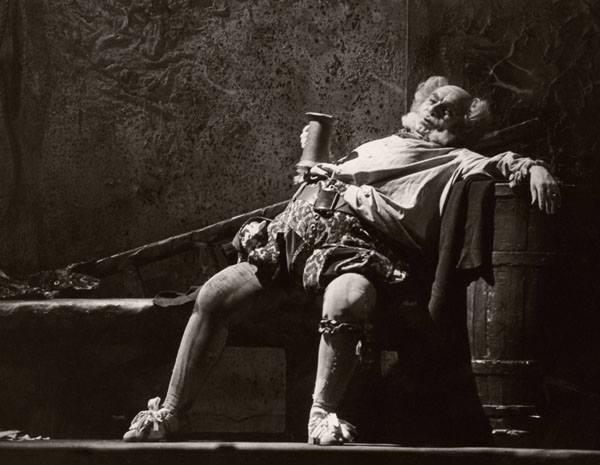
Westminster Opera Theatre will present two performances of Verdi’s “Falstaff,” tonight and tomorrow at 7:30 p.m. at the Robert L. Annis Playhouse on the campus of Westminster Choir College in Princeton. Allegedly the run is sold out, but there could be turn-ins.
On Sunday at 3 p.m., Westminster Conservatory of Music faculty singers Danielle Sinclair, Tracy Chebra, Timothy Urban and Krishna Raman will share a recital of Shakespeare in song as part of the Kaleidoscope Chamber Series. The free concert will take place in Gill Chapel on the campus of Rider University in Lawrenceville.
Next Thursday at 12:15, Mary Greenberg will present a program of Bard-inspired music for the keyboard, interlaced with readings from the Shakespearean sources, as part of Westminster Conservatory’s noontime concert series. The free recital will be given in the Niles Chapel of Nassau Presbyterian Church in Princeton.
Next weekend, on Saturday, the actual anniversary of the Bard’s death (also traditionally held to be the anniversary of his birth, 52 years earlier), The Princeton Singers will present “Brush Up Your Shakespeare” at 5:30 and 8 p.m. The concerts will be held at Princeton University Art Museum.
Finally, on Tuesday, April 26 at 7 p.m., The Merrie Companions – Rebecca Mariman, soprano, John Burkhalter, Renaissance recorders, and John Orluk Lacombe, lute – will present “Hamlet’s Castle, or Mr. Shakespeare’s Musicke.” The free concert will take place in the Community Room of Princeton Public Library.
Words, words, words. You can read more about it in my article in today’s Trenton Times.
Our #Shakespeare400 celebration continues this week on “Picture Perfect,” as we focus on the music of Patrick Doyle composed for the films of Kenneth Branagh.
Doyle joined Branagh’s Renaissance Theatre Company in 1987, for which he provided incidental music. In 1989, Branagh – and by extension, Doyle – made a leap to the big screen, where they achieved a remarkable feat, rethinking Shakespeare’s “Henry V.” Remember, this is the play that propelled Laurence Olivier to worldwide fame in 1944, both as a filmmaker and the Bard’s most celebrated interpreter, and William Walton’s score is regarded as one of the best of all time.
Branagh’s version is quite different. Though equally rousing, it doesn’t shy away from Henry’s more complicated nature and the grittier aspects of what it means to go to war. It was a bold gamble, but one that paid off. Not only did this revisionist “Henry” receive nearly universal acclaim, the film was a box office success, and Branagh would be nominated for two Academy Awards, like his predecessor, in the categories of Best Actor and Best Director. Certainly the film’s score deserved to be recognized – but in the year of “The Little Mermaid,” it failed even to secure an Academy Award nomination.
An interesting footnote: Doyle himself is the baritone who introduces “Non nobis Domine,” a prayer of thanksgiving, following the Battle of Agincourt.
In 2006, Branagh directed an adaptation of “As You Like It.” As has become his custom, he took a celebrity approach to its casting, although perhaps not so widely uneven as some of the cameos in his big screen “Hamlet.” Kevin Kline appears as Jacques; Alfred Molina is the fool, Touchstone; and Branagh regulars, Brian Blessed and Richard Briers appear, as well.
The most radical liberty taken with the play is that Branagh recasts the events to take place among English traders in 19th century Japan. The language remains firmly rooted in Shakespeare’s text, although there are striking cross-cultural elements, including ample kimonos, kabuki theatre, ninjas, and a sumo wrestler. Still, it’s a long way off from the astounding bomb that was Branagh’s American Songbook-interpolated “Love’s Labour’s Lost.”
While Olivier’s “Hamlet” won four Academy Awards in 1948, including those for Best Picture and Best Actor, Branagh’s 1996 version is cinema’s first adaptation of the complete text. It is, perhaps, an uneven interpretation, with some puzzling casting choices – including walk-ons by Jack Lemmon, Robin Williams and Gerard Depardieu – but there are enough merits, certainly, to make the four-hour trek worthwhile.
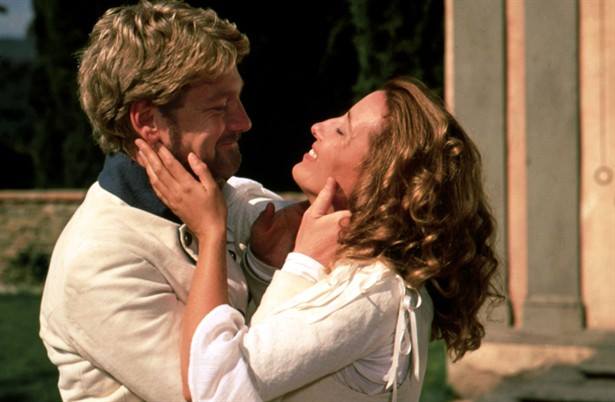
Finally, Branagh teamed with his then-wife, Emma Thompson, for a titanic battle of wits as Benedick and Beatrice in his 1993 adaptation of “Much Ado About Nothing.” Again, the film features an eclectic supporting cast of classically trained actors and pop Hollywood phenomena. Briers, Blessed, and Imelda Staunton share screen time with Denzel Washington, Michael Keaton and Keanu Reeves. Yet, somehow, despite the different nationalities, ethnicities, and accents, the entire enterprise works. There is an exuberance to the over-the-top opening sequence which sets up a momentum that carries through the rest of the film.
How could you not love a movie that opens like this?
I hope you’ll join me for the Shakespeare scores of Patrick Doyle on “Picture Perfect,” this Friday evening at 6, with a repeat Saturday morning at 6; or that you’ll listen to it later as a webcast at wwfm.org.
‘Swounds! If it isn’t Emma Thompson’s birthday today!