Tag: Shakespeare

  • Shakespeare on WPRB This Morning

    Shakespeare on WPRB This Morning

    Roughly two hours to go in our month-of-Thursdays salute to William Shakespeare.

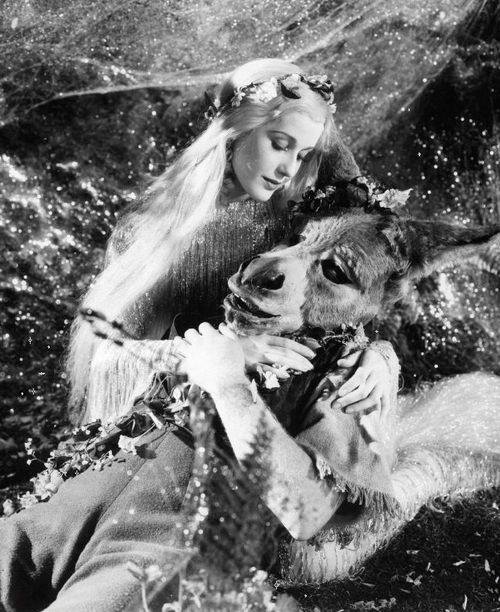
    Yet to come: Frank Bridge’s “There is a willow grows aslant a brook,” his atmospheric reflection on the death of Ophelia; Gerald Finzi’s “Let us Garlands bring,” song settings of some of the Bard’s memorable texts; a suite from Florent Schmitt’s “Antony and Cleopatra,” in a recent recording by the Buffalo Philharmonic Orchestra, conducted by JoAnn Falletta; and a special treat from the pen of Erich Wolfgang Korngold – his imaginative arrangements of music by Felix Mendelssohn made for a 1935 film version of “A Midsummer Night’s Dream,” which starred James Cagney, Olivia de Havilland, and a 15 year-old Mickey Rooney as Puck.

    How now, spirit! Whither wander thee? It’s all Shakespeare this morning until 11:00 EDT, on WPRB 103.3 FM and at wprb.com.

    If we shadows have offended,
    Think but this, and all is mended,
    That you have but slumber’d here
    While these visions did appear.
    And this weak and idle theme,
    No more yielding but a dream,
    Gentles, do not reprehend:
    if you pardon, we will mend…

  • Shakespeare on WPRB Final Show April 28

    Shakespeare on WPRB Final Show April 28

    Time is growing short.

    Tomorrow marks the final installment of our four-part salute to William Shakespeare on WPRB. Every Thursday morning in April, we have been honoring the Bard with music inspired by his writings, to mark the 400th anniversary of his shuffling off this mortal coil on April 23, 1616 (also the anniversary of his birth, though 52 years earlier).

    We have five hours in which to hear any or all of the following: Frank Bridge’s “There is a willow grows aslant a brook,” Ernest Chausson’s “The Tempest,” Cecil Cole’s “Comedy of Errors Overture,” Gabriel Fauré’s “Shylock,” Gerald Finzi’s “Let us Garlands bring,” Florent Schmitt’s “Antony and Cleopatra,” Bedrich Smetana’s “Richard III,” and Johan Wagenaar’s “The Taming of the Shrew Overture,” among others.

    ‘Tis a consummation devoutly to be wished, tomorrow morning from 6 to 11 EDT, on WPRB 103.3 FM and at wprb.com. Conscience does make cowards of us all, on Classic Ross Amico.

    #Shakespeare400

  • Shakespeare After School PTSD? Give Him Another Look

    Shakespeare After School PTSD? Give Him Another Look

    For anyone still suffering from PTSD as a result of having to read Shakespeare in school, you should consider giving him a second look. Not only are his nimble wordplay and poetic imagination mesmerizing, the number of phrases and idioms Shakespeare coined or popularized that are still in everyday use is astonishing.

    There has been much posted about this over the past several days. This is one of my favorites: comedian Rob Brydon recites “Quoting Shakespeare.”

    http://www.telegraph.co.uk/news/2016/04/23/rob-brydon-reveals-popular-shakespeare-phrases-in-everyday-use/

    If you don’t know “The Trip,” the road comedy Brydon made with Steve Coogan, you owe it to yourself to check it out. It’s a mouthwatering blend of gourmet cuisine, banter, and dueling celebrity impressions.

    #Shakespeare400

  • Shakespeare’s Dream Music on The Lost Chord

    Shakespeare’s Dream Music on The Lost Chord

    What fools these mortals be!

    Fairy high jinks become a metaphor for the mutability and volatility of the human heart, in “A Midsummer Night’s Dream.” This Sunday night on “The Lost Chord,” we’ll have two works inspired by Shakespeare’s pixilated comedy.

    English composer Walter Leigh (1905-1942) was killed in action during the Second World War, just shy of his 37th birthday. Like Paul Hindemith, who was his teacher for two years, Leigh thrived on writing music made to order for specific occasions. His incidental music for “A Midsummer Night’s Dream,” first played in open air in 1936, sounds like a throwback to the Restoration period.

    The Italian-born composer Mario Castelnuovo-Tedesco (1895-1968) fled fascism in Europe to settle in California. There, he wrote concertos for Jascha Heifetz, Gregor Piatigorsky and Andrés Segovia. He was probably best known for his guitar music. In all, he composed nearly 100 works for the instrument. During the war, he also worked on some 200 film scores.

    Over the course of his career, he churned out an extraordinary amount of music inspired by the Bard. He composed an opera after “The Taming of the Shrew,” four dances for “Love’s Labour’s Lost,” 33 Shakespeare songs drawn from the plays, and settings of 35 of the sonnets.

    Between 1930 and 1953, he wrote a number of overtures on Shakespearean themes – at least 11, enough to fill two compact discs, which have been issued on the Naxos label. He composed his overture to “A Midsummer Night’s Dream” in 1940.

    The Czech composer Josef Bohuslav Foerster (1859-1951) lived a very long life, during which he witnessed, firsthand, many remarkable events in music history. Born in Prague, Foerster worked as a critic in Hamburg, then moved to Vienna, where he became closely acquainted with Gustav Mahler.

    Although he occasionally employed in his works musical inflections of his native land, he wasn’t truly part of the Czech nationalist school embraced by Dvořák and others. Because his music is not as overtly Czech-sounding as some, and because he spent so much of his early career in Germany and Austria, Foerster’s output and reputation were embraced only gradually by his countrymen.

    He returned to Prague in 1918, with the establishment of the Czechoslovak Republic, and found employment there at both the conservatory and university. Gradually, he assumed the position of venerated “grand old man” of Czech music.

    He composed his symphonic suite “From Shakespeare” in 1909. Made up of four portraits of prominent female characters from Shakespeare plays, the work consists of a brief introduction, followed by musical reflections on Perdita (from “The Winter’s Tale”), Viola (from “Twelfth Night”), Lady Macbeth (from – well, you know), and finally, Katherina, Petruchio and Eros (from “The Taming of the Shrew”).

    I hope you’ll join me for “A Bier for the Bard” – commemorating the 400th anniversary of the death of William Shakespeare – this Sunday night at 10:00 EDT, with a repeat Wednesday evening at 6; or that you’ll listen to it later as a webcast, at wwfm.org.

    #Shakespeare400

  • Shakespeare St Crispin’s Day Speech Analysis

    Shakespeare St Crispin’s Day Speech Analysis

    Happy birthday – and lamentable death date – William Shakespeare!

    The next time you’re feeling overwhelmed, do yourself a favor and revisit these two contrasting interpretations of the St. Crispin’s pep talk from “Henry V.”

    Olivier, a powerful and patriotic – if somewhat theatrical – symbol for the beleaguered British during World War II:

    And Branagh, a cinematic, very human Henry for today:

    https://www.youtube.com/watch?v=cRj01LShXN8

    Wow! Somebody hand me a sword!

    #Shakespeare400

Tag Cloud

Aaron Copland (92) Beethoven (95) Composer (114) Film Music (120) Film Score (143) Film Scores (255) Halloween (94) John Williams (185) KWAX (229) Leonard Bernstein (100) Marlboro Music Festival (125) Movie Music (135) Opera (198) Philadelphia Orchestra (88) Picture Perfect (174) Princeton Symphony Orchestra (106) Radio (87) Ralph Vaughan Williams (85) Ross Amico (244) Roy's Tie-Dye Sci-Fi Corner (290) The Classical Network (101) The Lost Chord (268) Vaughan Williams (103) WPRB (396) WWFM (881)

DON’T MISS A BEAT

Receive a weekly digest every Sunday at noon by signing up here


RECENT POSTS