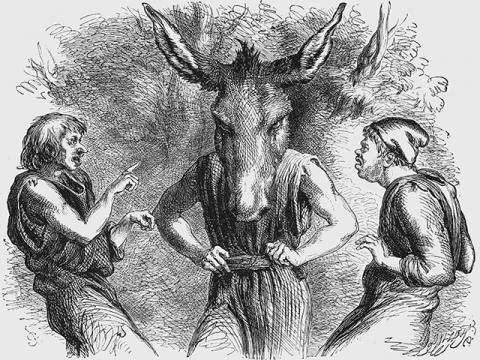
What fools these mortals be!
Fairy high jinks become a metaphor for the mutability and volatility of the human heart, in “A Midsummer Night’s Dream.” This Sunday night on “The Lost Chord,” we’ll have two works inspired by Shakespeare’s pixilated comedy.
English composer Walter Leigh (1905-1942) was killed in action during the Second World War, just shy of his 37th birthday. Like Paul Hindemith, who was his teacher for two years, Leigh thrived on writing music made to order for specific occasions. His incidental music for “A Midsummer Night’s Dream,” first played in open air in 1936, sounds like a throwback to the Restoration period.
The Italian-born composer Mario Castelnuovo-Tedesco (1895-1968) fled fascism in Europe to settle in California. There, he wrote concertos for Jascha Heifetz, Gregor Piatigorsky and Andrés Segovia. He was probably best known for his guitar music. In all, he composed nearly 100 works for the instrument. During the war, he also worked on some 200 film scores.
Over the course of his career, he churned out an extraordinary amount of music inspired by the Bard. He composed an opera after “The Taming of the Shrew,” four dances for “Love’s Labour’s Lost,” 33 Shakespeare songs drawn from the plays, and settings of 35 of the sonnets.
Between 1930 and 1953, he wrote a number of overtures on Shakespearean themes – at least 11, enough to fill two compact discs, which have been issued on the Naxos label. He composed his overture to “A Midsummer Night’s Dream” in 1940.
The Czech composer Josef Bohuslav Foerster (1859-1951) lived a very long life, during which he witnessed, firsthand, many remarkable events in music history. Born in Prague, Foerster worked as a critic in Hamburg, then moved to Vienna, where he became closely acquainted with Gustav Mahler.
Although he occasionally employed in his works musical inflections of his native land, he wasn’t truly part of the Czech nationalist school embraced by Dvořák and others. Because his music is not as overtly Czech-sounding as some, and because he spent so much of his early career in Germany and Austria, Foerster’s output and reputation were embraced only gradually by his countrymen.
He returned to Prague in 1918, with the establishment of the Czechoslovak Republic, and found employment there at both the conservatory and university. Gradually, he assumed the position of venerated “grand old man” of Czech music.
He composed his symphonic suite “From Shakespeare” in 1909. Made up of four portraits of prominent female characters from Shakespeare plays, the work consists of a brief introduction, followed by musical reflections on Perdita (from “The Winter’s Tale”), Viola (from “Twelfth Night”), Lady Macbeth (from – well, you know), and finally, Katherina, Petruchio and Eros (from “The Taming of the Shrew”).
I hope you’ll join me for “A Bier for the Bard” – commemorating the 400th anniversary of the death of William Shakespeare – this Sunday night at 10:00 EDT, with a repeat Wednesday evening at 6; or that you’ll listen to it later as a webcast, at wwfm.org.
#Shakespeare400
Leave a Reply