Tag: Soviet Music

  • Shostakovich Plays Shostakovich 50th Anniversary

    Shostakovich Plays Shostakovich 50th Anniversary

    This week on “The Lost Chord,” on the 50th anniversary of the composer’s death, we’ll revisit two documents from a collection released on the Melodiya label, “Shostakovich Plays Shostakovich.” These are riveting, not only for the musicianship they enshrine, but also on account of their biographical fascination and their sense of history.

    Dmitri Shostakovich was a fabulous pianist, who, early on, eked out a living with his improvisations at a local cinema. He began serious studies at the age of 9, and continued, formally, at the Petrograd Conservatory, upon his acceptance there, at the age of 13. Once he began to receive international attention for his original compositions, for works such as his Symphony No. 1, written when he was only 19, his principal focus began to shift. He did, however, continue to perform and record his own music.

    Perhaps no Shostakovich recording is imbued with a greater sense of time and place than a 1954 performance of his Symphony No. 10. An arrangement, for piano four-hands, was played by the composer at his apartment with his close friend and neighbor Mieczyslaw Weinberg.

    Weinberg found himself in a very precarious situation only the year before. He was arrested on a charge of “Jewish bourgeois nationalism,” in connection with the so-called Doctor’s Plot, at the command of Stalin himself, on the pretense that Jewish doctors were planning to assassinate Soviet officials. Weinberg’s father-in-law had been implicated, and killed. Shostakovich attempted to intercede on his friend’s behalf, but it was only with the sudden and fortuitous death of Stalin in 1953 that Weinberg was officially rehabilitated, and released.
    In a piece of living history, these two artists sit down to perform on Shostakovich’s home piano. This is music that was claimed, in Solomon Volkov’s “Testimony,” Shostakovich’s alleged memoir, to be about Stalin and the Stalin years.

    The pianos used in some of these recordings may be a little rough around the edges, but they only lend to the neurotic intensity of the music-making. It’s also a kind of window into what it must have been like to have been a musician in Soviet Russia, between 1946 and 1958, commandeering whatever means of expression you could lay your hands on.

    I hope you’ll join me for “Black and White and Red All Over,” remembering Dmitri Shostakovich on the 50th anniversary of his death, on “The Lost Chord,” now in syndication on KWAX, the radio station of the University of Oregon!


    Clip and save the start times for all three of my recorded shows:

    PICTURE PERFECT, the movie music show – Friday at 8:00 PM EDT/5:00 PM PDT

    SWEETNESS AND LIGHT, the light music program – Saturday at 11:00 AM EDT/8:00 AM PDT

    THE LOST CHORD, unusual and neglected rep – Saturday at 7:00 PM EDT/4:00 PM PDT

    Stream them, wherever you are, at the link!
    https://kwax.uoregon.edu/

  • Kabalevsky F Troop and Soviet Music Anniversaries

    Kabalevsky F Troop and Soviet Music Anniversaries

    The guy who taught me basic music theory was a nut for Dmitri Kabalevsky (1904-1987). In particular, he was crazy for Kabalevsky’s piano sonatas. It was a rare instance in which he introduced me to something I hadn’t heard (I would have been 19 at the time), as opposed to the other way around. That’s the thing about musicians. They’re so busy performing that they have no time to laze around and listen to records!

    In any case, of course I knew Kabalevsky from his “Colas Breugnon Overture” (from his opera after the novel of Romain Rolland) and the ubiquitous Galop from “The Comedians,” which I believe I first heard on Bob McAllister’s “Wonderama,” if you remember that show.

    Am I the only one who detects Kabalevsky in the theme to “F Troop?”

    “The Comedians: Galop”

    “Colas Breugnon Overture”

    “F Troop”

    Interesting choice, to allude to a Soviet composer in a sitcom about the Wild West. Happy birthday, Dmitri Kabalevsky!

    Vladimir Horowitz plays Kabalevsky’s Piano Sonata No. 3


    It’s quite a day for the Soviets. This date also marks the anniversaries of the first performances of Aram Khachaturian’s Symphony No. 2, in Moscow, in 1943, Dmitri Shostakovich’s Symphony No. 4, also in Moscow, in 1961 (the work was originally scheduled to be performed in 1936, but was prudently withdrawn by the composer after he was denounced in Pravda for his “formalist” opera “Lady Macbeth of Mtsensk”), and – one hundred years ago today – Sergei Prokofiev’s opera “The Love for Three Oranges,” in Chicago, of all places, with the composer in attendance.

    Finally, according to the Julian calendar, Reinhold Glière was born on this date in 1875!


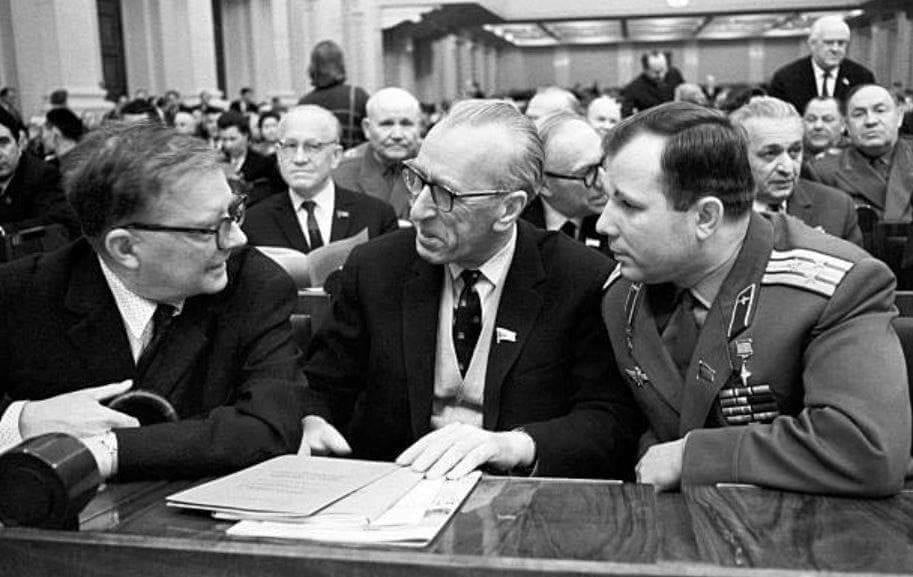
    TOP PHOTO: Kabalevsky with Shostakovich (left) and cosmonaut Yuri Gagarin at the Kremlin, 1966

    BOTTOM PHOTO: Union of Soviet Composers plenum in Moscow, 1946

    Standing (left to right): Yuri Shaporin, Dmitri Kabalevsky, Ivan Dzerhinsky, Maran Koval, Vano Muradelli

    Sitting (also left to right): Aram Khachaturian, Uzeyir Hajibeyli, Dmitri Shostakovich, Reinhold Glière, Sergei Prokofiev

Tag Cloud

Aaron Copland (92) Beethoven (95) Composer (114) Film Music (123) Film Score (143) Film Scores (255) Halloween (94) John Williams (187) KWAX (229) Leonard Bernstein (101) Marlboro Music Festival (125) Movie Music (138) Opera (202) Philadelphia Orchestra (89) Picture Perfect (174) Princeton Symphony Orchestra (106) Radio (87) Ralph Vaughan Williams (85) Ross Amico (244) Roy's Tie-Dye Sci-Fi Corner (290) The Classical Network (101) The Lost Chord (268) Vaughan Williams (103) WPRB (396) WWFM (881)

DON’T MISS A BEAT

Receive a weekly digest every Sunday at noon by signing up here


RECENT POSTS