Tag: Stravinsky

  • Stravinsky’s Agon A Ballet Masterpiece

    Stravinsky’s Agon A Ballet Masterpiece

    Forget Balanchine’s “The Nutcracker,” with its insipid candy cane hula hoops. This is the one to beat!

    Stravinsky’s “Agon” was first staged by Balanchine’s New York City Ballet (co-founded with Lincoln Kirstein) on this date in 1957. The first performance of the music alone took place at UCLA’s Royce Hall earlier in the year, on June 17th, on a 75th birthday concert for the composer, less than two months after Stravinsky completed the work. Stravinsky’s assistant, Robert Craft, conducted. The next day, the composer himself led the sessions for the work’s first recording.

    “Agon” is Greek for “contest,” but it also implies “anguish” or “struggle.” The ballet has no story, but consists of a series of dance movements. Groupings of dancers interact in pairs, trios, quartets, etc. A number of the movements are based on 17th-century French court dances – sarabande, galliard, bransle – but Stravinsky reinterprets them in his own distinctive up-to-date manner. The twelve-tone music is as flirty as anything displayed in the choreography.

    I’m no balletomane, but the first time I saw it danced, I knew it was genius.

    Stravinsky conducts an excerpt from “Agon”

    Some danced selections

    Maria Kowroski shares her insights

    The complete ballet, seen from a fixed position. Suzanne Farrell, a Balanchine muse, founded her own company at the Kennedy Center in 2000.

    A 1960 performance with the New York City Ballet

    Of course, watching it on video is not the same as experiencing it in the theater.

    I love “The Nutcracker,” but I can’t stand this: it takes a lot to spoil the “Russian Dance,” but Balanchine found a way!


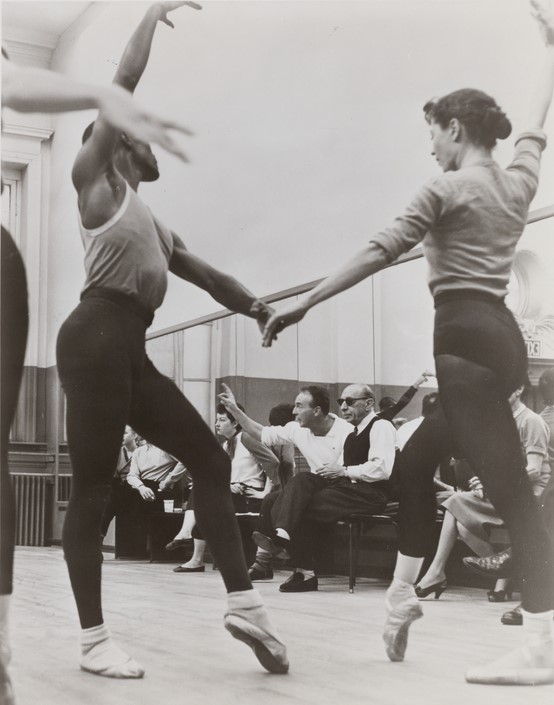
    PHOTO: Balanchine and Stravinsky, center, during rehearsals for “Agon”

  • Princeton’s Dead Composers A Musical Ghost Tour

    Princeton’s Dead Composers A Musical Ghost Tour

    Did you know, the composer of “Old Nassau” was a pupil of Franz Liszt? That Princeton was the birthplace of one of the great stride pianists? That a colleague of Igor Stravinsky rests in St. Paul’s Parish Cemetery?

    Put on some sensible shoes, and grab your coffee to go. Just in time for Halloween, I lead a “dead composers” tour of Princeton cemeteries in this week’s U.S. 1 Newspaper – PrincetonInfo, available online and in area vending machines today.

    https://www.communitynews.org/princetoninfo/coverstories/a-requiem-for-princeton-s-passed-composers/article_a83ca082-5487-11ed-9182-8771c220bdaf.html

  • May Day Madrigals on the Lost Chord

    May Day Madrigals on the Lost Chord

    Now is the month of maying!

    This Sunday night on “The Lost Chord,” at the end of a lusty day of reveling around the maypole and “playing barley-break,” unwind with three 20th century instrumental and orchestral works inspired by Renaissance madrigals.

    Tune in for Igor Stravinsky’s “Monumentum pro Gesualdo di Venosa,” Bohuslav Martinu’s “Three Madrigals” for violin and viola, and Joaquin Rodrigo’s “Concierto Madrigal,” a piece for two guitars and orchestra.

    Fie then! why sit we musing, youth’s sweet delight refusing? Celebrate May Day with “Unsung Madrigals,” this Sunday night at 10:00 EDT, on WWFM – The Classical Network and wwfm.org.


    Throwback to Merrie England

    Maypole dance from “La Fille mal gardée”

    Suite from Howard Hanson’s “Merry Mount” (after Hawthorne’s “The Maypole of Merry Mount”)

    A toast to Merrymount’s Thomas Morton

    https://almostchosenpeople.wordpress.com/tag/thomas-morton/

    Shakespeare, the May Pole and the Hobby Horse

    https://silibrary1.wordpress.com/tag/maypole/

    Welcoming the sun with a good old-fashioned morris dance

    May Day is for capering around the May Pole. Beltane is for embarrassing your parents.

    The May Day Fish-Slapping Dance and the Gavotte of the Long John Silvers

    “Now is the month of maying” on crumhorns

    Deer Man

    Fa la la la la la la la la, fa la la la la la la!

  • Stravinsky’s Wind Symphonies A Centennial

    Stravinsky’s Wind Symphonies A Centennial

    On this date, 100 years ago, Igor Stravinsky’s “Symphonies of Wind Instruments” was given its first performance at Queen’s Hall, London, on a concert conducted by Serge Koussevitzky. Written the previous year, and dedicated to the memory of Debussy, the chorale that concludes the piece was first published in the French magazine “La Revue musicale,” alongside memorial works by Ravel, Bartók, Falla, Dukas, Satie, and others. The issue was titled “Le Tombeau de Claude Debussy.”

    However, the opening night audience found Stravinsky’s music anything but grave. They chortled inappropriately, and Koussevitzky glanced over his shoulder to share a conspiratorial grin. Even so, at the end of the performance, any cheekiness was obliterated by applause, as Stravinsky rose to take a bow.

    The work is scored for 24 wind instruments. The term “symphonies” has nothing to do with symphonic form. Rather, Stravinsky employed the word for its broader, older connotation, from the Greek, of “sounding together.” He would reorchestrate the piece in 1947.

    Three days prior to the Queen’s Hall jeers, Stravinsky had given Londoners something to cry about, as he attended the UK premiere, in the same venue, of the concert version of his riot-inducing ballet “The Rite of the Spring.”

    It’s always refreshing to look back on a time when people were actually passionate about music.


    “Symphonies of Wind Instruments”

    Riot at “The Rite”


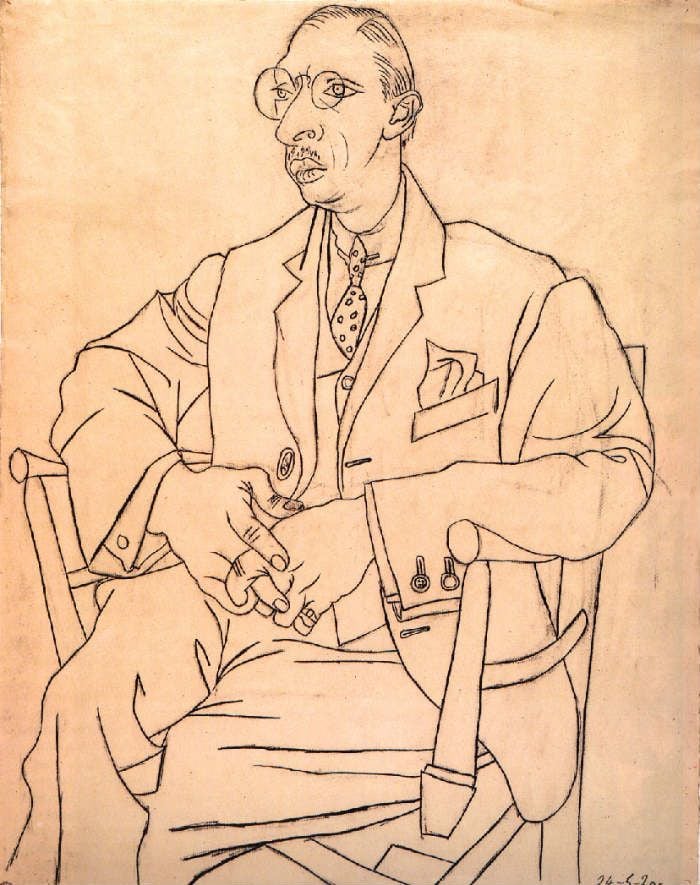
    Stravinsky as rendered by Picasso in 1920

  • Florent Schmitt Rediscovered French Composer

    Florent Schmitt Rediscovered French Composer

    Florent Schmitt was one of the most successful French composers of the early 20th century. However, as fashions changed, his characteristically opulent music became marginalized, only to experience something of a revival, in recent years, mostly on recordings.

    This Sunday night on “The Lost Chord,” we’ll mark the sesquicentenary of Schmitt’s birth (on September 28, 1870) with selections from his incidental music for a production of Shakespeare’s “Antony and Cleopatra” and his grandiose setting of “Psalm XLVII.”

    Schmitt entered the Paris Conservatory in 1889, where he studied with Gabriel Fauré, Jules Massenet, and Théodore Dubois. He was a winner of the Prix de Rome in 1900. He also befriended Frederick Delius, while Delius was in Paris, and prepared the vocal scores for a number of his operas.

    In addition, Schmitt was a music critic, who attained a degree of notoriety for shouting out his assessments from the audience. He was described by one music publisher as an irresponsible lunatic.

    The later neglect of his music may have been due, in part, to his willingness to go along with the Vichy regime during the Nazi occupation of France. But Schmitt is too fascinating a figure to be dismissed out-of-hand. Stravinsky was an early admirer, remarking that the composer’s “The Tragedy of Salome” gave him greater joy than any other he had heard in a long time. Certain elements of the ballet anticipate analogous experiments in Stravinsky’s own “The Rite of Spring.”

    Indeed, Schmitt’s appetite for overheated decadence and lurid orientalism seems to have been insatiable. There’s nothing on the menu tonight but overegged Florentine. I hope you’ll join me for “Schmitt Happens,” this Sunday night at 10:00 EDT, on WWFM – The Classical Network and wwfm.org.


    Exhaustive website devoted to all things Florent Schmitt: florentschmitt.com

Tag Cloud

Aaron Copland (92) Beethoven (95) Composer (114) Film Music (120) Film Score (143) Film Scores (255) Halloween (94) John Williams (185) KWAX (229) Leonard Bernstein (100) Marlboro Music Festival (125) Movie Music (135) Opera (198) Philadelphia Orchestra (88) Picture Perfect (174) Princeton Symphony Orchestra (106) Radio (87) Ralph Vaughan Williams (85) Ross Amico (244) Roy's Tie-Dye Sci-Fi Corner (290) The Classical Network (101) The Lost Chord (268) Vaughan Williams (103) WPRB (396) WWFM (881)

DON’T MISS A BEAT

Receive a weekly digest every Sunday at noon by signing up here


RECENT POSTS