Tag: Stravinsky

  • Ida Rubinstein Scandalous Sugar Heiress

    Ida Rubinstein Scandalous Sugar Heiress

    The actor and dancer Ida Rubinstein specialized in strong, often sultry heroines. A remarkable figure, this sugar heiress from a family of Ukrainian Orthodox Jews essentially willed herself onto the Parisian stage, where her acting ability and natural magnetism more than compensated for her limited ability as a dancer.

    She was welcomed into the Ballets Russes in 1909, where she assumed the roles of Cleopatra and Scheherazade. Later, for her own company, she introduced Ravel’s “Bolero” and Stravinsky’s “Le Baiser de la fée” (“The Fairy’s Kiss”).

    She gained notoriety for her often racy sensuality, stripping naked for the “Dance of the Seven Veils” in a production of Oscar Wilde’s “Salome” in 1908. Her performance in the title role in Gabriele d’Annunzio and Claude Debussy’s “The Martyrdom of Saint Sebastian” generated further scandal in 1911. The Archbishop of Paris prohibited all Catholics from attending, on account of Saint Sebastian being portrayed by a woman and a Jew.

    This Sunday night on “The Lost Chord,” we salute Rubinstein with music that supported two of her lesser-known characterizations.

    In 1924, she appropriated the symphonic variations “Istar,” by Vincent d’Indy. Originally composed in 1896, the subject was a natural fit for the Rubinstein image, with the Assyrian goddess of love and war descending into the underworld to rescue her lover. Along the way, she passes through seven doors. At each door, she removes a piece of jewelry or an article of clothing, until, as she passes through the last, she stands unadorned. So does the music arrive finally at a complete statement of the theme, turning the usual structure of theme and variations on its head to suit the narrative.

    We’ll also hear “Sémiramis,” from 1934. This time Rubinstein played an Assyrian queen with insatiable carnal appetites. The music was by Arthur Honegger, and the instrumentation is quite striking: female narrator, vocal soloists, five-part mixed chorus, with orchestra including double bass clarinet, saxophone, two harps, two pianos, celesta, and two ondes Martenot – electronic keyboard instruments sounding very much like a couple of theremins.

    This was the fifth commission the composer was to receive from Rubinstein The sixth and last brought forth his magnum opus, “Jeanne d’Arc au Bûcher” (“Joan of Arc at the Stake”).

    “Sémiramis” was not a success, and the work remained unpublished during Honegger’s lifetime. In particular, a 15 minute monologue toward the climax, written by Paul Valéry, took all the air out of the room. This spoken interlude has been omitted from the recording we’ll hear of the piece’s first modern performance in 1992.

    I hope you’ll join me as we celebrate Ida Rubinstein, with “Ida Danced All Night,” this Sunday night at 10:00 EDT, on WWFM – The Classical Network and wwfm.org.


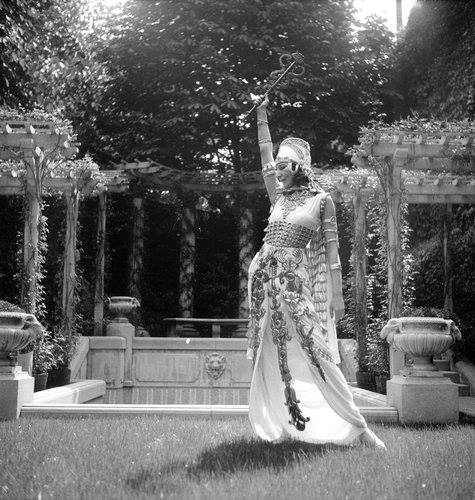
    PHOTO: Diaphanous dancer Ida Rubinstein

  • Henry Kramer’s Sweeping Piano Program on WWFM

    Henry Kramer’s Sweeping Piano Program on WWFM

    Judging from the content of today’s Noontime Concert on The Classical Network, pianist Henry Kramer crams a lot into his programs. Join me for a journey from Mozart to Stravinsky, by way of Brahms, Albéniz, and Ravel.

    On the program will be Mozart’s Piano Sonata No. 9 in D major, K. 311; Brahms’ Six Pieces for Piano, Op. 118; Albéniz’s Iberia: Book I; Ravel’s “Gaspard de la Nuit;” and Stravinsky’s Etudes, Op. 7. The concert took place at Merkin Concert Hall at Kaufman Music Center in New York City on October 31.

    Merkin’s Tuesday Matinees present a new generation of critically acclaimed, extraordinary young performers in a concert hall known for its near-perfect acoustics. The next concert in the series will take place on November 28. Violinist Stephen Waarts will join pianist Chelsea Wang for Schumann’s Sonata No. 1 in A minor, Op. 105; Schubert’s Sonata in A major “Grand Duo,” D. 574; Ravel’s Sonata No. 1 in A minor “Posthumous;” and Stravinsky’s Divertimento from “The Fairy’s Kiss.” More information is available at kaufmanmusiccenter.org.

    We’ll also remember Malcolm Williamson, on the anniversary of his birth, as part of an hour devoted to works by former Masters of the Queen’s Music. In fact, I’ll be using the royal “we” until 4:00 EST, on WWFM – The Classical Network and wwfm.org.

  • Stravinsky A Princeton Celebration

    Stravinsky A Princeton Celebration

    If it’s not too early for Igor, who traveled so far, it shouldn’t be too early for you.

    So pull up a chair and enjoy a cup of neoclassicism. Pour yourself a bowl of serialism. Nibble on some Russian nationalism. It’s music by the 20th century’s most versatile composer, an incredible journey from a student symphony steeped in the idiom of the Mighty Handful to the absorption of twelve-tone technique in the moving “Requiem Canticles,” his last major work.

    In 1966, the “Requiem Canticles” was commissioned by Princeton University, which led to a residency by the composer, who, at 84, conducted the world premiere of the work at McCarter Theatre. Join me this morning, as we gaze back a half-century to this remarkable event, with a full playlist of Stravinsky’s music.

    The program will be enhanced by commentary by Maida Pollock, now 90 years-old and living in Hawaii. Pollock was the university’s concert manager at the time of Stravinsky’s visit. In the 9:00 hour, we’ll hear recorded excerpts from a conversation we had yesterday by telephone. That will be followed by a recording of “Requiem Canticles.”

    In addition, we’ll have some special guests in the 10:00 hour: Michael Pratt, who will conduct the suite from Stravinsky’s “The Firebird” on two concerts of the Princeton University Orchestra, on Dec. 8 & 9, and Gabriel Crouch, who will lead a program including Stravinsky’s “Les Noces,” with the Princeton University Glee Club and So Percussion, on Dec. 11. All three concerts will be held at Richardson Auditorium.

    It’s a full morning of grapefruit and Grape Nuts with the 20th century’s greatest composer, from 6 to 11 EST, on WPRB 103.3 FM and wprb.com. Suddenly we’re kind of hungry, on Classic Ross Amico.

  • Stravinsky’s “Funeral Song” Rediscovered & Streamed

    Stravinsky’s “Funeral Song” Rediscovered & Streamed

    Tying in with our celebration of Igor Stravinsky this morning on WPRB, I just learned that the composer’s recently rediscovered “Funeral Song,” composed in memory of his teacher Rimsky-Korsakov, will receive its first performance in over 100 years (its second performance ever!) tomorrow afternoon, and it will be streamed live. Valery Gergiev will conduct the Mariinsky Orchestra in St. Petersburg at 2:00 EST. Take a late lunch and watch it here:

    http://www.medici.tv/#!/valery-gergiev-stravinsky-chant-funebre

    Here’s more about it::

    http://www.nytimes.com/2016/11/29/arts/second-ever-concert-of-stravinskys-lost-funeral-song-to-stream-free.html?_r=0

    Stravinsky served a residency at Princeton University in 1966, which culminated in the first performance of his “Requiem Canticles” at McCarter Theatre. To mark the 50th anniversary of his visit, it’s all Stravinsky this morning until 11:00 EST, with interviews, on WPRB 103.3 FM and at wprb.com.


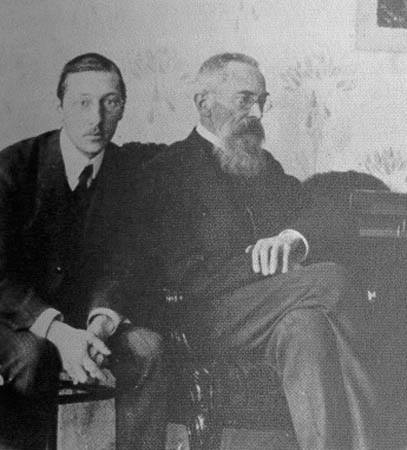
    PHOTO: Stravinsky (left) with his hirsute teacher

  • Debussy 20th Century Music Dark Horse?

    Debussy 20th Century Music Dark Horse?

    Is Claude Debussy the dark horse of 20th century music? While seemingly the entire musical world was polarized between Stravinsky and Schoenberg, no one seemed to care that 20th century music never would have happened without Debussy.

    Debussy saw to it that music could be as diffuse as the light in an impressionist painting. He swirled his brush in the harmonic procedures of the 19th century and devised a 21-note scale to obscure the conventional sense of tonality. True to form, Debussy played fast and loose even with his own system.

    He also challenged the traditional use of instruments, using strings, winds and brass for coloristic ends as opposed to pushing lyricism for lyricism’s sake. The layout of an orchestra is undermined, with each instrument instead frequently treated as a soloist in a great chamber ensemble.

    He also stretched the concept of piano music, so that eighth notes, quarter notes, and half notes are as illusive as objects viewed through a heat shimmer. His chords seem to have no resolution (the composer referred to them himself as “floating chords”) and whole tone scales abound.

    Had he not died of cancer in 1918, at the age of 55, who knows how far he would have gone?

    Happy birthday, Claude Debussy!


    “Feux d’artifice” (“Fireworks,” 1913), from the second book of Preludes, played by Marc-André Hamelin:

    While not my favorite Debussy piece, “Jeux” (“Games,” 1912) is really out there:

    From much earlier, the chromatic flute and recurring tritone in a work everyone can enjoy, “Prélude à l’après-midi d’un faune” (“Prelude to the Afternoon of a Faun,” 1894), danced here by Nureyev:

    https://www.youtube.com/watch?v=zzzF21CFJFE

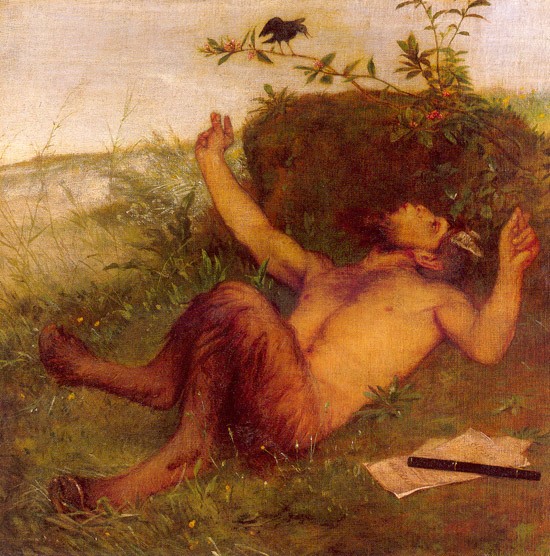
    PHOTO: Fauning over Debussy

Tag Cloud

Aaron Copland (92) Beethoven (95) Composer (114) Film Music (120) Film Score (143) Film Scores (255) Halloween (94) John Williams (185) KWAX (229) Leonard Bernstein (100) Marlboro Music Festival (125) Movie Music (135) Opera (198) Philadelphia Orchestra (88) Picture Perfect (174) Princeton Symphony Orchestra (106) Radio (87) Ralph Vaughan Williams (85) Ross Amico (244) Roy's Tie-Dye Sci-Fi Corner (290) The Classical Network (101) The Lost Chord (268) Vaughan Williams (103) WPRB (396) WWFM (881)

DON’T MISS A BEAT

Receive a weekly digest every Sunday at noon by signing up here


RECENT POSTS