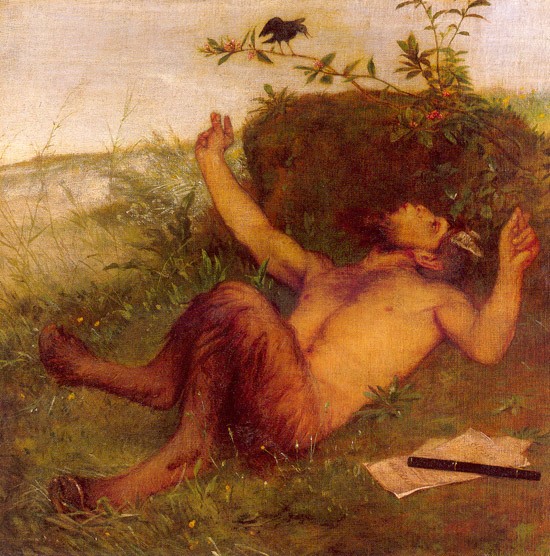
Is Claude Debussy the dark horse of 20th century music? While seemingly the entire musical world was polarized between Stravinsky and Schoenberg, no one seemed to care that 20th century music never would have happened without Debussy.
Debussy saw to it that music could be as diffuse as the light in an impressionist painting. He swirled his brush in the harmonic procedures of the 19th century and devised a 21-note scale to obscure the conventional sense of tonality. True to form, Debussy played fast and loose even with his own system.
He also challenged the traditional use of instruments, using strings, winds and brass for coloristic ends as opposed to pushing lyricism for lyricism’s sake. The layout of an orchestra is undermined, with each instrument instead frequently treated as a soloist in a great chamber ensemble.
He also stretched the concept of piano music, so that eighth notes, quarter notes, and half notes are as illusive as objects viewed through a heat shimmer. His chords seem to have no resolution (the composer referred to them himself as “floating chords”) and whole tone scales abound.
Had he not died of cancer in 1918, at the age of 55, who knows how far he would have gone?
Happy birthday, Claude Debussy!
“Feux d’artifice” (“Fireworks,” 1913), from the second book of Preludes, played by Marc-André Hamelin:
While not my favorite Debussy piece, “Jeux” (“Games,” 1912) is really out there:
From much earlier, the chromatic flute and recurring tritone in a work everyone can enjoy, “Prélude à l’après-midi d’un faune” (“Prelude to the Afternoon of a Faun,” 1894), danced here by Nureyev:
https://www.youtube.com/watch?v=zzzF21CFJFE
PHOTO: Fauning over Debussy
Leave a Reply