One of Antonín Dvořák’s great joys – when he wasn’t busy trainspotting, that is – was keeping pigeons.
At his summer home in Vysoká, he was pretty relaxed about providing free room and board to whatever winged companion would follow him home. And while he was away, he kept up a correspondence with a local miner to whom he entrusted care of the property. This included the house, the garden, and of course the pigeons. Dvořák’s letters were full of meticulous instructions as to how best to keep his little friends healthy and contented.
Word got out about Dvořák’s enthusiasm. At a concert in England, his wife was asked by a member of the royal family what types of things Dvořák really enjoyed. This resulted in the surprise delivery, back at home, of six braces of English pigeons!
In 1896, Dvořák wrote a series of symphonic poems inspired by the grim fairy tales of Karel Jaromir Erben. These include “The Water Goblin,” “The Noon Witch,” and “The Golden Spinning Wheel.” His opera, “Rusalka,” written a few years later, also bears Erben’s influence.
I imagine his fondness for Columbidae would have made it difficult to pass up “The Wood Dove” (also translated as “The Wild Dove”). The story, from Erben’s collection of poetic ballads, “Kytice,” tells of a woman who poisons her husband and marries another man. Day after day, a dove perches on the husband’s grave and sings a mournful song, until the wife, overcome with guilt, commits suicide by hurling herself into a river.
The premiere of Dvořák’s symphonic poem was given in Brno, on March 20, 1898, under the baton of Leoš Janáček.
Hard to believe that the composer of the Serenade for Strings and the sunny Symphony No. 8 could write these lurid potboilers after Czech fairy tales, and that he could find so much depth and melancholy in simple children’s stories.
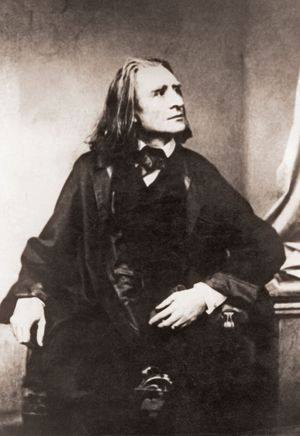
In his years before the public, he was recognized as a pianist of diabolical stamina. Franz Liszt was the inventor of the modern piano recital. While most of his rivals cultivated their reputations on the more intimate salon circuit, Liszt graduated to the larger halls. He was the first to turn the piano sideways, the better to show off his long hair and noble profile, like that of a Hungarian falcon.
He made mincemeat of the delicate instruments of his day, which were unable to withstand his musical onslaughts. In a masterstroke of showmanship, he always kept a spare on stage. On at least one occasion, he went to head-to-head with an orchestra. He mesmerized his audiences with his superhuman transcriptions and paraphrases, whipping them into frenzies. The ladies of Europe forgot their manners and rushed the stage. Skirmishes broke out, as they wrestled for his gloves and cigar butts, carelessly, calculatedly, left behind.
Liszt enjoyed enormous fame. He accumulated staggering wealth. And he enjoyed prodigious love affairs. Then all at once, at the age of 35, he simply walked away. He knew he was more than a vulgar showman, and he was eager to explore other avenues. He may have been a man who savored the privileges of celebrity, but he was also an intellectual and an artist of the spirit. In fact, he was one of the most innovative musical thinkers who ever lived.
Among his innumerable achievements, he pioneered a technique known as thematic transformation, which he employed in his own compositions, as a radical alternative to traditional classical form. He is also credited with the creation of the symphonic poem. Without Liszt, there would have been no Wagner as we know him. In fact, Romantic music would have had to find its own way.
He also happened to be extraordinarily generous. He never took payment from any of his pupils. He programmed the operas of Wagner and Berlioz, when nobody else would touch them. He selflessly promoted the works of Grieg, Smetana, Debussy, Saint-Saëns, Fauré, Borodin, and many others. He was lured back to the concert stage only for charitable purposes – for the relief of victims of fire and flood, in support of political refugees, and to raise money for a Beethoven monument in Bonn.
When Wagner was on the run as a fugitive for his role in the 1849 Dresden uprising, Liszt, then a prominent conductor at the Weimar court, not only gave him the money to flee to Switzerland, he endorsed Wagner’s courtship of his (already married) daughter. Wagner’s “Tristan chord” would send shockwaves throughout Europe, changing music forever, but in actuality it was only one of the many innovations he borrowed from his future father-in-law.
Liszt’s later music at times anticipates the experiments of the 20th century, by composers as diverse as Debussy, Scriabin, and Schoenberg. “My sole ambition as composer,” he once pronounced, “is to hurl my lance into the infinite space of the future.”
For his pains, he was unrelentingly lambasted by his critics and intrigued against by jealous rivals. At various points throughout his career, he was dismissed for pandering to the mob, ridiculed as a charlatan and a hypocrite, and shunned for his long-term relationships with two women who fled troubled marriages.
Yet there is a depth and spirituality in his greatest music that defies all charges. Liszt may have been something of a glamor puss, but he was not a shallow man. He was an intellectual, and he was also devoutly religious, even to the point of taking minor orders and living in a cell in Rome. In all, he was a fascinating amalgam of charlatan and visionary, sinner and saint, peacock and messiah.
Happy birthday, Franz Liszt (1811-1886). One thing you were not was listless!
“Totentanz” (“Dance of Death”), 1849, rev. 1859
“Nuages gris” (“Grey Clouds”), gnomic and existential,1881
“La lugubre gondola,” Liszt’s premonition of Wagner’s funeral procession through the canals of Venice, 1882
Transcription of Saint-Saëns’ “Danse Macabre,” 1874
With Halloween lurking right around a withered cornfield, in my cheerful morbidity, my thoughts drift to Keats’ “Lamia.” I’ve long been familiar with the symphonic poem on the subject by the American pianist and composer Edward MacDowell, he of MacDowell Colony fame. But this one is entirely new to me: a symphonic poem by Dorothy Howell.
Howell, born in Birmingham in 1898, was a private student of Granville Bantock. Bantock was founder of the City of Birmingham Symphony Orchestra and an active composer himself. He was also a conductor. He led the first performance of Delius’ “Brigg Fair” and was the dedicatee of Sibelius’ Third Symphony.
These studies laid the foundation for her acceptance into the Royal College of Music at the age of 15. Howell achieved fame early, with her symphonic poem, in 1919, at the age of 21. Sir Henry Wood premiered “Lamia” at The Proms and repeated it no less than five times within a single season. Subsequently, it was revived by Wood in 1921, 1923, 1924, 1926, 1930, and 1940. The work then fell into neglect, essentially for a lifetime, until it was resurrected, also at The Proms, in 2010. It received another, centenary performance there last year.
Howell, who was brought up musically (she began composing at the age of 13), received her formal education at a convent school. It’s interesting, then, that her greatest success would be a musical response to a shapeshifting seductress, and a serpent no less!
Following the premiere of “Lamia,” Howell was declared a genius and hounded by the press. Her family was disconcerted by her sudden celebrity, but she appeared to take it all in stride. She continued to compose until at least mid-century – a time when many tonal composers found it difficult to secure performances – and taught at the Royal Academy for 46 years, retiring in 1970. After that, she continued to give private instruction. She died in Malvern, weeks before he 84th birthday, in 1982. She is buried near Sir Edward Elgar, whose grave she tended.
In her lifetime, Howell received the nickname “The English Strauss,” a comparison that I think does neither composer justice.
Keats’ Lamia is a serpent woman, who has the power to send her spirit abroad. On one of these spiritual journeys, she espies a lovely Corinthian youth, by the name of Lycius. She assumes human form and places herself in his path, and it isn’t long before they are living together as man and wife. Lycius wants to make it legal, but Lamia resists. Finally, with reluctance, she consents, but only if Lycius agrees not to invite the philosopher Apollonius. All seems to go well. Lamia uses her enchantments to oversee preparations for a lavish nuptial feast. Unfortunately, then Apollonius crashes. He recognizes Lamia for who she is, the feasting and music stop, Lamia vanishes, and Lycius falls lifeless. Thanks a lot, Apollonius.
Howell’s “Lamia”:
Her Piano Concerto, in its first public performance since 1925:
Rehearsing “Two Pieces for Muted Strings”
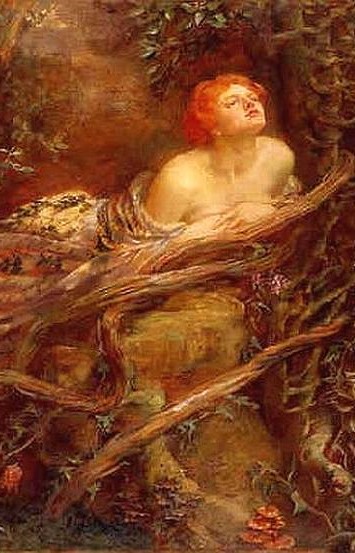
Dorothy Howell (right) with detail from “Lamia, the Serpent Woman” (1906), by Anna Léa Merritt (American painter), 1844-1930
View complete the painting and learn more about Merritt here:
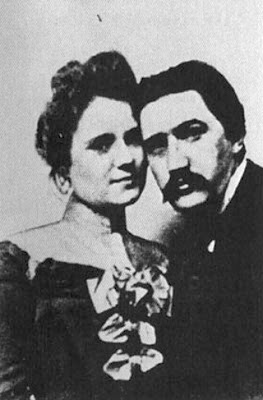
Josef Suk’s 30th year was a tragic one, marked by the deaths of both his young wife, Otilie, and his former teacher, her father, Antonín Dvořák. Not surprisingly, a sense of morbidity colors much of his mature output. The double-loss directly inspired Suk’s “Asrael Symphony” (named for the Angel of Death).
This Sunday night on “The Lost Chord,” we’ll take a look at “A Summer’s Tale,” the next step in Suk’s emotional rehabilitation. The work is a five-movement symphonic poem, the second of a four-part cycle, that contemplates death and the meaning of life. More affirmative than the grim “Asrael,” which is full of pain, loss and grief, “A Summer’s Tale” explores the healing powers of nature, in a score that at times reflects the epic romanticism of Gustav Mahler and at others the impressionism of Claude Debussy. It was composed over the course of just six weeks in the summer of 1907. Further tinkering took place over the next year-and-a-half. The work received its premiere in January of 1909.
Suk later described the theme of the piece as “finding a soothing balm in nature.” I hope you’ll join me as I clear a path to “Healing by Nature” – Josef Suk’s “A Summer’s Tale” – this Sunday night at 10:00 EDT, on WWFM – The Classical Network and wwfm.org.
He is one of history’s most influential and undersold composers.
A champion of program music (music intended to express extramusical ideas), the inventor of the symphonic poem, a pioneer of structural innovation, and an explorer of strange new harmonies, Franz Liszt seldom gets the credit he deserves. By contrast, a composer like Richard Wagner (Liszt’s son-in-law) is revered for the “Tristan chord,” a kind of shot-heard-‘round-the-world that is said to have changed music. It’s seldom noted that it was but one of the ideas Wagner “borrowed” from Liszt.
As a conductor, Liszt’s energetic promotion of composers like Hector Berlioz and Wagner – then a political fugitive – marred with scandal and intrigues his tenure at the Weimar court. For his pains, he was frequently attacked by critics, derided by his peers, and undercut by his own showmanship.
No one seems to contest that he was one of the most remarkable pianists who ever lived, but the assessment is often tempered by charges of vulgarity, of crass pandering to sensation and to the mob.
Liszt played benefit concerts for victims of flood and fire, as well as for political refugees, spearheaded the creation of a monument to and festival for Beethoven in Bonn, never charged a fee for his lessons to his many pupils, and selflessly promoted the works of others, including (beside Berlioz and Wagner) Grieg, Smetana, Debussy, Saint-Saëns, Fauré, and Borodin.
This is the thanks he gets?
At the very least, I think he deserves three hours of airplay on his birthday. I hope you’ll join me this afternoon for a mix of piano and orchestral works, choral music and lieder, and transcriptions and fantasies of famous works by other composers.
It will be an all-Liszt playlist, from 4 to 7 p.m. EDT, on WWFM – The Classical Network and wwfm.org.