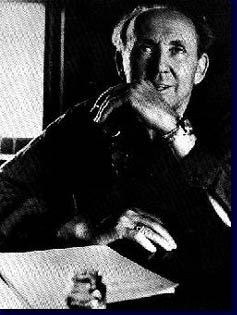
Roy Harris was born on Lincoln’s birthday in a log cabin in Lincoln County, Oklahoma. If that doesn’t imbue a composer with a sense of destiny, I don’t know what will.
Harris went on to became one of our great American symphonists. In particular, his Symphony No. 3 of 1939 has been much beloved and frequently performed. Unfortunately, we don’t hear all that much of his music anymore. And that’s a damned shame.
So thank you, Princeton University Orchestra, for reviving Harris’ Symphony No. 3 on your opening concerts this weekend at Richardson Auditorium, Saturday at 7:30 p.m. and Sunday at 3:00, on the same program with Hector Berlioz’s “Symphonie fantastique.”
Most of the orchestra’s personnel, mind you, are not music majors, but rather committed dilettantes pursuing degrees in other fields, such as astrophysics, bioengineering, computer science, linguistics, sociology, philosophy, and a lot of other things in no way related to music. Also, a substantial number of the players turn over every year as students graduate.
Yet on those occasions when I have been privileged to hear them perform, the orchestra has never been less than solid – interpretively safe, perhaps, but on occasion they surpass themselves. And I have heard them tackle Mahler’s 3rd, “Ein Heldenleben,” and the complete “Daphnis and Chloé.”
Most recently, a performance with the Princeton University Glee Club of Elgar’s “The Dream of Gerontius” was revelatory, finally unlocking the magic of the piece for me, which I had previously known only from recordings. Music director Michael Pratt, who has led the orchestra since 1977, is a miracle worker.
I can’t wait to hear Harris’ symphony. I’d travel a lot further to enjoy music from this now-neglected “greatest generation” of American symphonists. What a delight to have some of it right here, in my own backyard!
Charles Ives was the most nostalgic of avant-gardists. For the most part laboring at his music in isolation – in the evenings and on weekends, while earning his bread as an insurance executive – he managed to prognosticate, or at any rate, arrive independently, at some of the major developments of the 20th century. Some may perceive his grinding harmonies and clashing meters as a kind of temple of Moloch, on the altar of which beauty is sacrificed for effect. As Ives himself once remarked, “Are my ears on wrong?” But consider, the straw for his bricks was harvested from the music of the world around him, especially that recollected from his boyhood in Connecticut.
Ives could construct breathtaking musical edifices from the most diverse materials. Forget Moloch. Perhaps a better parallel would be the Tower of Babel. Only in Ives’ case, once the language becomes confused it actually seems to enliven his creative impulse. Consonance and dissonance are of no consequence to the composer. He listens past the cacophony to draw his energy from powerful associations. And he continued right on building, always grasping for the stars.
I find it fascinating that Gustav Mahler took an interest in Ives’ Symphony No. 3. Mahler discovered a copy of the score on his final visit to Manhattan as music director of the New York Philharmonic in 1911, and presumably it was still in his possession at the time of his death later that year. In the 1950s, an aged percussionist recollected playing the bell-part in a read-through of the work under Mahler’s baton in Munich. Did it happen? Mahler’s score has never come to light. Ives claimed Mahler took it with the intention of giving the work its premiere. Unfortunately, Mahler died (at 50) before he was able to do anything about it. It’s mind-bending to contemplate the one-time music director of the Vienna State Opera (and by extension the Vienna Philharmonic) performing Ives in 1911. When worlds collide!
But really, were the artists so very different? Mahler famously stated (to Sibelius), “The symphony must be like the world: it must embrace everything!” Mahler demonstrated this by filling his symphonies with fondly recollected folk material, rustic and courtly dances, children’s songs, hymns, and klezmer riffs. Ives leaned into hymns, patriotic marches, parlor songs, and quotations from the core classical repertoire he loved. Their music may have come out completely different, but both composers yearned to express, through these everyday human associations, universal truths that often reached beyond our terrestrial concerns.
Ives heard Mahler conduct in New York, but as he became more deeply involved in composition, he largely stopped going to concerts of other composers’ music. He found that it interfered with his recall of ideas in development, when he was still carrying them around inside his head. He said he could listen to Beethoven or Brahms, any of the music he grew up with, and it wouldn’t be an issue. But taking in new music could muddy his thoughts. Whether or not he ever heard any of Mahler’s symphonies, I do not know.
In the event, like most of Ives’ output, his Symphony No. 3 was not performed until years after it was written. Composed in 1908-10, it was finally given its premiere (in New York, under Lou Harrison) in 1946. The next year, it was awarded the Pulitzer Prize for Music. Ives passed along half the prize money to Harrison and commented gruffly, “Prizes are for boys, and I’m all grown up.”
Ives may come across as something of a tinkerer, and he often portrayed himself as such, but like the greatest modernists, he had mastered the basics of his craft. His studies with Horatio Parker at Yale gave him a sound foundation in the rules of composition. Just as Picasso or Schoenberg demonstrated that they had mastered traditional forms before blazing their own trails, Ives was capable of writing within convention. But he was always irrepressibly Ives. He was always chafing and often pushing, and you just know Professor Parker had his hands full.
Ives, the cranky Yankee, often got his back up against the musically complacent, whom he derided in his writings as “Rollo” – a named borrow from a popular children’s book character in the decades preceding the American Civil War.
He also played baseball for Yale. Whether on the field or in his study, throughout his career, he kept right on swinging for the fences.
Remembering Charles Ives, with admiration, on the 150th anniversary of his birth!
The Symphony No. 3, subtitled “The Camp Meeting,” is actually one of Ives’ most immediately accessible scores. The three movements: “Old Folks Gatherin’,” “Children’s Day,” and “Communion.”
For Ives at his cumulatively cacophonous best, try “The Fourth of July.” No composer understood as well the holiday from a boy’s perspective!
The eeriest thing about Peter Mennin is not that he was born in Erie, PA, but that his music is now almost never performed. His Symphony No. 3 was shortlisted for a Pulitzer Prize in 1950. Good luck ever hearing it unless it’s on a recording.
Mennin’s studies with Norman Lockwood at the Oberlin Conservatory were interrupted by World War II, during which he served in the U.S. Army Air Force. Later, he studied with Howard Hanson at the Eastman School. He completed his Third Symphony on his 23rd birthday to fulfill his PhD requirements. The work immediately catapulted him to fame.
He lost the Pulitzer to Gian Carlo Menotti and the opera “The Consul.” However, a performance of the symphony by the New York Philharmonic paved the way for his appointment to the composition faculty of the Juilliard School.
Mennin was also a successful administrator. In 1958, he was named director of the Peabody Conservatory. In 1962, he became Juilliard’s president, a position he held until his death in 1983. In that capacity, he oversaw the school’s move from Claremont Avenue to Lincoln Center. He introduced both the drama and dance departments, he commenced the Master Class Program, and he attracted many high-profile artists as teachers.
In all, he composed nine symphonies (the first two were later withdrawn); also concertos for piano, cello, and flute, sundry orchestral pieces (including “Concertato: Moby Dick”), chamber works, choral pieces, and instrumental music.
Mennin was born to Italian immigrants one hundred years ago today. His brother was the composer Louis Mennini, who retained the family surname.
I just found the Albany Symphony Ochestra’s CD of Mennin’s Symphonies Nos. 5 & 6, with “Concertato: Moby Dick,” at Princeton Record Exchange only last week. The price: $1.00. That’s a penny a year. Somebody give this guy some performances, already!
Buon Centenario, Peter Mennin!
Symphony No. 3, with Dimitri Mitropoulos and the New York Philharmonic
John Ogdon plays the Piano Concerto
Fantasia for String Orchestra
“Concertato: Moby Dick”
“Folk Overture”
In the Erie Hall of Fame
How nice it would have been to acknowledge this important anniversary by sharing some of Mennin’s music over the radio, had my shows not been dropped by WWFM!
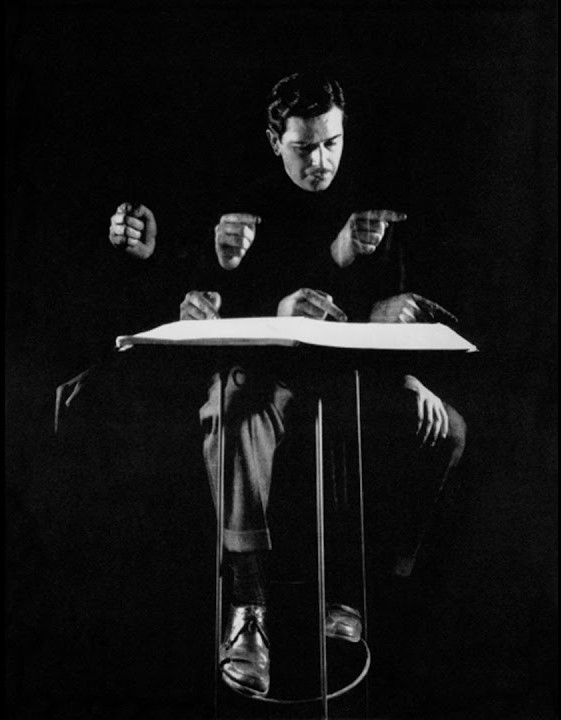
PHOTO: An eerie Octo-Mennin, courtesy of Gordon Parks
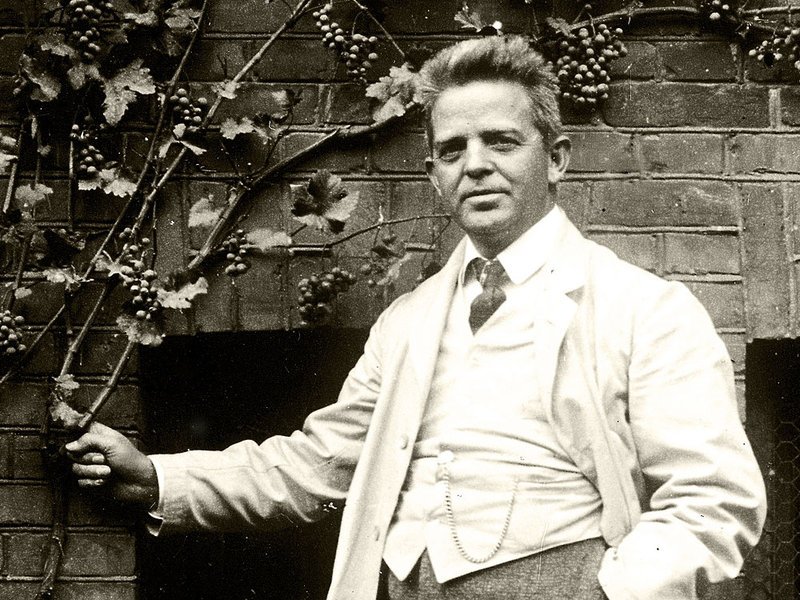
When I first heard Carl Nielsen’s Symphony No. 3, I was sweating it out in a one-room efficiency in West Philadelphia that I shared with two of my classmates, while making up a math course I had flubbed at Temple University.
It was the summer of ’85, there was no air conditioning, and I studied and slept in a netted hammock suspended from two bicycle hooks I had screwed into the door frames to prevent being surprised by mice. There was always movement in the lone trash bag that sat exposed on the linoleum in the corner of the kitchenette, and to prove a point once I lobbed a sneaker into it, from the safety of my resting place, so that the rodents poured out of it and scurried around the apartment, sending one of my roommates, the one whose name was on the lease, shrieking into his bunk. He had a job canvasing for a political organization, so he was gone all day and would stagger back every night after last-call to sketch with intensity under a bright, exposed lightbulb that shone down in my face. Somewhere along the way, he brought home a turtle, which he kept in the bathtub and fed raw hamburger, until I couldn’t take its imprisonment any longer and finally released it into Fairmount Park.
The other roommate had the good sense to get a girlfriend, so he was never there. His contribution was a makeshift bunk bed hastily assembled from planks he had plucked from the garbage. The top bunk was usually vacant, due to his absence, and the bottom bunk was where my politically-motivated, alcohol-fueled, musky, mulchy-footed friend slept between me and the sole window fan.
Occasionally, I’d glimpse a cockroach making its way down one of the ropes of my hammock, and I’d start rocking about, trying to dislodge it. More than once, one of the bike hooks let go. The roaches were everywhere. There were even roaches in the freezer.
It was under these circumstances, one boxed-in, sweltering afternoon, that I first experienced Carl Nielsen’s Symphony No. 3, subtitled “Sinfonia espansiva.” It was broadcast on WFLN, Philadelphia’s classical music station for nearly 50 years (sadly, now defunct). Nielsen’s aspirational music opened up horizons for me and offered glimpses of larger things.
The recording was conducted by Leonard Bernstein. For those of you who aren’t familiar with him, Carl Nielsen is Denmark’s most celebrated composer. Yet, internationally, his music has struggled to take root in the shadow of that other great bard of the North, Jean Sibelius. This is a shame, since, far from being a Sibelius knock-off, Nielsen forged his own, immediately-recognizable style. Bernstein believed Nielsen’s rightful place was as Sibelius’ equal.
“I think many people are in for pleasant surprises as they get to know Nielsen,” he said at a centennial celebration of the composer’s birth, “his rough charm, his swing, his drive, his rhythmic surprises, his strange power of harmonic and tonal relationships – and especially his constant unpredictability – all these are irresistible. I feel confident that Nielsen’s time has come.”
Hey, he was right about Mahler. But that was in 1965, and Lenny’s prophetic lightning failed to strike twice. Fifty-seven years on, with many more recordings and performances to choose from, Nielsen’s music remains, stubbornly, an acquired taste, if a rewarding one. There really is nothing else quite like it – the puckish wit, the ambiguities, the quirky juxtaposition of seemingly disparate melodies, harmonies, and key signatures, all very often shot through with a sense of hope and optimism that rises above the chaos.
I only lived in that hell hole for about a month, one summer session, thankfully, just long enough to make-up my credits, and then it was off to the greenery of my hometown to detox. But I was in the process of selling my soul for a piece of parchment, a degree, so in the fall it was back to Philadelphia.
After the purchase of my first CD-player, in order to feed my habit, I took a part-time job as a clerk at Sam Goody, a record shop then located at 11th and Chestnut Streets, which at the time had the most extensive classical music section in the city. (This was before the arrival of Tower Records.) It was there that I acquired Neeme Järvi’s Prokofiev cycle, Bernard Haitink’s Shostakovich cycle, Adrian Boult’s Vaughan Williams cycle, and my first recording of Nielsen’s Symphony No. 3. Essentially, I signed my paycheck back over to the company in exchange for CDs. I remember my frustration that so much of the good stuff was still only on LP.
The Nielsen recording was not the classic Leonard Bernstein performance I had heard on the radio – which had yet to be transferred to compact disc – but a newer, digital recording with Myung-Whun Chung and the Gothenburg Symphony Orchestra, on the BIS label. And I have to say, giving all credit to Bernstein for his advocacy of Nielsen’s music, I believe Chung’s recording outshines his in every way. To this day, I find it to be one of the most satisfying Nielsen recordings. It must have been within my first ten CD purchases. I remember when I had so few, I could keep them all in a shoebox. Now I’ve got a library of a good 10,000. You might say it has gone “espansiva.”
What exactly did Nielsen mean by that choice of subtitle? Robert Simpson wrote that the use of “espansiva” suggests an “outward growth of the mind’s scope.” There is certainly a sensation of expanding horizons about the piece, which includes a pastoral slow movement complete with wordless solos for soprano and baritone. According to Nielsen, the symphony concludes with “a hymn to work and the healthy activity of living.” All I know is that it fills me with optimism and happiness.
A tip of the blond brush cut to Carl Nielsen on his birthday. Perhaps his time will come. For me, it arrived in a very different climate from that of Copenhagen, in tropical West Philadelphia, in the summer 1985.
Leonard Bernstein conducts the Royal Danish Orchestra on its own turf
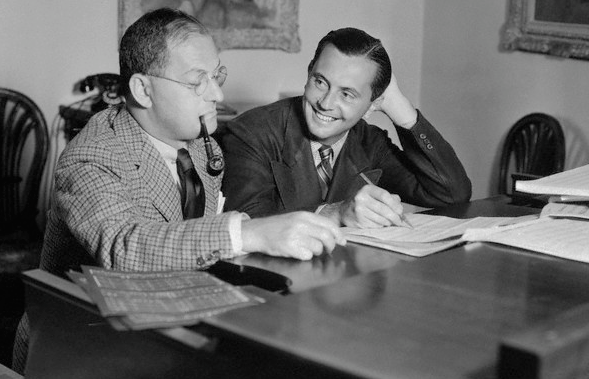
Vernon Duke (né Vladimir Dukelsky) was born in what is now Belarus on this date in 1903. In Kiev, he studied composition under Reinhold Gliere. He left the USSR in 1920, traveling to New York, where he was befriended by George Gershwin. In fact, it was Gershwin who suggested a name-change to something a bit more comprehensible to American audiences. (Gershwin himself was born Jacob Gershowitz.)
For a time, Duke ping-ponged back and forth to Europe, where he fulfilled a commission by Serge Diaghilev (for the ballet “Zephyr and Flora”). The work impressed Sergei Prokofiev, and the two became fast friends. Dukelsky’s Symphony No. 1 was given its premiere in Paris, under Serge Koussevitzky, on the same program as excerpts from Prokofiev’s “The Fiery Angel.”
Around the same time, Duke began contributing material to musical comedies in London. This laid the groundwork for a return to New York in 1929. There, he continued to composed “serious” works, while insinuating himself into the Broadway scene. A number of his songs – “April in Paris,” “Autumn in New York,” “Taking a Chance on Love,” “I Can’t Get Started” – have since become standards.
When Gershwin died in 1937, Duke stepped in to complete his unfinished score for “The Goldwyn Follies,” for which he contributed a couple of ballets (choreographed by George Balanchine) and the song, “Spring Again.” His greatest success came in 1940, with the Broadway show, “Cabin in the Sky.”
Here’s a rare concert broadcast of his Symphony No. 3:
A number of his concert works have been recorded in recent years, including this Piano Concerto for Arthur Rubinstein:
The Metropolitan Opera’s Samuel Magill is soloist in Duke’s Cello Concerto: