Tag: Symphony No. 3

  • Classical Music Rakes Over Leaf Blowers

    Classical Music Rakes Over Leaf Blowers

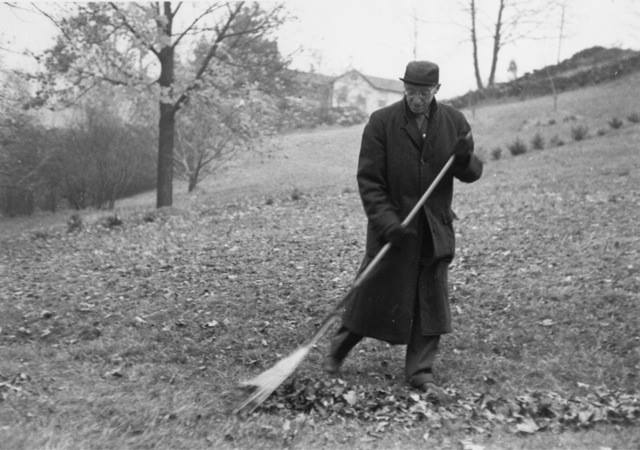
    Who likes leaf blowers? Not Aaron Copland!

    We’ll celebrate the birthday of the Dean of American Composers this afternoon with a performance of his Symphony No. 3. That’s the one that incorporates the “Fanfare for the Common Man,” making for a rousing quarter hour. But listen carefully to the symphony’s other 30 minutes, too – the fanfare’s intervals are all over the place.

    First, we’ll enjoy another Noontime Concert on The Classical Network. Join me for a Bach birthday bash featuring The Dryden Ensemble. The program was presented twice in March of this year, within days of the anniversary of Bach’s birth. On the program will be music by Dietrich Buxtehude, Johann Jakob Froberger, Sylvius Leopold Weiss, Georg Philipp Telemann, and Bach himself. Performers will include oboist and artistic director Jane McKinley, violinist Vita Wallace, bass viola da gambist Lisa Terry, theorbist and lutenist Daniel Swenberg, and harpsichordist Webb Wiggins.

    Dryden’s next program, “Bach’s French Taste” – focusing on Bach and the French composers he admired – will be presented this Saturday at 7:30 p.m., at Miller Chapel on the campus of Princeton Theological Seminary, and Sunday at 3 p.m., at Trinity Episcopal Church, Solebury, PA. The concerts launch Dryden’s 2017-2018 survey, “Bach for All Seasons.” Tickets are available at the door or online at drydenensemble.org.

    Make America rake again! Also, join me from 12 to 4 p.m. EST. It’s music for common men by extraordinary composers, on WWFM – The Classical Network and wwfm.org.
  • Arnell’s Bruckner Symphony on WWFM Today

    Arnell’s Bruckner Symphony on WWFM Today

    I know, I play an awful lot of Bruckner on WWFM on Tuesday afternoons. It’s a way for me to regroup as I come down off the adrenaline rush of hosting the live noon concerts, which are unscripted and basically improvised from a sheaf of papers handed to me, which I do my best to assimilate in advance.

    I also know I have been going on an awful lot about Richard Arnell, the neglected English master, in connection with the centenary of his birth, which was last Friday. (Yesterday I played his String Quintet No. 3.)

    So, in the interest of mixing it up, today I will offer something a little different: Arnell’s Bruckner-inflected Symphony No. 3. Arnell’s wartime symphony bears other diverse influences – some Sibelius here, a dash of Nielsen there; perhaps even some Shostakovich – but try listening to it with Bruckner in mind, especially the earlier movements.

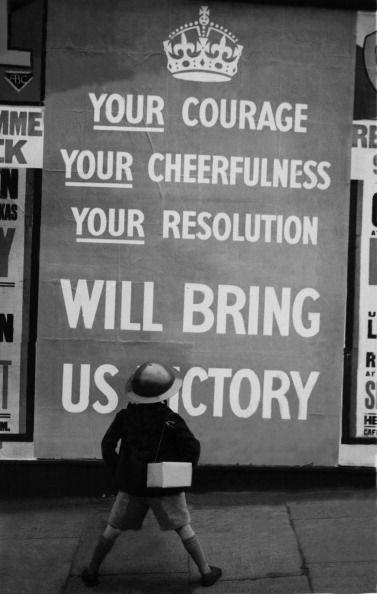
    The six-movement piece was composed in the United States, where Arnell found himself stranded while visiting the World’s Fair in 1939, his return home cut off by the outbreak of the Second World War. His mother would be killed in the Blitz in 1942. Arnell dedicated his symphony “to the political courage of the British people.”

    It certainly achieves an ambitious scale, running to over an hour in length. And don’t get me wrong: despite the multiplicity of influences – there’s even a kind of barn dance that recalls American symphonic music of the era – it is English, and most certainly Arnell, to the core. I think you’ll agree, it works up a good head of steam and achieves passages of genuine nobility. Judge for yourself; I’ll be playing it around 2:00.

    First, today’s Noontime Concert will be made up of performances by the New York Chamber Ensemble, drawn from this summer’s Cape May Music Festival. We’ll hear selections from two programs. The first will include music by Philippe Hersant (“Héliades” for flute and strings), Johan Kvandal (from his Hardanger fiddle quintet) and Felix Mendelssohn (his String Quartet No. 2 in B-flat major). Then saxophonist Eddie Barbash will join the group for riffs on a variety of old favorites by Cole Porter, Ruben Fuentes, Manuel Ponce, Vincenzo Bellini, Harry Warren, and the ever-prolific Anonymous. Next year’s Cape May Music Festival will run from May 27 to June 14. Further developments, as they become available, will be posted at the festival’s website, capemaymac.org.

    I hope you’ll join me today, from 12 to 4 p.m. EDT, for chamber music, an epic symphony and more, on WWFM – The Classical Network and wwfm.org.
  • Vittorio Giannini Composer Remembered

    Vittorio Giannini Composer Remembered

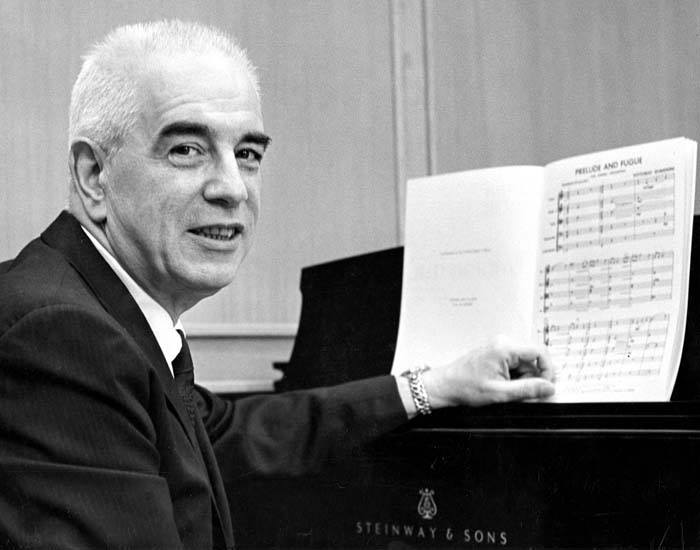
    Happy birthday, Vittorio Giannini!

    Giannini was born in Philadelphia in 1903. He studied at the Milan Conservatory, after which he earned his graduate degree from Juilliard. He then taught at Juilliard, the Manhattan School of Music and the Curtis Institute.

    Arguably his most important contribution as an educator was the foundation in 1965 of the North Carolina School of the Arts, which he envisioned as a Juilliard of the South. The school attracted to its faculty such luminaries as Ruggiero Ricci and Janos Starker. Giannini died the year after it opened, in 1966.

    He was from a family of opera singers. His father founded the Verdi Opera House in Philadelphia. One sister taught voice at the Curtis Institute of Music and the other sang at the Metropolitan Opera. Giannini himself composed 14 operas, including “Lucedia,” “The Scarlet Letter,” “The Taming of the Shrew,” and one for radio, “Beauty and the Beast.” Two, “Casanova” and “Christus,” remain unperformed.

    Not surprisingly, then, in his day he was known largely for his vocal music, but his Symphony No. 3 for wind band has fared best on disc. There are seven recordings in the current catalogue, from the classic release directed by A. Clyde Roller on the Mercury label to one of the later-in-life, digital recordings of Frederick Fennell.

    Daniel Spalding, enterprising music director of the New Jersey Capital Philharmonic, recorded the Symphony No. 4 with the Bournemouth Symphony, for Naxos. We’ll hear that recording in the 4:00 hour.

    Spalding will conduct the Capital Philharmonic of New Jersey this Saturday, Oct. 22, at the Trenton War Memorial. The program will include Aaron Copland’s “Fanfare for the Common Man,” Antonin Dvorak’s Symphony No. 9 “From the New World,” and Peter Boyer’s “Ellis Island: The Dream of America,” a stirring work for actors and orchestra, on texts of actual émigrés who came to the United States in search of a better life. You can read all about it in my article in the Friday edition of the Trenton Times. Or you can get a sneak preview here:

    http://www.nj.com/times-entertainment/index.ssf/2016/10/classical_music_njcp_performin_2.html

    Later on this afternoon, we’ll have music by Norwegian composers Edvard Grieg (performed by Emil Gilels on the 100th anniversary of his birth) and Geirr Tveitt. Listen in from 4 to 7 EDT on WWFM – The Classical Network, and at wwfm.org.

  • Carl Nielsen A Labor Day Composer

    Carl Nielsen A Labor Day Composer

    Carl Nielsen understood the value of hard work. He grew up, one of twelve children, in a musical family of very limited means. By the time he was accepted into the Royal Danish Academy of Music in Copenhagen, he had already been performing and composing for many years. Like “The Ugly Duckling” of his compatriot Hans Christian Andersen, he emerged from humble origins to become a cherished thing of beauty, embraced as his country’s national composer.

    Nielsen described the finale of his Symphony No. 3 as “a hymn to work and the healthy activity of living.” Enjoy it tomorrow morning, as we anticipate the Labor Day weekend with musical salutes to labor and the worker.

    Be there with your lunch pail and dungarees, from 6 to 11 EDT, on WPRB 103.3 FM. We’re always working hard for your enjoyment, on Classic Ross Amico.


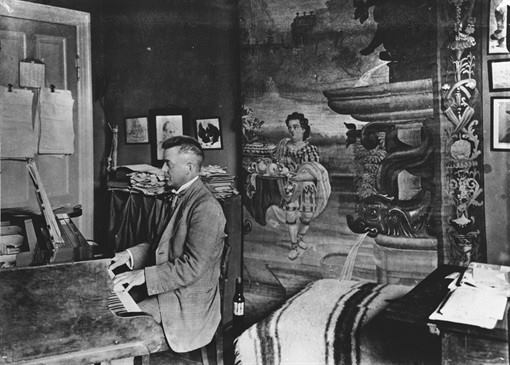
    PHOTO: Nielsen breaking a sweat in his workroom, where he completed his Symphony No. 3 in 1911

  • Elgar’s Symphony No 3 Celebrated Today

    Elgar’s Symphony No 3 Celebrated Today

    No Payne, no gain!

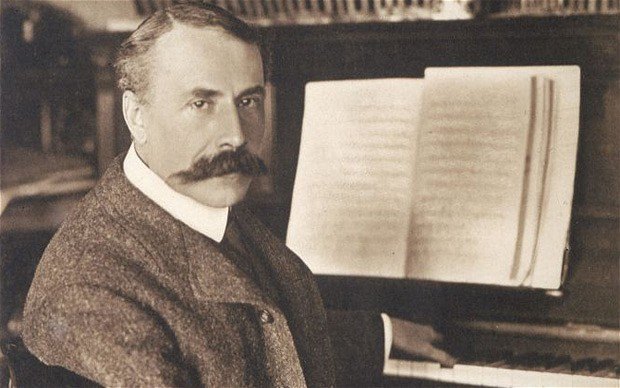
    I hope you’ll join me this afternoon, as we celebrate the 80th birthday of composer and musicologist Anthony Payne. Payne did an uncanny job channeling the spirit of one of England’s most celebrated composers in bringing about the completion of sketches for Sir Edward Elgar’s Symphony No. 3. The resultant work, judiciously titled “Edward Elgar: Sketches for the Symphony No. 3 elaborated by Anthony Payne,” will be heard in the 1:00 hour.

    We’ll also honor a former Master of the Queen’s Music, Sir Arthur Bliss, on his birthday, and I wouldn’t be the least bit surprised if music by Karl Amadeus Hartmann will turn up at some point, as well.

    Hartmann was an anti-fascist German composer who played the dangerous game of remaining in Nazi Germany during World War II. He withdrew completely from musical life there and refused to allow his works to be performed. However, his symphonies continued to be championed abroad. Though still very much underrated, Hartmann was one of the great composers of the 20th century. We’ll be listening to his Symphony No. 6.

    Experience these and more today, when you tune in from noon to 4 p.m. EDT, on WWFM – The Classical Network and at wwfm.org.


    PHOTOS: Elgar (top) and Payne

Tag Cloud

Aaron Copland (92) Beethoven (95) Composer (114) Film Music (119) Film Score (143) Film Scores (255) Halloween (94) John Williams (185) KWAX (229) Leonard Bernstein (99) Marlboro Music Festival (125) Movie Music (134) Opera (198) Philadelphia Orchestra (86) Picture Perfect (174) Princeton Symphony Orchestra (106) Radio (87) Ralph Vaughan Williams (85) Ross Amico (244) Roy's Tie-Dye Sci-Fi Corner (290) The Classical Network (101) The Lost Chord (268) Vaughan Williams (102) WPRB (396) WWFM (881)

DON’T MISS A BEAT

Receive a weekly digest every Sunday at noon by signing up here


RECENT POSTS