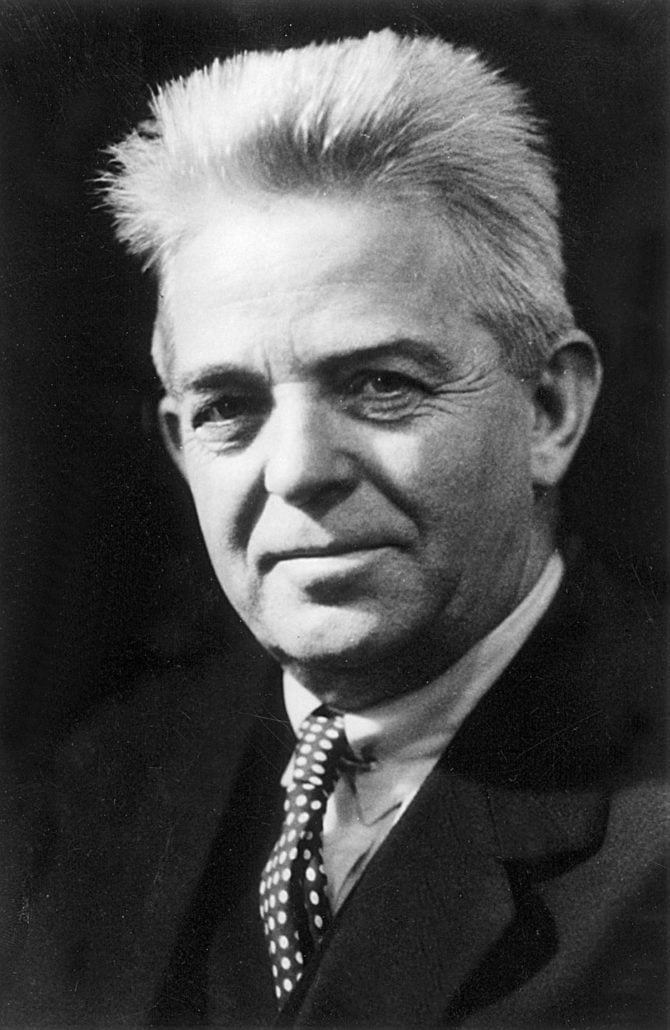
Great Dane or Ugly Duckling? In the case of Carl Nielsen, the two are not necessarily mutually exclusive.
While Nielsen retains his status as Denmark’s most celebrated composer, internationally, he has had difficulty emerging from the shadow of that other great bard of the North, Jean Sibelius.
This is a shame, since, far from being a Sibelius knock-off, Nielsen forged his own, immediately-recognizable style – which can’t always be said, with as much conviction, about a lot of other fin de siècle Scandinavian composers. Not that I don’t love their music.
Leonard Bernstein believed Nielsen’s rightful place was as Sibelius’ equal.
“I think many people are in for pleasant surprises as they get to know Nielsen,” he said at a centennial celebration of the composer’s birth, “his rough charm, his swing, his drive, his rhythmic surprises, his strange power of harmonic and tonal relationships – and especially his constant unpredictability – all these are irresistible. I feel confident that Nielsen’s time has come.”
Here’s Bernstein, conducting the Danes on their own turf, in what may be my favorite Nielsen symphony, the Symphony No. 3:
That was in 1965. Sadly, fifty-six years on, with many more recordings and performances to choose from, Nielsen’s music remains, stubbornly, an acquired taste. But it is a rewarding one. There really is nothing else quite like it. The puckish wit, the ambiguity, the quirky juxtaposition of seemingly disparate melodies, harmonies, and key signatures, all very often shot through with a sense of hope and optimism that rises above the chaos.
Next to Sibelius, Nielsen doesn’t really have that many imitators. The English composer Robert Simpson was evidently a great admirer of both. This is Simpson’s centenary year. (He was born on March 2, 1921.) His own symphonies often resemble Nielsen’s, but without the big moments.
Simpson’s Symphony No. 2:
Simpson introduces Nielsen:
“Espansiva: A Portrait of Carl Nielsen” (featuring Simpson):
Rare glimpses of Nielsen on film:
Happy birthday, Carl Nielsen, and thanks for the advocacy, Robert Simpson.