Tag: Tchaikovsky

  • Grieg’s Circle: Friends & Admirers

    Grieg’s Circle: Friends & Admirers

    From all accounts, Edvard Grieg was a gentle-though-principled, generous soul. He was certainly Norway’s most important composer, and his example proved an inspiration not only to Scandinavians, but also to musicians worldwide seeking to find a way around the Austro-German stranglehold on music.

    Is it any wonder that he attracted such a devoted following? Tchaikovsky dedicated his “Hamlet Fantasy Overture” to Grieg. Liszt performed his piano concerto. Antonin Dvorak was a friend. Frederick Delius worshipped him.

    This Sunday night on “The Lost Chord,” we’ll listen to an hour of music dedicated to Grieg by his friends and admirers.

    The American composer Edward MacDowell never actually met Grieg, though he shared a certain musical affinity. He contacted the Norwegian to ask permission to dedicate to him his Piano Sonata No. 3, which he subtitled the “Norse.” Grieg was full of compliments about the piece, and he enthusiastically accepted. The two men enjoyed an admiring, though unfortunately short-lived correspondence, since both were already nearing the end of their lives. (MacDowell died in 1908, at the age of 47; he was already in the throes of the illness that would claim him at the time Grieg passed in 1907, at the age of 64.)

    Julius Röntgen was born in Leipzig, but by his early 20s he settled in Amsterdam. He went on to become one of the most important figures in Dutch music, establishing the city’s music conservatory and participating in the founding of the Concertgebouw. Rontgen was successful in becoming a good friend not only of Johannes Brahms (no mean feat), but also Grieg, whom he visited in Norway 14 times. The result was a number of works he composed on Norwegian themes. Röntgen dedicated his suite “Aus Jotunheim,” inspired by a hike he had taken with the composer through the Norwegian mountains, to Grieg and his wife, on the occasion of their 25th wedding anniversary.

    Grieg encountered the tireless Australian pianist Percy Grainger only toward the end of his life, but he was convinced he had found his ideal interpreter. He invited Grainger to perform his Piano Concerto in A Minor under his own direction. Sadly, Grieg died before it could come to pass. Nevertheless, Grainger continued to champion Grieg’s music for the rest of his life. Also, he dedicated a number of folk-inspired works to the memory of the Norwegian master. We’ll hear two historical recordings, of Grainger playing music of Grieg and then one of his own such works.

    I hope you’ll join me for “Grieg-arious,” music by Grieg’s dedicated friends. You can enjoy it tonight at 10 ET, with a repeat at 3 a.m. Friday, or listen to it later as a webcast at http://www.wwfm.org.

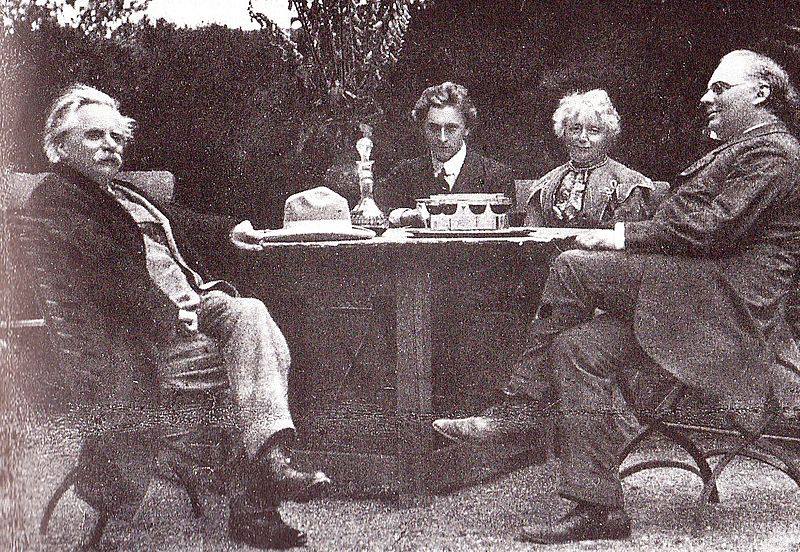
    PHOTO: (left to right) Grieg, Grainger, Nina Grieg & Röntgen at Grieg’s home, Troldhaugen, in 1907

  • Brahms and Tchaikovsky Birthday

    Brahms and Tchaikovsky Birthday

    Now, now, boys! Play nice.

    Today is the shared birthday of Brahms and Tchaikovsky, two of the great musical geniuses of their time. Brahms was born in 1833, and Tchaikovsky was born in 1840.

    Of course, Brahms has the advantage of the Austro-German propaganda machine, placing him at the center of the musical universe (although it didn’t help him with George Bernard Shaw, who described him as “a sentimental voluptuary”); Tchaikovsky has taken it on the chin not only for being born outside the German tradition, but also from his own countrymen for being too “cosmopolitan.”

    Yet audiences go crazy for his ballets, concertos and symphonies. Give him some credit for achieving such polish in a country that, until around the time of his birth, had very little serious musical tradition of its own. With his gift for melody and pathos, and his talent as an orchestrator, he would have flourished no matter where he lived.

    Brahms too was a natural. Sometimes his symphonies can seem a little over-breaded, and on occasion he can come across as something of a stuffed owl. But even so, he is Minerva’s owl, wise, learned and all-knowing. His piano works and chamber music are some of the best there are.

    Interestingly, the two composers actually met twice, and they got along smashingly. In a letter to his publisher, Tchaikovsky was effusive about Brahms’ cheerfulness and lack of pretension.

    “I’ve been on the booze with Brahms,” he wrote. “He is tremendously nice – not at all proud as I’d expected but remarkably straightforward and entirely without arrogance. He has a very cheerful disposition, and I must say that the hours I spent in his company have left me with nothing but pleasant memories.”

    That was in 1888, after a rehearsal of Brahms’ Piano Trio No. 3 in Leipzig.

    The following year, the two met again in Hamburg, where Brahms slept through a rehearsal of Tchaikovsky’s Symphony No. 5. If Tchaikovsky was insulted, he bore it lightly and was convivial all through the meal they shared after. Although Brahms was harsh in his assessment of the last movement of the symphony and Tchaikovsky confessed an overall aversion to Brahms’ style, the two seem to have parted great friends. Tchaikovsky even invited Brahms to visit him in Russia, something which never came to pass.

    How much alcohol played into the two men’s warm feelings we can only guess. It was not just anyone who could be Brahms’ drinking buddy.

    Who was the better composer? Who cares. In an open heart, there is room for both. Happy Birthday, Brahms and Tchaikovsky!

  • Tchaikovsky’s Devilish Opera

    Tchaikovsky’s Devilish Opera

    Okay, so the Kentucky Derby is today. But I’m not here to write about that. I’m here to write about Tchaikovsky and the Devil.

    Opera aficionado Sandy Steiglitz will be broadcasting Tchaikovsky’s “Cherevichki” (“The Slippers”), tomorrow on WPRB’s “Sunday Morning Opera with Sandy.”

    Part fairy tale and part farce, Yakov Polansky’s libretto features such incidentals as the theft of the moon, amorous peasants secreting themselves in burlap sacks, and a ride through the air on the Devil’s back to collect the Tsarina’s slippers (hence, the title). All this takes place against the backdrop of a Ukrainian Christmas.

    “Cherevichki” (sometimes spelled “Tcherevichki”) is Tchaikovsky’s reworking of an earlier opera, “Vakula the Smith,” which the composer believed unjustly ignored. Even in its revised form, the work is arguably more obscure than Rimsky-Korsakov’s neglected gem, “Christmas Eve,” which was drawn from the same source material (a story from Nikolai Gogol’s collection, “Evenings on a Farm Near Dikanka,” of which you will hear more on June 23, Saint John’s Eve).

    Fun fact: there was a complicated rivalry between Tchaikovsky and Rimsky-Korsakov, each composer supportive of the other in public, while in private nagged by suspicion and envy. Though Tchaikovsky was sufficiently awed to swear his publisher to secrecy about his use of the then-new celesta in “The Nutcracker,” lest Rimsky steal his thunder, Rimsky had no qualms about following in Tchaikovsky’s footsteps when setting “Christmas Eve.” His version of the Gogol tale appeared ten years later, in 1895.

    The only thing crazier than airing a Christmas opera in May is writing a Christmas opera about the devil. Needless to say, I can resist neither.

    Check out “Cherevichki” on WPRB’s “Sunday Morning Opera with Sandy,” tomorrow at 6:45 a.m. ET. If you’re an early riser, tune in around 5:30. Sandy’s there spinning arias and duets at a time when the roosters are still wiping the sleep out of their eyes.

    You can hear the show locally (Princeton, NJ) at 103.3 FM, or anywhere online at wprb.com. While you’re listening, visit her Facebook page – Sunday Morning Opera with Sandy – and leave nice comments.

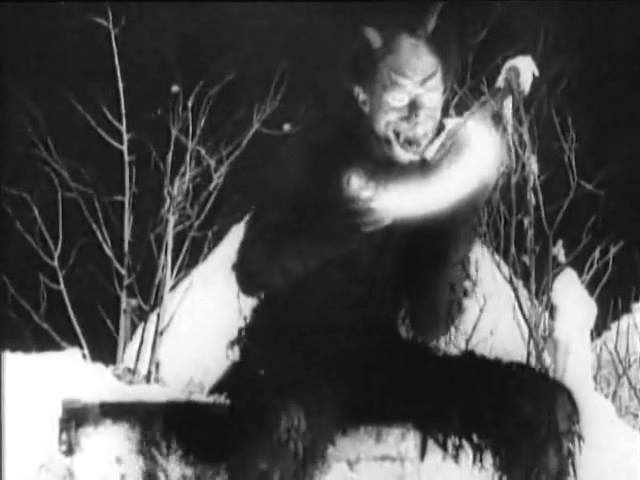
    PHOTO: Ivan Mozzhukhin in a silent film version of Gogol’s tale, “The Night Before Christmas” (1913)

Tag Cloud

Aaron Copland (92) Beethoven (95) Composer (114) Film Music (119) Film Score (143) Film Scores (255) Halloween (94) John Williams (185) KWAX (229) Leonard Bernstein (99) Marlboro Music Festival (125) Movie Music (134) Opera (198) Philadelphia Orchestra (86) Picture Perfect (174) Princeton Symphony Orchestra (106) Radio (87) Ralph Vaughan Williams (85) Ross Amico (244) Roy's Tie-Dye Sci-Fi Corner (290) The Classical Network (101) The Lost Chord (268) Vaughan Williams (102) WPRB (396) WWFM (881)

DON’T MISS A BEAT

Receive a weekly digest every Sunday at noon by signing up here


RECENT POSTS